Compare and Contrast Text Structure and Main Idea: Telling a Frog from a Toad

7 questions · 7 points · Grade 4 · English · Preview the 7 questions

Made by Andre Whitaker · LessonRally (AI-assisted)

Digital classroom activity

What is a digital classroom activity?

Teachers who sign in can assign LessonRally activities to their Google Classroom classes: students open them in Classroom and answer online, and their grades go to the teacher's Classroom gradebook. Practice lets you try it first, the way students see it.

Free for teachers. Sign in to assign activities to your Google Classroom classes.

Printable worksheet

Students read an original informational passage that compares and contrasts frogs and toads. They choose the main idea, the order of the passage's parts, how each difference is set out and what one signal phrase links. They also choose the detail the passage gives for each of two ideas and select two details that back up a warning. Grade 4 reading comprehension practice on compare and contrast text structure in nonfiction.

Learning goal: Describe how a compare and contrast passage is organized and how its parts and signal words connect ideas.

Estimated reading level 4.7

  1. Grade 2Hard
  2. Grade 3Stretch
  3. Grade 4On level
  4. Grade 5Easier
  5. Grade 6Easy
About this estimate

The estimate is the middle score of five readability formulas. Their scores run from 2.4 to 6.3.

  • Flesch-Kincaid GradeSentence length and syllables per word2.4
  • Gunning Fog Middle scoreSentence length and words of three or more syllables4.7
  • Coleman-LiauLetters per word and sentences per 100 words5.3
  • Automated Readability IndexCharacters per word and words per sentence2.7
  • SMOGWords of three or more syllables, for texts of 30 sentences or more6.3
Flesch Reading Ease
94.2 on a 0 to 100 scale where higher is easier: very easy. Not part of the estimate.
Text measured
737 words, 40 sentences

Adapted from common readability formulas (Flesch-Kincaid, Gunning Fog, Coleman-Liau and ARI, plus SMOG for long texts), which look at sentence length and word length. Answer choices count toward word length only. Grades below the estimate will likely find the text harder, grades above it easier. It does not measure ideas, background knowledge or images.

Common Core

Closest anchor: CCRA.R.5 Analyze the structure of texts, including how specific sentences, paragraphs, and larger portions of the text (e.g., a section, chapter, scene, or stanza) relate to each other and the whole.Anchor Standards for ReadingShow 3 matched standardsHide matched standards

Matched standards

  • RI.4.5

    Describe the overall structure (e.g., chronology, comparison, cause/effect, problem/solution) of events, ideas, concepts, or information in a text or part of a text.

    Student preview questions 2, 3, 4

  • RI.4.1

    Refer to details and examples in a text when explaining what the text says explicitly and when drawing inferences from the text.

    Student preview questions 5, 6, 7

  • RI.4.2

    Determine the main idea of a text and explain how it is supported by key details; summarize the text.

    Student preview question 1

Matched independently by two AI models from this activity's questions.

© Copyright 2010. National Governors Association Center for Best Practices and Council of Chief State School Officers. All rights reserved.

Topics: Text Structure, Main Idea and Key Details, Citing Text Evidence Chosen by LessonRally

Question types: multiple choice, select all that apply.

Student preview

The questions as students see them, without the answers.

Read the passage about frogs and toads. As you answer, look at how the passage is put together.

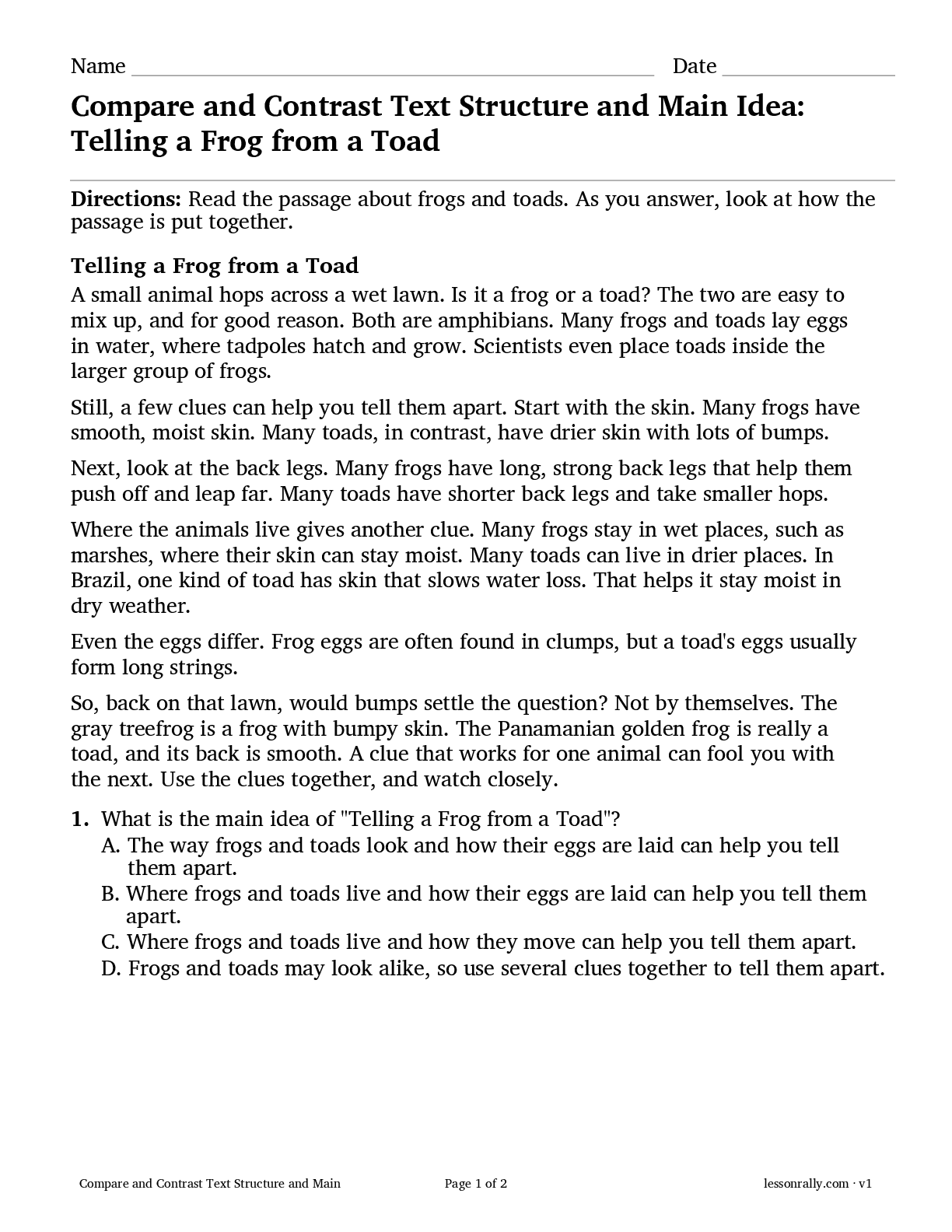
Telling a Frog from a Toad

A small animal hops across a wet lawn. Is it a frog or a toad? The two are easy to mix up, and for good reason. Both are amphibians. Many frogs and toads lay eggs in water, where tadpoles hatch and grow. Scientists even place toads inside the larger group of frogs.

Still, a few clues can help you tell them apart. Start with the skin. Many frogs have smooth, moist skin. Many toads, in contrast, have drier skin with lots of bumps.

Next, look at the back legs. Many frogs have long, strong back legs that help them push off and leap far. Many toads have shorter back legs and take smaller hops.

Where the animals live gives another clue. Many frogs stay in wet places, such as marshes, where their skin can stay moist. Many toads can live in drier places. In Brazil, one kind of toad has skin that slows water loss. That helps it stay moist in dry weather.

Even the eggs differ. Frog eggs are often found in clumps, but a toad's eggs usually form long strings.

So, back on that lawn, would bumps settle the question? Not by themselves. The gray treefrog is a frog with bumpy skin. The Panamanian golden frog is really a toad, and its back is smooth. A clue that works for one animal can fool you with the next. Use the clues together, and watch closely.


Question 1

What is the main idea of "Telling a Frog from a Toad"?

Choose one answer.

  • The way frogs and toads look and how their eggs are laid can help you tell them apart.
  • Frogs and toads may look alike, so use several clues together to tell them apart.
  • Where frogs and toads live and how they move can help you tell them apart.
  • Where frogs and toads live and how their eggs are laid can help you tell them apart.

Question 2

In what order does the passage present its three main parts?

Choose one answer.

  • ways the two animals are alike, then ways they differ, then a warning about the clues
  • ways the two animals differ, then ways they are alike, then a warning about the clues
  • a warning about the clues, then ways the two animals are alike, then ways they differ
  • a warning about the clues, then ways the two animals differ, then ways they are alike

Question 3

How does the passage set out the ways that frogs and toads differ?

Choose one answer.

  • It takes one feature at a time and tells about the toad before the frog.
  • It tells all about the toad first and then tells all about the frog.
  • It takes one feature at a time and tells about the frog before the toad.
  • It tells all about the frog first and then tells all about the toad.

Question 4

The words in contrast appear once in the passage. Which two things do they set against each other?

Choose one answer.

  • the long strings of toad eggs and the clumps of frog eggs
  • the smooth, moist skin of many frogs and the drier, bumpy skin of many toads
  • the wet places where many frogs stay and the drier places where many toads can live
  • the shorter back legs of a toad and the long back legs of a frog

Question 5

Frogs and toads have a lot in common. Which detail from the passage supports this idea?

Choose one answer.

  • Frogs and toads both take in water through their skin.
  • Insects, spiders and worms are food for most frogs and toads.
  • Scientists place toads inside the larger group of frogs.
  • Many frogs and toads have eyes that stick out from their heads.

Question 6

The writer gives an example of a toad that can keep from drying out. Which detail from the passage tells how this toad does it?

Choose one answer.

  • Some toads can store water in their bodies for later.
  • Some toads hide under logs during the day.
  • Some toads can soak up water through a patch of skin under their bodies.
  • Some toads have skin that helps them hold on to water.

Question 7

The writer warns that one clue by itself can lead to a wrong guess. Which two details from the passage support that warning? Select two.

Choose 2 answers.

  • Some frogs can glide through the air.
  • Some frogs have bumpy skin.
  • Some toads have smooth skin.
  • Some toads make their homes partly in streams.
  • Some toads give birth to live young.

Reviews

No reviews yet.

Reviews come from teachers who assigned this activity to a class.

Sign in to write a review

Have a topic of your own? Make a printable worksheet and online quiz, free.

Create an activity

Answer key

Answer keys come with Premium

Print this worksheet with the correct answers marked. The key includes any explanations, sample answers, and rubrics supplied with the activity.

Answer keys aren't public: only teachers with Premium and the people who can edit an activity can download one, so students can't get a ready-to-print key from this page.

Premium includes:

  • No ads for you, and no ads for your students on the assignments you post.
  • Answer keys for printable worksheets, with the correct answers marked and any explanations, sample answers, and rubrics.
  • Create with AI: up to 100 activities a year (5 during the free trial), with every answer checked before you see the draft.

$29 a year, plus sales tax where it applies.

New Premium teachers can try it free for 7 days. A card or other payment method is needed to start. Unless you cancel before the trial ends, you are charged then and the plan renews every year.

Already have Premium or edit this activity? Sign in