First-Person and Third-Person Point of View and Central Message: Two Tellings of One Camping Trip

8 questions · 8 points · Grade 4 · English · Preview the 8 questions

Made by Andre Whitaker · LessonRally (AI-assisted)

Digital classroom activity

What is a digital classroom activity?

Teachers who sign in can assign LessonRally activities to their Google Classroom classes: students open them in Classroom and answer online, and their grades go to the teacher's Classroom gradebook. Practice lets you try it first, the way students see it.

Free for teachers. Sign in to assign activities to your Google Classroom classes.

Printable worksheet

Students read two short original tellings of one night on a camping trip, one in first person and one in third person. They choose the narrator of each, when each lets the reader know what made a sound, a belief that one telling shows to be wrong, details given in only one telling or in both, and the detail a telling gives for each of two ideas. The opening question asks for the central message of both. Grade 4 reading comprehension practice on point of view in fiction.

Learning goal: Compare and contrast a first-person and a third-person telling of the same story, including what each narrator can and cannot tell.

Estimated reading level 4.3

  1. Grade 2Hard
  2. Grade 3Stretch
  3. Grade 4On level
  4. Grade 5Easier
  5. Grade 6Easy
About this estimate

The estimate is the middle score of five readability formulas. Their scores run from 1.8 to 4.8.

  • Flesch-Kincaid GradeSentence length and syllables per word2.2
  • Gunning FogSentence length and words of three or more syllables4.4
  • Coleman-Liau Middle scoreLetters per word and sentences per 100 words4.3
  • Automated Readability IndexCharacters per word and words per sentence1.8
  • SMOGWords of three or more syllables, for texts of 30 sentences or more4.8
Flesch Reading Ease
95.3 on a 0 to 100 scale where higher is easier: very easy. Not part of the estimate.
Text measured
722 words, 46 sentences

Adapted from common readability formulas (Flesch-Kincaid, Gunning Fog, Coleman-Liau and ARI, plus SMOG for long texts), which look at sentence length and word length. Answer choices count toward word length only. Grades below the estimate will likely find the text harder, grades above it easier. It does not measure ideas, background knowledge or images.

Common Core

Closest anchor: CCRA.R.6 Assess how point of view or purpose shapes the content and style of a text.Anchor Standards for ReadingShow 2 matched standardsHide matched standards

Matched standards

  • RL.4.6

    Compare and contrast the point of view from which different stories are narrated, including the difference between first- and third-person narrations.

    Student preview questions 2, 5

  • RL.4.1

    Refer to details and examples in a text when explaining what the text says explicitly and when drawing inferences from the text.

    Student preview questions 4, 6, 7

Matched independently by two AI models from this activity's questions.

© Copyright 2010. National Governors Association Center for Best Practices and Council of Chief State School Officers. All rights reserved.

Topics: Theme, Point of View Chosen by LessonRally

Question types: multiple choice, select all that apply.

Student preview

The questions as students see them, without the answers.

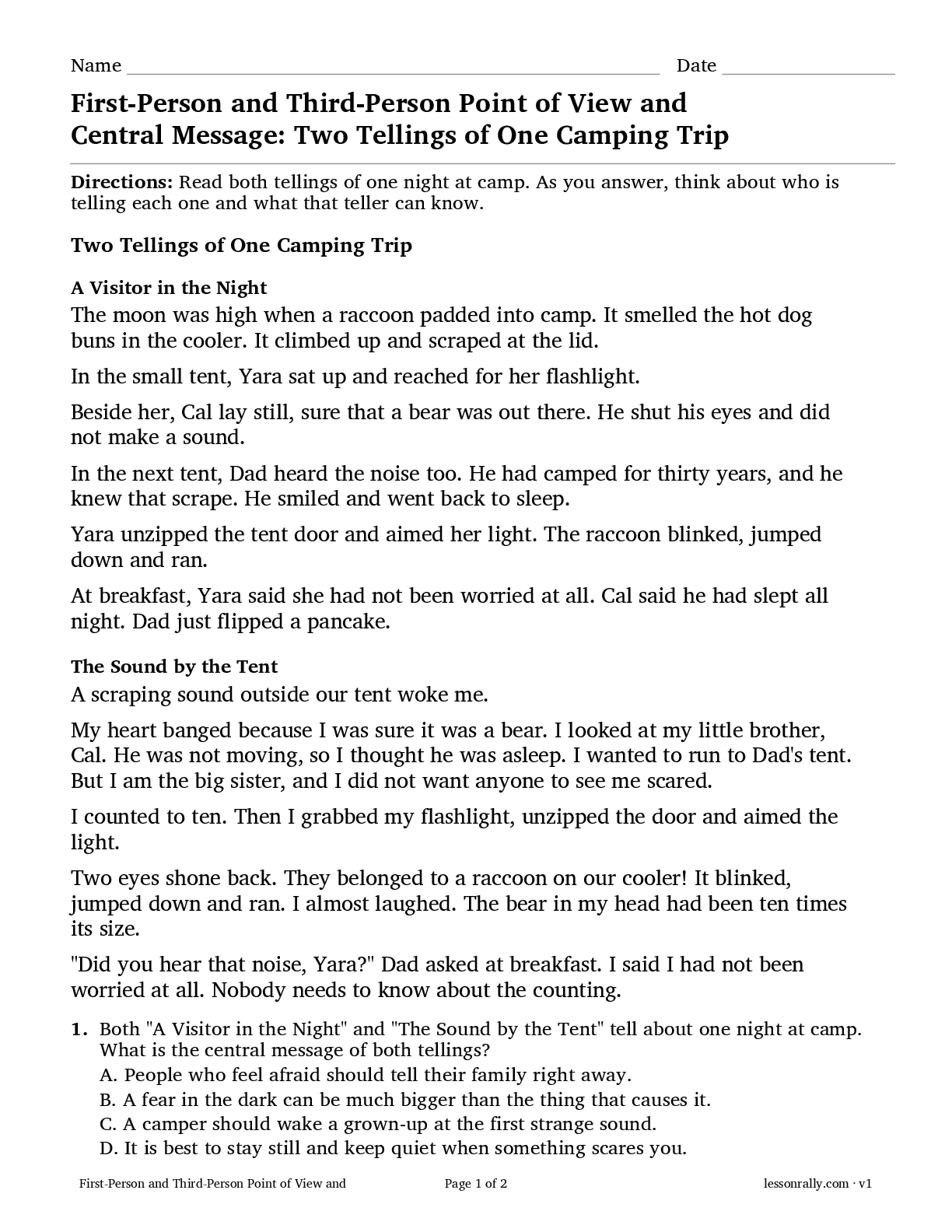
Read both tellings of one night at camp. As you answer, think about who is telling each one and what that teller can know.

Two Tellings of One Camping Trip

A Visitor in the Night

The moon was high when a raccoon padded into camp. It smelled the hot dog buns in the cooler. It climbed up and scraped at the lid.

In the small tent, Yara sat up and reached for her flashlight.

Beside her, Cal lay still, sure that a bear was out there. He shut his eyes and did not make a sound.

In the next tent, Dad heard the noise too. He had camped for thirty years, and he knew that scrape. He smiled and went back to sleep.

Yara unzipped the tent door and aimed her light. The raccoon blinked, jumped down and ran.

At breakfast, Yara said she had not been worried at all. Cal said he had slept all night. Dad just flipped a pancake.

The Sound by the Tent

A scraping sound outside our tent woke me.

My heart banged because I was sure it was a bear. I looked at my little brother, Cal. He was not moving, so I thought he was asleep. I wanted to run to Dad's tent. But I am the big sister, and I did not want anyone to see me scared.

I counted to ten. Then I grabbed my flashlight, unzipped the door and aimed the light.

Two eyes shone back. They belonged to a raccoon on our cooler! It blinked, jumped down and ran. I almost laughed. The bear in my head had been ten times its size.

"Did you hear that noise, Yara?" Dad asked at breakfast. I said I had not been worried at all. Nobody needs to know about the counting.

Question 1

Both "A Visitor in the Night" and "The Sound by the Tent" tell about one night at camp. What is the central message of both tellings?

Choose one answer.

  • People who feel afraid should tell their family right away.
  • A fear in the dark can be much bigger than the thing that causes it.
  • It is best to stay still and keep quiet when something scares you.
  • A camper should wake a grown-up at the first strange sound.
Question 2

The first telling is "A Visitor in the Night." The second is "The Sound by the Tent." Who tells each one?

Choose one answer.

  • Yara tells the first, and a narrator outside the story tells the second.
  • A narrator outside the story tells the first, and Cal tells the second.
  • Cal tells the first, and a narrator outside the story tells the second.
  • A narrator outside the story tells the first, and Yara tells the second.

Question 3

When does each telling first show the reader what made the sound?

Choose one answer.

  • Both show it at the start.
  • The second shows it at the start. The first waits until someone at camp spots the animal.
  • The first shows it at the start. The second waits until someone at camp spots the animal.
  • Both wait until someone at camp spots the animal.

Question 4

Which detail about the raccoon is given only in "A Visitor in the Night"?

Choose one answer.

  • It smells the buns in the cooler.
  • It jumps down and runs.
  • Its eyes shine in the light.
  • It blinks at the light.

Question 5

One telling shows a belief about Cal that the other telling shows is wrong. What is that belief?

Choose one answer.

  • Cal made the sound.
  • Cal is in Dad's tent.
  • Cal is asleep.
  • Cal has the flashlight.

Question 6

Which two details are given in both tellings? Select two.

Choose 2 answers.

  • Yara's heart bangs at the sound.
  • Yara unzips the door and aims a light.
  • Dad smiles when he hears the scrape.
  • Yara says at breakfast that she was not worried.
  • The moon is high when the raccoon comes.

Question 7

Which detail shows that Yara wants to keep part of the night to herself?

Choose one answer.

  • She asks Cal to keep quiet about what happened.
  • She thinks that nobody needs to know about her counting.
  • She decides to leave out what she saw when she writes about the trip.
  • She hides a note she wrote about the noise.

Question 8

Which detail explains why Dad stays calm and is given in only one telling?

Choose one answer.

  • He had heard Yara say that it was a raccoon.
  • He had tied the cooler shut before going to bed.
  • He had seen a raccoon near the camp that day.
  • He had camped for many years and knew that scrape.

Reviews

No reviews yet.

Reviews come from teachers who assigned this activity to a class.

Sign in to write a review

Have a topic of your own? Make a printable worksheet and online quiz, free.

Create an activity

Answer key

Answer keys come with Premium

Print this worksheet with the correct answers marked. The key includes any explanations, sample answers, and rubrics supplied with the activity.

Answer keys aren't public: only teachers with Premium and the people who can edit an activity can download one, so students can't get a ready-to-print key from this page.

Premium includes:

  • No ads for you, and no ads for your students on the assignments you post.
  • Answer keys for printable worksheets, with the correct answers marked and any explanations, sample answers, and rubrics.
  • Create with AI: up to 100 activities a year (5 during the free trial), with every answer checked before you see the draft.

$29 a year, plus sales tax where it applies.

New Premium teachers can try it free for 7 days. A card or other payment method is needed to start. Unless you cancel before the trial ends, you are charged then and the plan renews every year.

Already have Premium or edit this activity? Sign in