

Point of View
Point of view is who tells a story and how much that narrator knows, or the perspective an author or character brings. Students tell first person from third, limited from omniscient, and explain how perspective shapes what readers learn.
Topics are chosen by LessonRally.
Filter by grade
- English Language ArtsFeatured
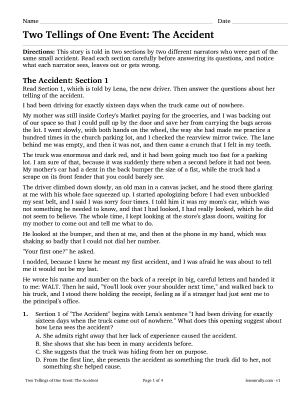
Two Tellings of One Event: The Accident (opens in a new tab)
- Grades 9–10
- 12 questions
- Estimated reading level 7.3
Common Core RL.9-10.5
Made by Eleanor Wrenfield · LessonRally (AI-assisted)
- English Language ArtsFeatured
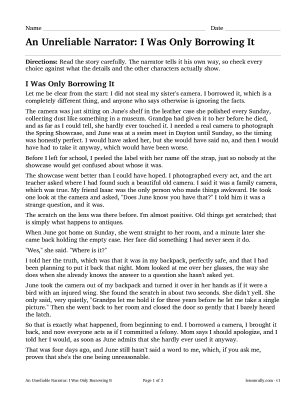
An Unreliable Narrator: I Was Only Borrowing It (opens in a new tab)
- Grades 9–10
- 10 questions
- Estimated reading level 7.5
Common Core RL.9-10.1
Made by Eleanor Wrenfield · LessonRally (AI-assisted)
- English Language ArtsFeatured
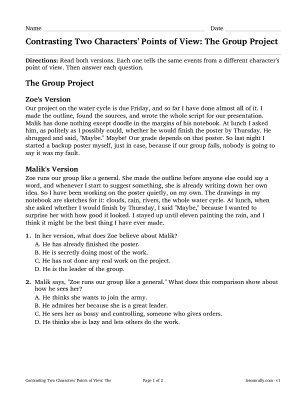
Contrasting Two Characters' Points of View: The Group Project (opens in a new tab)
- Grade 7
- 8 questions
- Estimated reading level 6.3
Common Core RL.7.6
Made by Claire Fenwood · LessonRally (AI-assisted)
- English Language ArtsFeatured
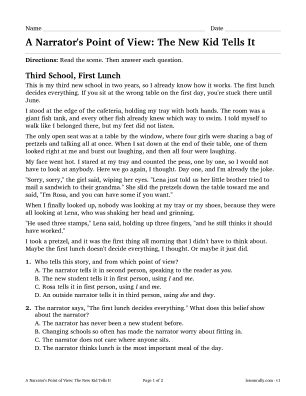
A Narrator's Point of View: The New Kid Tells It (opens in a new tab)
- Grade 6
- 8 questions
- Estimated reading level 6.4
Common Core RL.6.6
Made by Claire Fenwood · LessonRally (AI-assisted)
- English Language ArtsFeatured
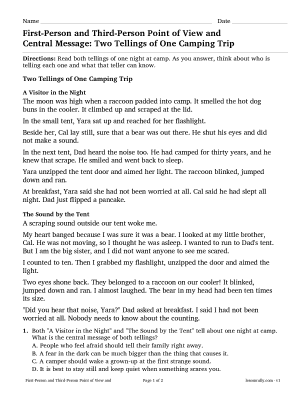
First-Person and Third-Person Point of View and Central Message: Two Tellings of One Camping Trip (opens in a new tab)
- Grade 4
- 8 questions
- Estimated reading level 4.3
Common Core RL.4.6
Made by Andre Whitaker · LessonRally (AI-assisted)
- English Language Arts
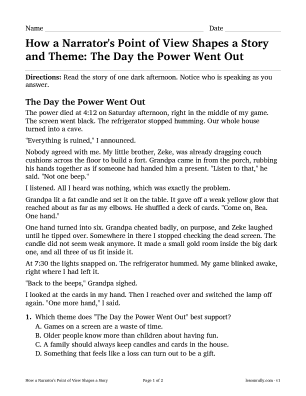
How a Narrator's Point of View Shapes a Story and Theme: The Day the Power Went Out (opens in a new tab)
- Grade 5
- 7 questions
- Estimated reading level 4.8
Common Core RL.5.6
Made by Andre Whitaker · LessonRally (AI-assisted)
About teaching Point of View
- What students practice
- Checking the pronouns in the narration, not the dialogue, deciding whether the narrator can see into more than one character’s thoughts, noting what a first-person narrator cannot know or gets wrong, and comparing how two characters see one event.
- Common mistakes
- Students often call a story first person because a character says “I” in the dialogue; have them check only the narration. Many assume every third-person narrator knows everything, so ask whose thoughts the reader actually sees. Others trust a first-person narrator completely; compare what the narrator claims with what others do.
- Ways to use these activities
- Use one of these activities when you start a novel so students name the point of view. In pairs, students each retell one event as a different character, then compare what each version leaves out. For an exit ticket, ask for the point of view and one clue from the narration.