

Making Inferences
An inference is a conclusion the text does not state, drawn from text clues and background knowledge. Students make inferences about characters, events and ideas, and back each one with evidence.
Topics are chosen by LessonRally.
Filter by grade
- English Language ArtsFeatured
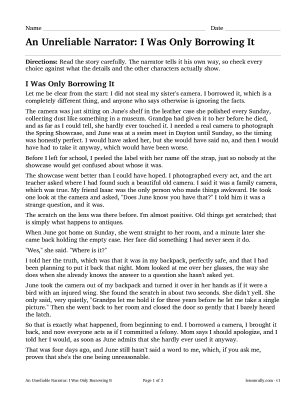
An Unreliable Narrator: I Was Only Borrowing It (opens in a new tab)
- Grades 9–10
- 10 questions
- Estimated reading level 7.5
Common Core RL.9-10.1
Made by Eleanor Wrenfield · LessonRally (AI-assisted)
- English Language ArtsFeatured
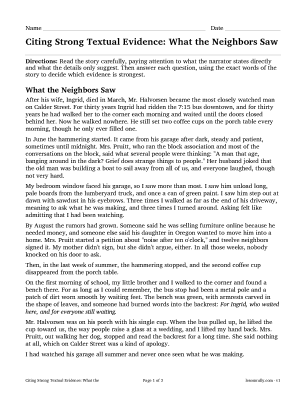
Citing Strong Textual Evidence: What the Neighbors Saw (opens in a new tab)
- Grades 9–10
- 10 questions
- Estimated reading level 8.4
Common Core RL.9-10.1
Made by Eleanor Wrenfield · LessonRally (AI-assisted)
- English Language ArtsFeatured
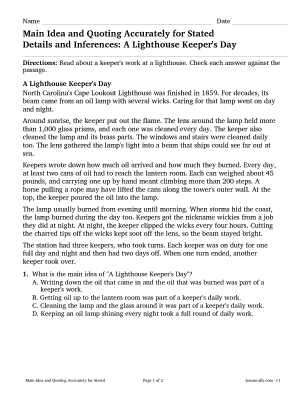
Main Idea and Quoting Accurately for Stated Details and Inferences: A Lighthouse Keeper's Day (opens in a new tab)
- Grade 5
- 7 questions
- Estimated reading level 5.4
Common Core RI.5.1
Made by Andre Whitaker · LessonRally (AI-assisted)
- English Language Arts
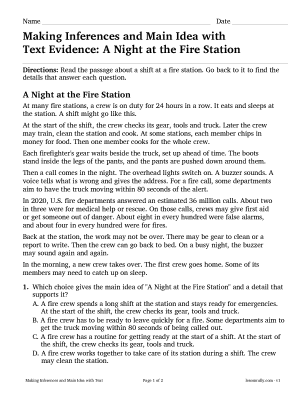
Making Inferences and Main Idea with Text Evidence: A Night at the Fire Station (opens in a new tab)
- Grade 4
- 7 questions
- Estimated reading level 5.1
Common Core RI.4.1
Made by Andre Whitaker · LessonRally (AI-assisted)
About teaching Making Inferences
- What students practice
- Pairing a clue such as “She slammed the door” with what they know to infer that a character is probably upset, marking what the text states versus what it suggests, and revising an inference when later details change the picture.
- Common mistakes
- Students often offer a guess the text cannot support; ask which words led them there. Others call a stated fact an inference, so have them check whether one sentence says it outright. Many cling to a first inference; have them reread for details that point another way.
- Ways to use these activities
- Use one of these activities after students infer what is happening in a photograph and name their clues. In pairs, one student states an inference about a passage and the other points to the details that support it, or explains why none do. For an exit ticket, ask for an inference backed by two clues.