Citing Strong Textual Evidence: What the Neighbors Saw

10 questions · 10 points · Grades 9–10 · English · Preview the 10 questions

Made by Eleanor Wrenfield · LessonRally (AI-assisted)

Digital classroom activity

What is a digital classroom activity?

Teachers who sign in can assign LessonRally activities to their Google Classroom classes: students open them in Classroom and answer online, and their grades go to the teacher's Classroom gradebook. Practice lets you try it first, the way students see it.

Free for teachers. Sign in to assign activities to your Google Classroom classes.

Printable worksheet

Students read an original short story about neighbors who misjudge a grieving man and practice citing strong textual evidence. They choose the quotation that best supports each inference and tell what the story states explicitly from what it only implies.

Learning goal: Cite strong and thorough textual evidence to support inferences about a story, and distinguish what the text says explicitly from what it implies.

Estimated reading level 8.4

  1. Grade 6Hard
  2. Grade 7Stretch
  3. Grade 8On level
  4. Grade 9Easier
  5. Grade 10Easy
About this estimate

The estimate is the middle score of five readability formulas. Their scores run from 6.8 to 9.3.

  • Flesch-Kincaid GradeSentence length and syllables per word6.8
  • Gunning FogSentence length and words of three or more syllables9.0
  • Coleman-Liau Middle scoreLetters per word and sentences per 100 words8.4
  • Automated Readability IndexCharacters per word and words per sentence7.7
  • SMOGWords of three or more syllables, for texts of 30 sentences or more9.3
Flesch Reading Ease
75.6 on a 0 to 100 scale where higher is easier: fairly easy. Not part of the estimate.
Text measured
1,345 words, 48 sentences

Adapted from common readability formulas (Flesch-Kincaid, Gunning Fog, Coleman-Liau and ARI, plus SMOG for long texts), which look at sentence length and word length. Answer choices count toward word length only. Grades below the estimate will likely find the text harder, grades above it easier. It does not measure ideas, background knowledge or images.

Common Core

Closest anchor: CCRA.R.1 Read closely to determine what the text says explicitly and to make logical inferences from it; cite specific textual evidence when writing or speaking to support conclusions drawn from the text.Anchor Standards for ReadingShow 2 matched standardsHide matched standards

Matched standards

  • RL.9-10.1

    Cite strong and thorough textual evidence to support analysis of what the text says explicitly as well as inferences drawn from the text.

    Student preview questions 4, 5, 6, 7, 8, 9

  • RL.9-10.4

    Determine the meaning of words and phrases as they are used in the text, including figurative and connotative meanings; analyze the cumulative impact of specific word choices on meaning and tone (e.g., how the language evokes a sense of time and place; how it sets a formal or informal tone).

    Student preview question 3

Matched independently by two AI models from this activity's questions.

© Copyright 2010. National Governors Association Center for Best Practices and Council of Chief State School Officers. All rights reserved.

Topics: Citing Text Evidence, Making Inferences Chosen by LessonRally

Question types: multiple choice, select all that apply.

Student preview

The questions as students see them, without the answers.

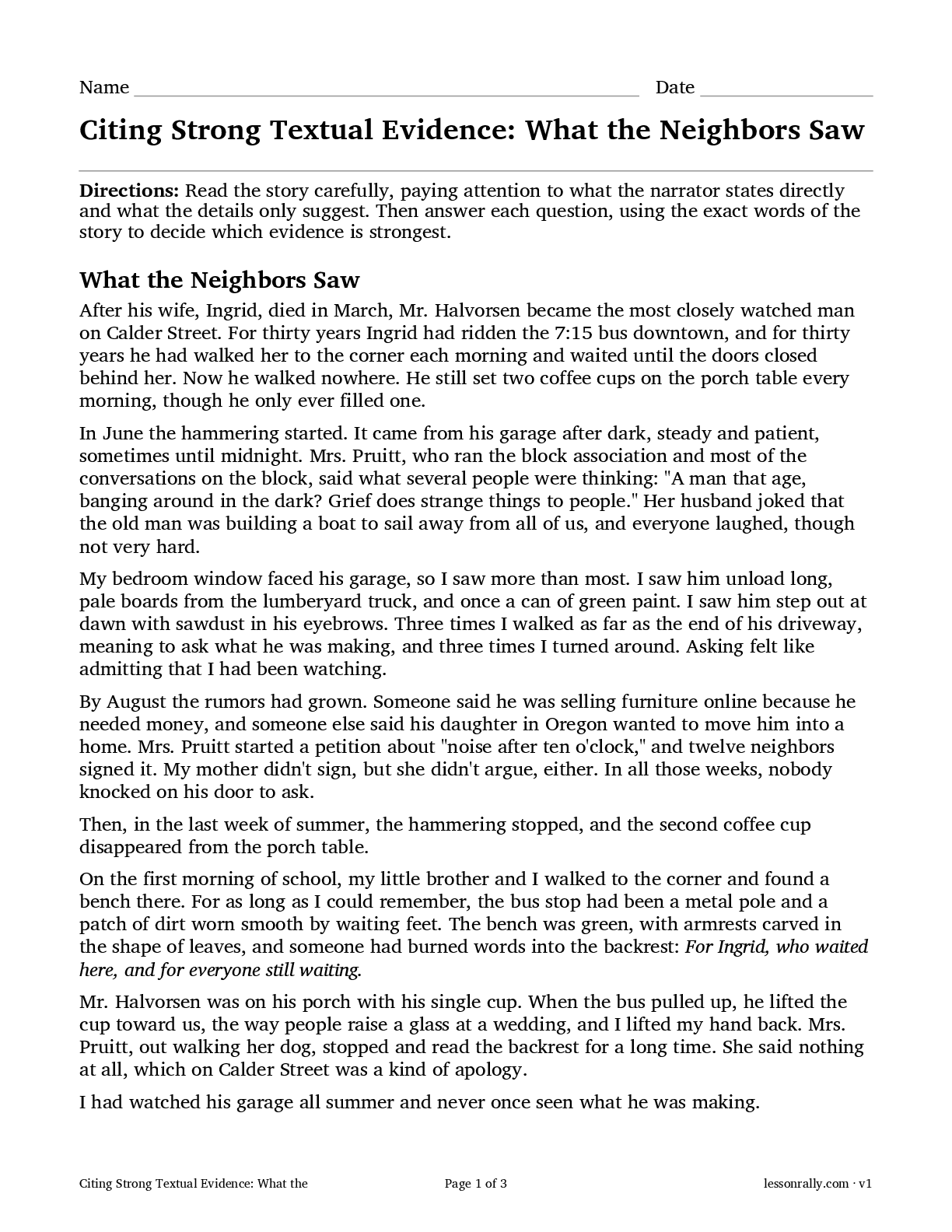
Read the story carefully, paying attention to what the narrator states directly and what the details only suggest. Then answer each question, using the exact words of the story to decide which evidence is strongest.

What the Neighbors Saw

After his wife, Ingrid, died in March, Mr. Halvorsen became the most closely watched man on Calder Street. For thirty years Ingrid had ridden the 7:15 bus downtown, and for thirty years he had walked her to the corner each morning and waited until the doors closed behind her. Now he walked nowhere. He still set two coffee cups on the porch table every morning, though he only ever filled one.

In June the hammering started. It came from his garage after dark, steady and patient, sometimes until midnight. Mrs. Pruitt, who ran the block association and most of the conversations on the block, said what several people were thinking: "A man that age, banging around in the dark? Grief does strange things to people." Her husband joked that the old man was building a boat to sail away from all of us, and everyone laughed, though not very hard.

My bedroom window faced his garage, so I saw more than most. I saw him unload long, pale boards from the lumberyard truck, and once a can of green paint. I saw him step out at dawn with sawdust in his eyebrows. Three times I walked as far as the end of his driveway, meaning to ask what he was making, and three times I turned around. Asking felt like admitting that I had been watching.

By August the rumors had grown. Someone said he was selling furniture online because he needed money, and someone else said his daughter in Oregon wanted to move him into a home. Mrs. Pruitt started a petition about "noise after ten o'clock," and twelve neighbors signed it. My mother didn't sign, but she didn't argue, either. In all those weeks, nobody knocked on his door to ask.

Then, in the last week of summer, the hammering stopped, and the second coffee cup disappeared from the porch table.

On the first morning of school, my little brother and I walked to the corner and found a bench there. For as long as I could remember, the bus stop had been a metal pole and a patch of dirt worn smooth by waiting feet. The bench was green, with armrests carved in the shape of leaves, and someone had burned words into the backrest: For Ingrid, who waited here, and for everyone still waiting.

Mr. Halvorsen was on his porch with his single cup. When the bus pulled up, he lifted the cup toward us, the way people raise a glass at a wedding, and I lifted my hand back. Mrs. Pruitt, out walking her dog, stopped and read the backrest for a long time. She said nothing at all, which on Calder Street was a kind of apology.

I had watched his garage all summer and never once seen what he was making.

Question 1

Which of these statements does the narrator of "What the Neighbors Saw" state directly, instead of leaving it for readers to infer from other details?

Choose one answer.

  • Mr. Halvorsen built the bench at the bus stop.
  • The narrator's mother disagreed with the petition.
  • Mr. Halvorsen knew what the neighbors were saying about him.
  • Twelve neighbors signed Mrs. Pruitt's petition.

Question 2

Which quotation best supports the inference that, months after his loss, the widower keeps up a daily habit that belonged to his married life with Ingrid?

Choose one answer.

  • "He still set two coffee cups on the porch table every morning, though he only ever filled one."
  • "After his wife, Ingrid, died in March, Mr. Halvorsen became the most closely watched man on Calder Street."
  • "I saw him step out at dawn with sawdust in his eyebrows."
  • "Now he walked nowhere."

Question 3

In the paragraph where the hammering begins, the narrator describes Mrs. Pruitt as someone "who ran the block association and most of the conversations on the block" before quoting her guess about the old man. What does this description imply about her?

Choose one answer.

  • She is the narrator's closest friend on the street.
  • She is the oldest person living on Calder Street.
  • She tends to steer what the neighbors talk about.
  • She rarely speaks at neighborhood meetings.

Question 4

Which two quotations, taken together, give the strongest support for the inference that the neighbors formed opinions about the widower's work without ever asking him about it? Select two.

Choose 2 answers.

  • "On the first morning of school, my little brother and I walked to the corner and found a bench there."
  • "I saw him step out at dawn with sawdust in his eyebrows."
  • "My bedroom window faced his garage, so I saw more than most."
  • "In all those weeks, nobody knocked on his door to ask."
  • "A man that age, banging around in the dark? Grief does strange things to people."

Question 5

Even after walking to the end of his driveway three times, the narrator never questions the old man about the garage. Which quotation explains the reason for this silence most directly?

Choose one answer.

  • "My bedroom window faced his garage, so I saw more than most."
  • "By August the rumors had grown."
  • "Three times I walked as far as the end of his driveway, meaning to ask what he was making, and three times I turned around."
  • "Asking felt like admitting that I had been watching."

Question 6

Because the story never says who built the bench, readers have to infer it. Which line provides the strongest evidence that the bench came out of the widower's garage?

Choose one answer.

  • "I saw him unload long, pale boards from the lumberyard truck, and once a can of green paint."
  • "Her husband joked that the old man was building a boat to sail away from all of us, and everyone laughed, though not very hard."
  • "My bedroom window faced his garage, so I saw more than most."
  • "Someone said he was selling furniture online because he needed money, and someone else said his daughter in Oregon wanted to move him into a home."

Question 7

The words burned into the bench honor Ingrid. Which earlier sentence best explains why the bench was placed at this particular spot rather than somewhere else on Calder Street?

Choose one answer.

  • "Now he walked nowhere."
  • "For thirty years Ingrid had ridden the 7:15 bus downtown, and for thirty years he had walked her to the corner each morning and waited until the doors closed behind her."
  • "In June the hammering started."
  • "My mother didn't sign, but she didn't argue, either."

Question 8

In the final scene, the widower appears genuinely pleased to see the children waiting at the new bench. Which quotation demonstrates his feeling most clearly?

Choose one answer.

  • "When the bus pulled up, he lifted the cup toward us, the way people raise a glass at a wedding, and I lifted my hand back."
  • "Mr. Halvorsen was on his porch with his single cup."
  • "Then, in the last week of summer, the hammering stopped, and the second coffee cup disappeared from the porch table."
  • "Mrs. Pruitt, out walking her dog, stopped and read the backrest for a long time."

Question 9

Suppose a reader argues that Mrs. Pruitt now regrets the way she treated her neighbor. Which quotation would support that argument most strongly?

Choose one answer.

  • "Her husband joked that the old man was building a boat to sail away from all of us, and everyone laughed, though not very hard."
  • "By August the rumors had grown."
  • "Mrs. Pruitt, out walking her dog, stopped and read the backrest for a long time."
  • "She said nothing at all, which on Calder Street was a kind of apology."

Question 10

The story ends with the sentence "I had watched his garage all summer and never once seen what he was making." What does this final line suggest about watching people from a distance?

Choose one answer.

  • Mr. Halvorsen hid his work in order to fool the neighbors.
  • A closed garage door makes it impossible to know what anyone is doing.
  • The neighbors were right to complain about the noise.
  • Watching someone closely is not the same as understanding what that person is going through.

Reviews

No reviews yet.

Reviews come from teachers who assigned this activity to a class.

Sign in to write a review

Have a topic of your own? Make a printable worksheet and online quiz, free.

Create an activity

Answer key

Answer keys come with Premium

Print this worksheet with the correct answers marked. The key includes any explanations, sample answers, and rubrics supplied with the activity.

Answer keys aren't public: only teachers with Premium and the people who can edit an activity can download one, so students can't get a ready-to-print key from this page.

Premium includes:

  • No ads for you, and no ads for your students on the assignments you post.
  • Answer keys for printable worksheets, with the correct answers marked and any explanations, sample answers, and rubrics.
  • Create with AI: up to 100 activities a year (5 during the free trial), with every answer checked before you see the draft.

$29 a year, plus sales tax where it applies.

New Premium teachers can try it free for 7 days. A card or other payment method is needed to start. Unless you cancel before the trial ends, you are charged then and the plan renews every year.

Already have Premium or edit this activity? Sign in