A Theme Shaped by Specific Details: My Mother's Second Language

10 questions · 10 points · Grades 9–10 · English · Preview the 10 questions

Made by Eleanor Wrenfield · LessonRally (AI-assisted)

Digital classroom activity

What is a digital classroom activity?

Teachers who sign in can assign LessonRally activities to their Google Classroom classes: students open them in Classroom and answer online, and their grades go to the teacher's Classroom gradebook. Practice lets you try it first, the way students see it.

Free for teachers. Sign in to assign activities to your Google Classroom classes.

Printable worksheet

Students read an original short story about a teenager whose mother is learning English as her second language, and analyze how small, specific details develop a theme. Questions cover the words, objects and habits that shape and refine the theme, and how a theme differs from a topic or a summary. Practice with theme, themes, theme development, key details and specific details.

Learning goal: Determine a theme of a story and analyze how specific details, such as words, objects and habits, shape and refine it over the course of the text.

Estimated reading level 7.8

  1. Grade 5Hard
  2. Grade 6Stretch
  3. Grade 7On level
  4. Grade 8Easier
  5. Grade 9Easy
About this estimate

The estimate is the middle score of five readability formulas. Their scores run from 7.4 to 10.0.

  • Flesch-Kincaid GradeSentence length and syllables per word7.4
  • Gunning FogSentence length and words of three or more syllables10.0
  • Coleman-LiauLetters per word and sentences per 100 words7.8
  • Automated Readability Index Middle scoreCharacters per word and words per sentence7.8
  • SMOGWords of three or more syllables, for texts of 30 sentences or more9.2
Flesch Reading Ease
74.0 on a 0 to 100 scale where higher is easier: fairly easy. Not part of the estimate.
Text measured
1,461 words, 48 sentences

Adapted from common readability formulas (Flesch-Kincaid, Gunning Fog, Coleman-Liau and ARI, plus SMOG for long texts), which look at sentence length and word length. Answer choices count toward word length only. Grades below the estimate will likely find the text harder, grades above it easier. It does not measure ideas, background knowledge or images.

Common Core

Closest anchor: CCRA.R.2 Determine central ideas or themes of a text and analyze their development; summarize the key supporting details and ideas.Anchor Standards for ReadingShow 1 matched standardHide matched standard

Matched standard

  • RL.9-10.2

    Determine a theme or central idea of a text and analyze in detail its development over the course of the text, including how it emerges and is shaped and refined by specific details; provide an objective summary of the text.

    Student preview questions 7, 8, 10

Matched independently by two AI models from this activity's questions.

© Copyright 2010. National Governors Association Center for Best Practices and Council of Chief State School Officers. All rights reserved.

Topic: Theme Chosen by LessonRally

Question types: multiple choice, select all that apply.

Student preview

The questions as students see them, without the answers.

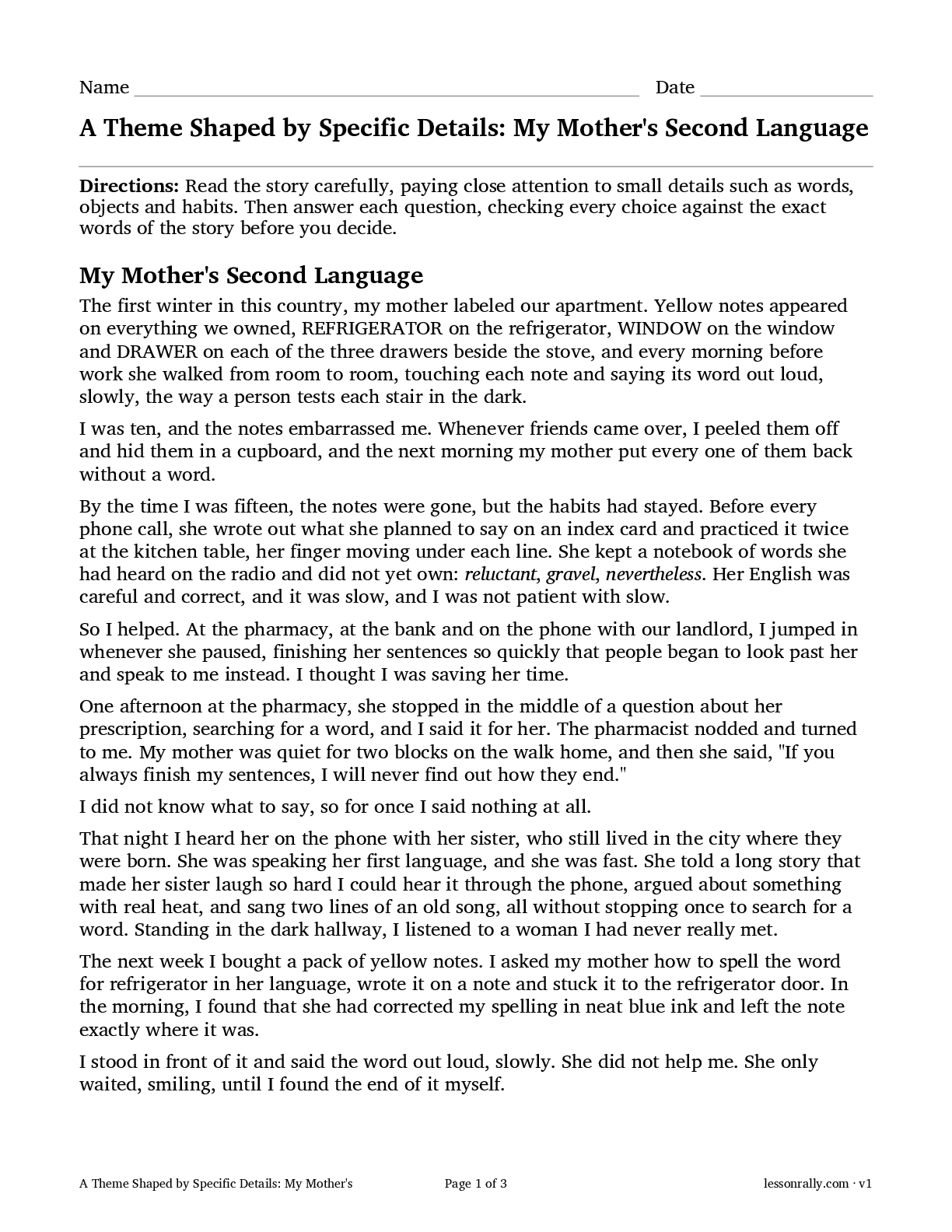
Read the story carefully, paying close attention to small details such as words, objects and habits. Then answer each question, checking every choice against the exact words of the story before you decide.

My Mother's Second Language

The first winter in this country, my mother labeled our apartment. Yellow notes appeared on everything we owned, REFRIGERATOR on the refrigerator, WINDOW on the window and DRAWER on each of the three drawers beside the stove, and every morning before work she walked from room to room, touching each note and saying its word out loud, slowly, the way a person tests each stair in the dark.

I was ten, and the notes embarrassed me. Whenever friends came over, I peeled them off and hid them in a cupboard, and the next morning my mother put every one of them back without a word.

By the time I was fifteen, the notes were gone, but the habits had stayed. Before every phone call, she wrote out what she planned to say on an index card and practiced it twice at the kitchen table, her finger moving under each line. She kept a notebook of words she had heard on the radio and did not yet own: reluctant, gravel, nevertheless. Her English was careful and correct, and it was slow, and I was not patient with slow.

So I helped. At the pharmacy, at the bank and on the phone with our landlord, I jumped in whenever she paused, finishing her sentences so quickly that people began to look past her and speak to me instead. I thought I was saving her time.

One afternoon at the pharmacy, she stopped in the middle of a question about her prescription, searching for a word, and I said it for her. The pharmacist nodded and turned to me. My mother was quiet for two blocks on the walk home, and then she said, "If you always finish my sentences, I will never find out how they end."

I did not know what to say, so for once I said nothing at all.

That night I heard her on the phone with her sister, who still lived in the city where they were born. She was speaking her first language, and she was fast. She told a long story that made her sister laugh so hard I could hear it through the phone, argued about something with real heat, and sang two lines of an old song, all without stopping once to search for a word. Standing in the dark hallway, I listened to a woman I had never really met.

The next week I bought a pack of yellow notes. I asked my mother how to spell the word for refrigerator in her language, wrote it on a note and stuck it to the refrigerator door. In the morning, I found that she had corrected my spelling in neat blue ink and left the note exactly where it was.

I stood in front of it and said the word out loud, slowly. She did not help me. She only waited, smiling, until I found the end of it myself.


Question 1

"My Mother's Second Language" opens with the yellow notes that the mother sticks on everything in the apartment and with her habit of "touching each note and saying its word out loud, slowly" every morning before work. What does this opening detail show about her?

Choose one answer.

  • She is forgetful and needs notes to remind her where things are kept.
  • She is decorating the new apartment to make it feel more cheerful.
  • She is trying to teach the narrator to speak English.
  • She is determined and patient about learning, practicing her new words every morning.

Question 2

When friends come over, the ten-year-old narrator peels the notes off and hides them, and "the next morning my mother put every one of them back without a word." What does her response reveal about her?

Choose one answer.

  • She agrees with the narrator that the notes are embarrassing.
  • She never noticed that the notes had been taken down.
  • She is too angry to speak to the narrator about it.
  • She quietly keeps to her way of learning, even though her child is embarrassed by it.

Question 3

The narrator says that the mother kept a notebook of words she had heard on the radio and "did not yet own" (reluctant, gravel, nevertheless). What does the phrase "did not yet own" suggest about the way she thinks of new words?

Choose one answer.

  • She already knows these words well and uses them every day.
  • She sees each word as something she will make her own through effort, and "yet" shows that she expects to.
  • She cannot afford to buy the books in which the words appear.
  • She dislikes the words she hears on the radio and plans to avoid them.

Question 4

The narrator calls the mother's English "careful and correct," then adds, "and it was slow, and I was not patient with slow." A paragraph later the narrator says, "I thought I was saving her time." How do these sentences prepare for the story's theme?

Choose one answer.

  • They show that the narrator wanted to hurt the mother's feelings on purpose.
  • They show that the mother had asked the narrator to speak for her.
  • They show that the mother's English was full of mistakes that needed fixing.
  • They show that the narrator judged the mother only by her speed and believed the help was kind, a belief that the rest of the story calls into question.

Question 5

At the pharmacy, the narrator supplies the word the mother is searching for, and then "The pharmacist nodded and turned to me." What does this small detail show about the narrator's help?

Choose one answer.

  • It pushes the mother out of her own conversation, since the pharmacist now speaks to the narrator instead of to her.
  • It shows that the pharmacist is rude to every customer.
  • It proves that the narrator understands the prescription better than the mother does.
  • It shows that the mother is relieved to let the narrator take over.

Question 6

On the walk home, the mother tells the narrator, "If you always finish my sentences, I will never find out how they end." What does she mean?

Choose one answer.

  • She needs to work through her own sentences in order to learn, so the narrator's help, however kindly meant, takes that chance away.
  • She is admitting that she will never learn to speak English well.
  • She is complaining that the narrator talks too much at dinner.
  • She wants the narrator to stop coming to the pharmacy with her.

Question 7

Which of these statements expresses a theme of the story, rather than naming a topic, summarizing events or repeating a single detail?

Choose one answer.

  • Learning a new language takes patience, and people help a learner most by giving that person time to find the words.
  • A mother labels her apartment, and years later her child begins to learn her first language.
  • A mother learning a new language in a new country
  • The mother writes out every phone call on an index card before she makes it.

Question 8

Late in the story, the narrator overhears the mother on the phone with her sister, telling a long story, arguing "with real heat" and singing, "all without stopping once to search for a word." How does the line "I listened to a woman I had never really met" refine the story's theme?

Choose one answer.

  • It reveals that the mother loves her sister more than she loves her own child.
  • It shows that the mother's slow English hides a quick, funny and forceful self, so judging her by her speed had meant seeing only part of her.
  • It suggests that the mother was only pretending to struggle with English.
  • It shows that the mother has given up on learning English.

Question 9

Which two details from the end of the story repeat the mother's habits from her first winter in the country? Select two.

Choose 2 answers.

  • The narrator writes a word on a yellow note and sticks it to the refrigerator door.
  • The mother waits, smiling, without helping.
  • The narrator stands in front of the note and says the word out loud, slowly.
  • The mother corrects the spelling in neat blue ink.
  • The narrator asks the mother how to spell the word.

Question 10

The story ends, "She did not help me. She only waited, smiling, until I found the end of it myself." How does this ending refine the theme?

Choose one answer.

  • It shows that the narrator decides the new language is too hard to learn.
  • It shows that the mother refuses to help because she is still upset about the pharmacy.
  • It shows the mother giving the narrator the patience that the narrator once failed to give her, so real help can mean letting a learner find the end without help.
  • It shows that the mother wants the narrator to stop speaking English at home.

Reviews

No reviews yet.

Reviews come from teachers who assigned this activity to a class.

Sign in to write a review

Have a topic of your own? Make a printable worksheet and online quiz, free.

Create an activity

Answer key

Answer keys come with Premium

Print this worksheet with the correct answers marked. The key includes any explanations, sample answers, and rubrics supplied with the activity.

Answer keys aren't public: only teachers with Premium and the people who can edit an activity can download one, so students can't get a ready-to-print key from this page.

Premium includes:

  • No ads for you, and no ads for your students on the assignments you post.
  • Answer keys for printable worksheets, with the correct answers marked and any explanations, sample answers, and rubrics.
  • Create with AI: up to 100 activities a year (5 during the free trial), with every answer checked before you see the draft.

$29 a year, plus sales tax where it applies.

New Premium teachers can try it free for 7 days. A card or other payment method is needed to start. Unless you cancel before the trial ends, you are charged then and the plan renews every year.

Already have Premium or edit this activity? Sign in