Writing an Objective Summary of a Story: The Ferry

10 questions · 10 points · Grades 9–10 · English · Preview the 10 questions

Made by Eleanor Wrenfield · LessonRally (AI-assisted)

Digital classroom activity

What is a digital classroom activity?

Teachers who sign in can assign LessonRally activities to their Google Classroom classes: students open them in Classroom and answer online, and their grades go to the teacher's Classroom gradebook. Practice lets you try it first, the way students see it.

Free for teachers. Sign in to assign activities to your Google Classroom classes.

Printable worksheet

Students read an original short story about the last run of a ferry and practice writing an objective summary. They choose the summary that keeps the main events in order, spot sentences that add opinions or invented details, and tell a theme apart from a summary of events. Practice with summary, summaries, how to summarize a story, summarizing, objective summaries, main events and theme.

Learning goal: Provide an objective summary of a story by identifying its main events in order without opinions or invented details, and distinguish a theme from a summary of events.

Estimated reading level 8.6

  1. Grade 6Hard
  2. Grade 7Stretch
  3. Grade 8On level
  4. Grade 9Easier
  5. Grade 10Easy
About this estimate

The estimate is the middle score of five readability formulas. Their scores run from 7.7 to 9.7.

  • Flesch-Kincaid GradeSentence length and syllables per word7.9
  • Gunning FogSentence length and words of three or more syllables9.7
  • Coleman-LiauLetters per word and sentences per 100 words7.7
  • Automated Readability Index Middle scoreCharacters per word and words per sentence8.6
  • SMOGWords of three or more syllables, for texts of 30 sentences or more9.1
Flesch Reading Ease
74.2 on a 0 to 100 scale where higher is easier: fairly easy. Not part of the estimate.
Text measured
1,549 words, 40 sentences

Adapted from common readability formulas (Flesch-Kincaid, Gunning Fog, Coleman-Liau and ARI, plus SMOG for long texts), which look at sentence length and word length. Answer choices count toward word length only. Grades below the estimate will likely find the text harder, grades above it easier. It does not measure ideas, background knowledge or images.

Common Core

Closest anchor: CCRA.R.2 Determine central ideas or themes of a text and analyze their development; summarize the key supporting details and ideas.Anchor Standards for ReadingShow 2 matched standardsHide matched standards

Matched standards

  • RL.9-10.2

    Determine a theme or central idea of a text and analyze in detail its development over the course of the text, including how it emerges and is shaped and refined by specific details; provide an objective summary of the text.

    Student preview questions 8, 10

  • RL.9-10.3

    Analyze how complex characters (e.g., those with multiple or conflicting motivations) develop over the course of a text, interact with other characters, and advance the plot or develop the theme.

    Student preview question 9

Matched independently by two AI models from this activity's questions.

© Copyright 2010. National Governors Association Center for Best Practices and Council of Chief State School Officers. All rights reserved.

Topics: Summarizing, Theme Chosen by LessonRally

Question types: multiple choice, select all that apply.

Student preview

The questions as students see them, without the answers.

Read the story carefully, keeping track of the main events and the order in which they happen. Then answer each question, checking every summary and every sentence against what the story actually says.

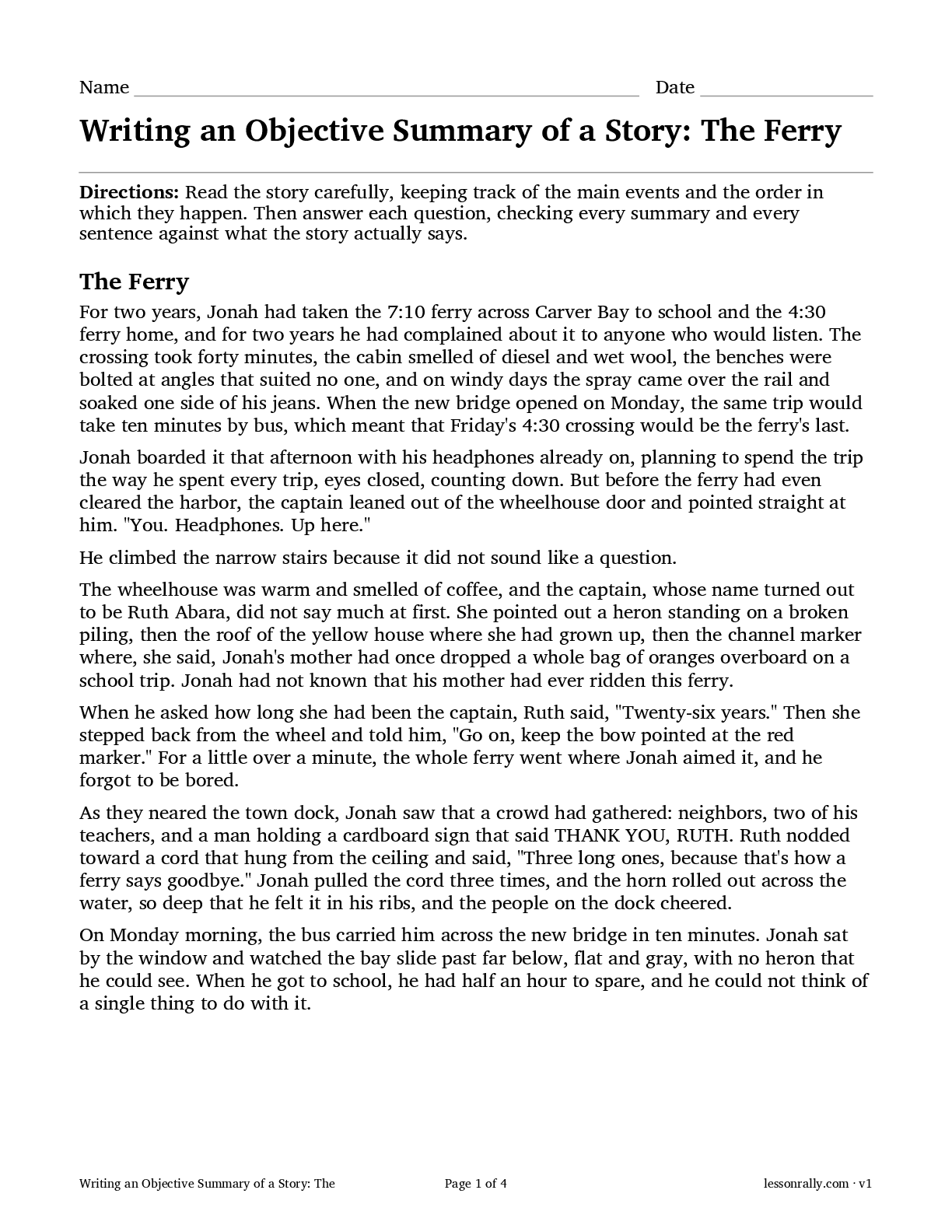
The Ferry

For two years, Jonah had taken the 7:10 ferry across Carver Bay to school and the 4:30 ferry home, and for two years he had complained about it to anyone who would listen. The crossing took forty minutes, the cabin smelled of diesel and wet wool, the benches were bolted at angles that suited no one, and on windy days the spray came over the rail and soaked one side of his jeans. When the new bridge opened on Monday, the same trip would take ten minutes by bus, which meant that Friday's 4:30 crossing would be the ferry's last.

Jonah boarded it that afternoon with his headphones already on, planning to spend the trip the way he spent every trip, eyes closed, counting down. But before the ferry had even cleared the harbor, the captain leaned out of the wheelhouse door and pointed straight at him. "You. Headphones. Up here."

He climbed the narrow stairs because it did not sound like a question.

The wheelhouse was warm and smelled of coffee, and the captain, whose name turned out to be Ruth Abara, did not say much at first. She pointed out a heron standing on a broken piling, then the roof of the yellow house where she had grown up, then the channel marker where, she said, Jonah's mother had once dropped a whole bag of oranges overboard on a school trip. Jonah had not known that his mother had ever ridden this ferry.

When he asked how long she had been the captain, Ruth said, "Twenty-six years." Then she stepped back from the wheel and told him, "Go on, keep the bow pointed at the red marker." For a little over a minute, the whole ferry went where Jonah aimed it, and he forgot to be bored.

As they neared the town dock, Jonah saw that a crowd had gathered: neighbors, two of his teachers, and a man holding a cardboard sign that said THANK YOU, RUTH. Ruth nodded toward a cord that hung from the ceiling and said, "Three long ones, because that's how a ferry says goodbye." Jonah pulled the cord three times, and the horn rolled out across the water, so deep that he felt it in his ribs, and the people on the dock cheered.

On Monday morning, the bus carried him across the new bridge in ten minutes. Jonah sat by the window and watched the bay slide past far below, flat and gray, with no heron that he could see. When he got to school, he had half an hour to spare, and he could not think of a single thing to do with it.

Question 1

Which of the following is the best objective summary of "The Ferry," one that keeps the main events in order without adding opinions or details that the story never gives?

Choose one answer.

  • Jonah, who has complained for two years about the slow ferry to school, rides its last trip before a new bridge opens. The captain calls him up to the wheelhouse and lets him steer. As the ferry nears the dock, Jonah sounds the horn, and the captain gives him her cap to keep. On Monday, after the bus crosses the new bridge, he cannot think of anything to do with his extra time.
  • Jonah, who has complained for two years about the slow ferry to school, rides its last trip before a new bridge opens. As the ferry nears the dock, Jonah sounds the horn to say goodbye. Then the captain calls him up to the wheelhouse and lets him steer. On Monday, after the bus crosses the new bridge, he cannot think of anything to do with his extra time.
  • Jonah, who has complained for two years about the slow ferry to school, rides its last trip before a new bridge opens. The captain calls him up to the wheelhouse and lets him steer. As the ferry nears the dock, Jonah sounds the horn to say goodbye. On Monday, after the bus crosses the new bridge, he cannot think of anything to do with his extra time.
  • Jonah, who has complained for two years about the slow ferry to school, rides its last trip before a new bridge opens. The captain calls him up to the wheelhouse and lets him steer, which is the best part of the story. As the ferry nears the dock, Jonah sounds the horn to say goodbye. On Monday, after the bus crosses the new bridge, he cannot think of anything to do with his extra time.

Question 2

A student wrote the following summary of "The Ferry": Jonah, who has complained for two years about the slow ferry to school, rides its last trip before a new bridge opens. The captain calls him up to the wheelhouse, tells him a story about his mother and lets him steer. As the ferry nears the dock, where a crowd has gathered, Jonah sounds the horn to say goodbye. What is the main problem with this summary?

Choose one answer.

  • It tells the events of the story in the wrong order.
  • It leaves out the ending, when Jonah rides the bus across the new bridge on Monday.
  • It includes the student's own opinion of the story.
  • It adds a detail that the story never actually gives.

Question 3

Which of the following sentences from a student's summary of "The Ferry" includes the student's own opinion instead of reporting what actually happens in the story?

Choose one answer.

  • The captain calls Jonah up to the wheelhouse.
  • Jonah's complaints about the ferry were childish, and he should have been grateful.
  • Jonah has ridden the ferry to school and back for two years.
  • After the bridge opens, the trip takes ten minutes by bus.

Question 4

Which of the following sentences from a student's summary of the story adds a detail that the story itself never gives?

Choose one answer.

  • A crowd has gathered at the town dock by the time the ferry nears it.
  • Jonah's mother is waiting for him in the crowd at the dock.
  • Ruth lets Jonah steer the ferry for a little over a minute.
  • Ruth Abara has been the ferry's captain for twenty-six years.

Question 5

A student's summary includes this sentence: In the best scene of the story, the kind captain finally lets lazy Jonah steer the ferry. Which revision removes every judgment from the sentence and keeps only what actually happens?

Choose one answer.

  • In the best scene of the story, the captain lets Jonah steer the ferry.
  • The kind captain lets Jonah steer the ferry.
  • The captain lets lazy Jonah steer the ferry.
  • The captain lets Jonah steer the ferry.

Question 6

Which two items from "The Ferry" belong in an objective summary because they are main events rather than minor details? Select two.

Choose 2 answers.

  • The benches in the cabin are bolted at angles that suit no one.
  • The ferry makes its last trip before a new bridge opens.
  • A heron stands on a broken piling.
  • The cabin smells of diesel and wet wool.
  • The captain calls Jonah up to the wheelhouse and lets him steer.

Question 7

A strong summary of "The Ferry" mentions that for two years Jonah complained about the ferry "to anyone who would listen." Why is this detail worth including in a summary of the story?

Choose one answer.

  • It shows that Jonah was the only passenger who disliked the ferry.
  • It explains why the town decided to build the new bridge.
  • It is the funniest part of the story, and a summary should keep the jokes.
  • It shows where Jonah starts, so readers of the summary can see how much he has changed by the end.

Question 8

Which statement expresses a theme of "The Ferry," a general idea about life, rather than summarizing the specific events of the story?

Choose one answer.

  • Something that seems like a waste of time can turn out to matter once a person pays attention to it.
  • A new bridge cuts the trip across Carver Bay from forty minutes to ten.
  • Ruth Abara has been the captain of the ferry for twenty-six years.
  • Jonah rides the ferry's last trip and sounds its horn as it nears the dock.

Question 9

During the crossing, which sentence from the story best shows that Jonah's attitude toward the ferry is starting to change?

Choose one answer.

  • "The wheelhouse was warm and smelled of coffee"
  • "For a little over a minute, the whole ferry went where Jonah aimed it, and he forgot to be bored."
  • "Jonah boarded it that afternoon with his headphones already on"
  • "He climbed the narrow stairs because it did not sound like a question."

Question 10

In the final paragraph, Jonah reaches school with "half an hour to spare," and he "could not think of a single thing to do with it." How does this ending develop the story's theme?

Choose one answer.

  • It shows that Jonah is glad the new bridge saves him so much time every morning.
  • It shows that Jonah has started arriving late for school since the bridge opened.
  • It shows that Jonah plans to ride the ferry again the following week.
  • It shows that the time he once wanted to save now feels empty, which suggests that the slow crossing held more value than he had realized.

Reviews

No reviews yet.

Reviews come from teachers who assigned this activity to a class.

Sign in to write a review

Have a topic of your own? Make a printable worksheet and online quiz, free.

Create an activity

Answer key

Answer keys come with Premium

Print this worksheet with the correct answers marked. The key includes any explanations, sample answers, and rubrics supplied with the activity.

Answer keys aren't public: only teachers with Premium and the people who can edit an activity can download one, so students can't get a ready-to-print key from this page.

Premium includes:

  • No ads for you, and no ads for your students on the assignments you post.
  • Answer keys for printable worksheets, with the correct answers marked and any explanations, sample answers, and rubrics.
  • Create with AI: up to 100 activities a year (5 during the free trial), with every answer checked before you see the draft.

$29 a year, plus sales tax where it applies.

New Premium teachers can try it free for 7 days. A card or other payment method is needed to start. Unless you cancel before the trial ends, you are charged then and the plan renews every year.

Already have Premium or edit this activity? Sign in