Characterization Through Dialogue: Parent-Teacher Night

10 questions · 10 points · Grades 9–10 · English · Preview the 10 questions

Made by Eleanor Wrenfield · LessonRally (AI-assisted)

Digital classroom activity

What is a digital classroom activity?

Teachers who sign in can assign LessonRally activities to their Google Classroom classes: students open them in Classroom and answer online, and their grades go to the teacher's Classroom gradebook. Practice lets you try it first, the way students see it.

Free for teachers. Sign in to assign activities to your Google Classroom classes.

Printable worksheet

Students read an original short story about a father, his son and a chemistry teacher at a parent-teacher conference, and analyze how dialogue reveals character. Questions cover what a line shows about a speaker, how two characters' ways of speaking contrast, and how dialogue moves the plot. Practice with characterization, dialogue, character traits, complex characters and indirect characterization.

Learning goal: Analyze how dialogue reveals complex characters, contrasts their ways of speaking and moves the plot of a story forward.

Estimated reading level 8.3

  1. Grade 6Hard
  2. Grade 7Stretch
  3. Grade 8On level
  4. Grade 9Easier
  5. Grade 10Easy
About this estimate

The estimate is the middle score of five readability formulas. Their scores run from 7.2 to 9.5.

  • Flesch-Kincaid GradeSentence length and syllables per word7.2
  • Gunning FogSentence length and words of three or more syllables9.5
  • Coleman-Liau Middle scoreLetters per word and sentences per 100 words8.3
  • Automated Readability IndexCharacters per word and words per sentence7.3
  • SMOGWords of three or more syllables, for texts of 30 sentences or more8.7
Flesch Reading Ease
71.7 on a 0 to 100 scale where higher is easier: fairly easy. Not part of the estimate.
Text measured
1,433 words, 57 sentences

Adapted from common readability formulas (Flesch-Kincaid, Gunning Fog, Coleman-Liau and ARI, plus SMOG for long texts), which look at sentence length and word length. Answer choices count toward word length only. Grades below the estimate will likely find the text harder, grades above it easier. It does not measure ideas, background knowledge or images.

Common Core

Closest anchor: CCRA.R.3 Analyze how and why individuals, events, or ideas develop and interact over the course of a text.Anchor Standards for ReadingShow 2 matched standardsHide matched standards

Matched standards

  • RL.9-10.3

    Analyze how complex characters (e.g., those with multiple or conflicting motivations) develop over the course of a text, interact with other characters, and advance the plot or develop the theme.

    Student preview questions 5, 8, 9, 10

  • RL.9-10.4

    Determine the meaning of words and phrases as they are used in the text, including figurative and connotative meanings; analyze the cumulative impact of specific word choices on meaning and tone (e.g., how the language evokes a sense of time and place; how it sets a formal or informal tone).

    Student preview question 6

Matched independently by two AI models from this activity's questions.

© Copyright 2010. National Governors Association Center for Best Practices and Council of Chief State School Officers. All rights reserved.

Topic: Characterization Chosen by LessonRally

Question types: multiple choice, select all that apply.

Student preview

The questions as students see them, without the answers.

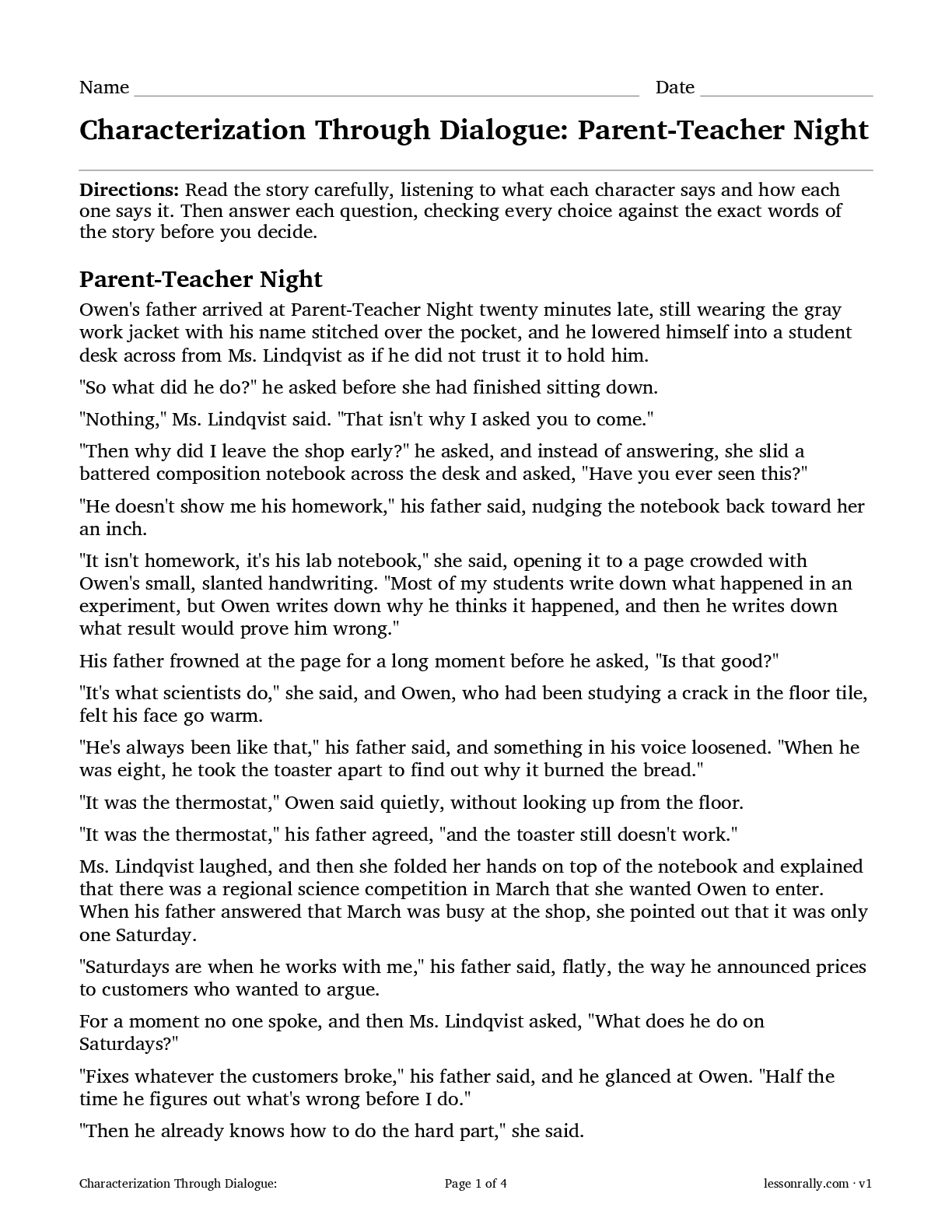
Read the story carefully, listening to what each character says and how each one says it. Then answer each question, checking every choice against the exact words of the story before you decide.

Parent-Teacher Night

Owen's father arrived at Parent-Teacher Night twenty minutes late, still wearing the gray work jacket with his name stitched over the pocket, and he lowered himself into a student desk across from Ms. Lindqvist as if he did not trust it to hold him.

"So what did he do?" he asked before she had finished sitting down.

"Nothing," Ms. Lindqvist said. "That isn't why I asked you to come."

"Then why did I leave the shop early?" he asked, and instead of answering, she slid a battered composition notebook across the desk and asked, "Have you ever seen this?"

"He doesn't show me his homework," his father said, nudging the notebook back toward her an inch.

"It isn't homework, it's his lab notebook," she said, opening it to a page crowded with Owen's small, slanted handwriting. "Most of my students write down what happened in an experiment, but Owen writes down why he thinks it happened, and then he writes down what result would prove him wrong."

His father frowned at the page for a long moment before he asked, "Is that good?"

"It's what scientists do," she said, and Owen, who had been studying a crack in the floor tile, felt his face go warm.

"He's always been like that," his father said, and something in his voice loosened. "When he was eight, he took the toaster apart to find out why it burned the bread."

"It was the thermostat," Owen said quietly, without looking up from the floor.

"It was the thermostat," his father agreed, "and the toaster still doesn't work."

Ms. Lindqvist laughed, and then she folded her hands on top of the notebook and explained that there was a regional science competition in March that she wanted Owen to enter. When his father answered that March was busy at the shop, she pointed out that it was only one Saturday.

"Saturdays are when he works with me," his father said, flatly, the way he announced prices to customers who wanted to argue.

For a moment no one spoke, and then Ms. Lindqvist asked, "What does he do on Saturdays?"

"Fixes whatever the customers broke," his father said, and he glanced at Owen. "Half the time he figures out what's wrong before I do."

"Then he already knows how to do the hard part," she said.

His father was quiet for so long that Owen finally looked up. "When I was his age," his father said, more slowly now, "I built a radio for the science fair, but my father needed me at the shop that Saturday." He turned the notebook a little, as if to see the page better. "I never found out whether it worked."

Then he looked straight at Owen and asked, "You want to do this?" When Owen said yes, his father stood, straightened his jacket and held out his hand to Ms. Lindqvist. "Then the shop can survive one Saturday," he said. "Show me where I sign."


Question 1

In "Parent-Teacher Night," Owen's father asks, "So what did he do?" before Ms. Lindqvist has even finished sitting down. What does this opening line suggest about what he expects from the conference?

Choose one answer.

  • He is eager to hear the teacher praise his son's accomplishments.
  • He has attended many previous conferences with Ms. Lindqvist.
  • He assumes that the teacher has called him in because Owen is in some kind of trouble.
  • He is irritated that the teacher kept him waiting outside the classroom.

Question 2

When the father demands to know what Owen did, Ms. Lindqvist answers, "Nothing," and says that this "isn't why I asked you to come." When he asks why he left the shop early, she slides the notebook across the desk instead of answering and asks, "Have you ever seen this?" How does her way of speaking contrast with his?

Choose one answer.

  • She avoids his question by describing her own teaching methods instead.
  • She remains calm and answers his short, suspicious questions with evidence and a question of her own.
  • She delivers a long lecture, while he remains calm and quiet.
  • She is just as suspicious as he is, so the conversation quickly becomes an argument.

Question 3

Ms. Lindqvist explains that most of her students record only what happened in an experiment, but "Owen writes down why he thinks it happened, and then he writes down what result would prove him wrong." What does this explanation show about her?

Choose one answer.

  • She believes that Owen's experiments are usually unsuccessful.
  • She is complaining that Owen writes unnecessarily long entries in his notebook.
  • She expects the father to supervise Owen's homework every evening.
  • She pays close attention to how Owen thinks, and she supports her point with a specific example from his work.

Question 4

After frowning at the page "for a long moment" the father asks only, "Is that good?" What does this short, plain question reveal about the father?

Choose one answer.

  • He does not know how to evaluate what he is seeing, and he is honest enough to ask.
  • He is criticizing the handwriting in the notebook as too messy.
  • He is mocking the teacher for praising something completely ordinary.
  • He already knows that Owen is the most talented student in the class.

Question 5

When Owen corrects the story with "It was the thermostat," his father repeats the words and adds, "and the toaster still doesn't work." What does this exchange show about the relationship between the father and his son?

Choose one answer.

  • The father is still furious with Owen about the ruined toaster.
  • The father's teasing is affectionate, showing warmth beneath his gruff manner.
  • The father disagrees with Owen's explanation about the thermostat.
  • The father wants the teacher to know that Owen carelessly breaks things.

Question 6

When Ms. Lindqvist points out that the competition takes "only one Saturday" of Owen's time, the father replies that "Saturdays are when he works with me" and says it "flatly, the way he announced prices to customers who wanted to argue." What does this description of his voice suggest?

Choose one answer.

  • He is joking and expects the teacher to laugh at his exaggeration.
  • He is uncertain and is asking the teacher for advice.
  • He is angry with Owen for wanting to enter the competition.
  • He intends the matter to be settled and not open to negotiation.

Question 7

Instead of arguing about the Saturday, Ms. Lindqvist asks, "What does he do on Saturdays?" How does this question move the conversation forward?

Choose one answer.

  • It invites the father to describe Owen's work at the shop, which leads him to reveal how skilled Owen is.
  • It changes the subject so that the father will forget about the competition.
  • It shows that the teacher has abandoned the idea of the competition.
  • It tricks the father into admitting that Owen does not really work on Saturdays.

Question 8

Which two details show, through the way the father speaks, that his attitude is beginning to soften before he makes his decision? Select two.

Choose 2 answers.

  • He asks what Owen did before the teacher has finished sitting down.
  • He says "Saturdays are when he works with me" flatly, like a price.
  • He asks why he had to leave the shop early.
  • When he talks about the toaster, "something in his voice loosened."
  • He speaks "more slowly now" as he begins the story of his radio.

Question 9

The father tells Ms. Lindqvist that when he was Owen's age, "I built a radio for the science fair, but my father needed me at the shop that Saturday." Then he adds, "I never found out whether it worked." What does this story reveal?

Choose one answer.

  • He is bragging that his own project was better than Owen's.
  • He once lost the same kind of chance that Owen is being offered, and the loss still stays with him.
  • He blames Owen for keeping him at the shop on Saturdays.
  • He is warning Owen that science fairs are a waste of time.

Question 10

At the end, the father looks straight at Owen and asks, "You want to do this?" and after Owen says yes, he tells Ms. Lindqvist, "Then the shop can survive one Saturday," and "Show me where I sign." What do these final lines show about him?

Choose one answer.

  • He changes his mind and gives Owen the Saturday that he never had himself, though he says it in his usual blunt, practical way.
  • He is still refusing, but he is too polite to say so directly.
  • He agrees only because the teacher has pressured him into it.
  • He wants Ms. Lindqvist to make the decision for Owen.

Reviews

No reviews yet.

Reviews come from teachers who assigned this activity to a class.

Sign in to write a review

Have a topic of your own? Make a printable worksheet and online quiz, free.

Create an activity

Answer key

Answer keys come with Premium

Print this worksheet with the correct answers marked. The key includes any explanations, sample answers, and rubrics supplied with the activity.

Answer keys aren't public: only teachers with Premium and the people who can edit an activity can download one, so students can't get a ready-to-print key from this page.

Premium includes:

  • No ads for you, and no ads for your students on the assignments you post.
  • Answer keys for printable worksheets, with the correct answers marked and any explanations, sample answers, and rubrics.
  • Create with AI: up to 100 activities a year (5 during the free trial), with every answer checked before you see the draft.

$29 a year, plus sales tax where it applies.

New Premium teachers can try it free for 7 days. A card or other payment method is needed to start. Unless you cancel before the trial ends, you are charged then and the plan renews every year.

Already have Premium or edit this activity? Sign in