Parallel Plots: Two Shifts

12 questions · 12 points · Grades 9–10 · English · Preview the 12 questions

Made by Eleanor Wrenfield · LessonRally (AI-assisted)

Digital classroom activity

What is a digital classroom activity?

Teachers who sign in can assign LessonRally activities to their Google Classroom classes: students open them in Classroom and answer online, and their grades go to the teacher's Classroom gradebook. Practice lets you try it first, the way students see it.

Free for teachers. Sign in to assign activities to your Google Classroom classes.

Printable worksheet

Students read an original two-section short story about two work shifts, a night shift at a diner and a morning shift at a bakery, and analyze parallel plot structure. Questions cover how the sections echo and mirror each other, where the two plot lines meet, and why the author orders the sections as they are. Practice with parallel plots, parallel structure, text structure and story structure.

Learning goal: Analyze how an author's choice to tell a story in parallel sections that echo and mirror each other creates meaning, connection and surprise.

Estimated reading level 8.6

  1. Grade 6Hard
  2. Grade 7Stretch
  3. Grade 8On level
  4. Grade 9Easier
  5. Grade 10Easy
About this estimate

The estimate is the middle score of five readability formulas. Their scores run from 7.3 to 10.7.

  • Flesch-Kincaid Grade Middle scoreSentence length and syllables per word8.6
  • Gunning FogSentence length and words of three or more syllables10.7
  • Coleman-LiauLetters per word and sentences per 100 words7.3
  • Automated Readability IndexCharacters per word and words per sentence9.3
  • SMOGWords of three or more syllables, for texts of 30 sentences or more7.8
Flesch Reading Ease
72.6 on a 0 to 100 scale where higher is easier: fairly easy. Not part of the estimate.
Text measured
2,008 words, 60 sentences

Adapted from common readability formulas (Flesch-Kincaid, Gunning Fog, Coleman-Liau and ARI, plus SMOG for long texts), which look at sentence length and word length. Answer choices count toward word length only. Grades below the estimate will likely find the text harder, grades above it easier. It does not measure ideas, background knowledge or images.

Common Core

Closest anchor: CCRA.R.5 Analyze the structure of texts, including how specific sentences, paragraphs, and larger portions of the text (e.g., a section, chapter, scene, or stanza) relate to each other and the whole.Anchor Standards for ReadingShow 1 matched standardHide matched standard

Matched standard

  • RL.9-10.5

    Analyze how an author's choices concerning how to structure a text, order events within it (e.g., parallel plots), and manipulate time (e.g., pacing, flashbacks) create such effects as mystery, tension, or surprise.

    Student preview questions 1, 6, 7, 12

Matched independently by two AI models from this activity's questions.

© Copyright 2010. National Governors Association Center for Best Practices and Council of Chief State School Officers. All rights reserved.

Topic: Plot and Setting Chosen by LessonRally

Question types: multiple choice, select all that apply.

Student preview

The questions as students see them, without the answers.

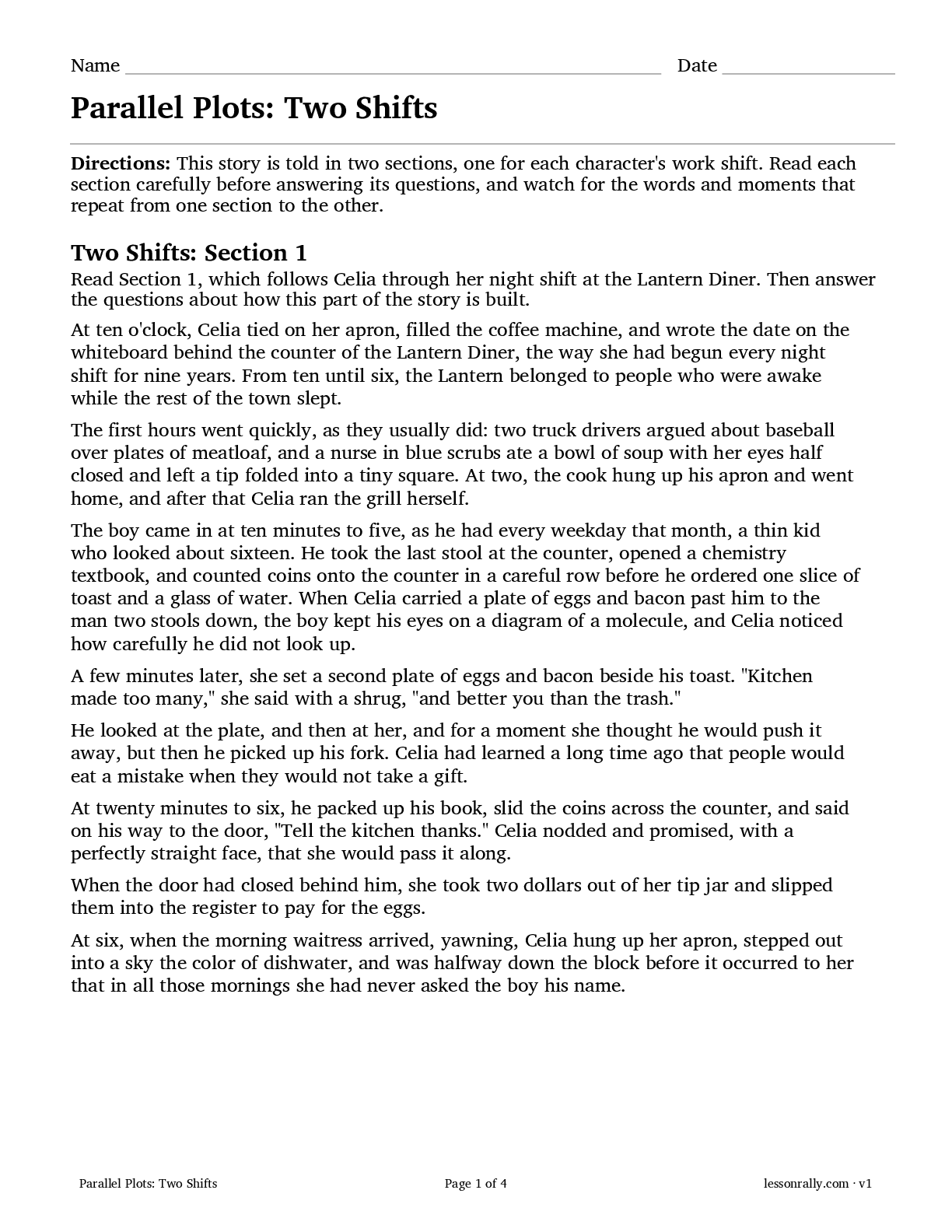
This story is told in two sections, one for each character's work shift. Read each section carefully before answering its questions, and watch for the words and moments that repeat from one section to the other.

Two Shifts: Section 1

Read Section 1, which follows Celia through her night shift at the Lantern Diner. Then answer the questions about how this part of the story is built.

At ten o'clock, Celia tied on her apron, filled the coffee machine, and wrote the date on the whiteboard behind the counter of the Lantern Diner, the way she had begun every night shift for nine years. From ten until six, the Lantern belonged to people who were awake while the rest of the town slept.

The first hours went quickly, as they usually did: two truck drivers argued about baseball over plates of meatloaf, and a nurse in blue scrubs ate a bowl of soup with her eyes half closed and left a tip folded into a tiny square. At two, the cook hung up his apron and went home, and after that Celia ran the grill herself.

The boy came in at ten minutes to five, as he had every weekday that month, a thin kid who looked about sixteen. He took the last stool at the counter, opened a chemistry textbook, and counted coins onto the counter in a careful row before he ordered one slice of toast and a glass of water. When Celia carried a plate of eggs and bacon past him to the man two stools down, the boy kept his eyes on a diagram of a molecule, and Celia noticed how carefully he did not look up.

A few minutes later, she set a second plate of eggs and bacon beside his toast. "Kitchen made too many," she said with a shrug, "and better you than the trash."

He looked at the plate, and then at her, and for a moment she thought he would push it away, but then he picked up his fork. Celia had learned a long time ago that people would eat a mistake when they would not take a gift.

At twenty minutes to six, he packed up his book, slid the coins across the counter, and said on his way to the door, "Tell the kitchen thanks." Celia nodded and promised, with a perfectly straight face, that she would pass it along.

When the door had closed behind him, she took two dollars out of her tip jar and slipped them into the register to pay for the eggs.

At six, when the morning waitress arrived, yawning, Celia hung up her apron, stepped out into a sky the color of dishwater, and was halfway down the block before it occurred to her that in all those mornings she had never asked the boy his name.


Question 1

Section 1 of "Two Shifts" passes over the hours from ten o'clock to two in one short paragraph, then slows down for the boy's visit, which runs from ten minutes to five until twenty minutes to six. What is the effect of this change in pace?

Choose one answer.

  • It shows that Celia considers the boy less interesting than the truck drivers.
  • It hurries through the ordinary customers so that the slowed-down visit stands out as the most significant part of Celia's night.
  • It suggests that nothing worth noticing happens during Celia's entire shift.
  • It shows that the story deliberately skips over the boy's visit to save time.

Question 2

In Section 1, when Celia carries a plate of eggs and bacon past the boy to another customer, he keeps his eyes on a diagram in his textbook, and Celia notices "how carefully he did not look up." What does this detail suggest about the boy?

Choose one answer.

  • The boy dislikes eggs and bacon and finds the smell unpleasant.
  • The boy resents Celia for serving another customer first.
  • The boy is too absorbed in his chemistry textbook to notice the food.
  • The boy is hungry and is deliberately trying not to reveal it.

Question 3

In Section 1, Celia sets a second plate beside the boy's toast and tells him, "Kitchen made too many," with a shrug, adding "and better you than the trash." Why does she present the food as a mistake?

Choose one answer.

  • So that the boy will not complain to anyone that the diner wastes food.
  • So that the boy will order more expensive meals the next time he visits.
  • So that the boy can accept the food without feeling that he is being handed charity.
  • So that the boy will feel obligated to repay Celia with a favor.

Question 4

On his way out of the diner in Section 1, the boy says "Tell the kitchen thanks" to Celia, and she promises, with a perfectly straight face, that she will pass it along. How do these parting words fit the way Celia offered the food?

Choose one answer.

  • The boy's thanks and Celia's promise both go along with the idea that the kitchen made a mistake, so neither of them has to call the food a gift.
  • Celia is promising to warn the cook to stop wasting expensive food.
  • The boy is complaining that the kitchen prepared his food incorrectly.
  • The boy is hinting that he expects the same free meal tomorrow.

Question 5

Which two details from Section 1 reveal that the extra eggs came from Celia herself rather than from a mistake in the kitchen? Select two.

Choose 2 answers.

  • The cook goes home at two, and after that Celia runs the grill herself.
  • Two truck drivers argue about baseball over meatloaf.
  • The boy opens a chemistry textbook at the counter.
  • A nurse leaves a tip folded into a tiny square.
  • After the boy leaves, Celia pays for the eggs with two dollars from her tip jar.

Question 6

Section 1 ends as Celia leaves the diner at six and, halfway down the block, realizes that "in all those mornings she had never asked the boy his name." What is the effect of ending the section with this realization?

Choose one answer.

  • It shows that Celia is completely indifferent to the boy.
  • It leaves an unanswered question about the boy's identity, which makes readers curious about what will come next.
  • It signals that the story is finished and nothing more will happen.
  • It reveals that the boy has been lying about his identity.

Two Shifts: Section 2

Read Section 2, which follows Theo through his morning shift at a bakery. Some questions quote Section 1 so that you can compare the two shifts.

At six o'clock, Theo tied on his apron, washed his hands, and unlocked the front door of Haddad's Bakery, one block down from the Lantern Diner. Mr. Haddad had been baking since three, and the shop smelled of warm bread and cardamom. Theo slid his chemistry textbook under the counter, where it would wait until the morning rush was over.

The first customer had been waiting outside in the cold, an old man in a thin gray coat who studied the rolls in the glass case for a long time without saying anything before he counted coins onto the counter in a careful row. Theo knew that row of coins well, because he had laid out one just like it on the counter of the Lantern that morning.

"Just one roll," the old man said, but Theo put two rolls in the bag. "Oven made too many," he said with a shrug, "and better you than the trash."

The old man looked at the bag, and then at Theo, and for a moment Theo thought he would hand it back, but then he tucked it inside his coat, nodded once, and went out into the gray morning. Theo took a dollar from his own pocket and dropped it into the register, and behind him Mr. Haddad, who missed nothing, said nothing.

At a quarter past six, the bell over the door rang again, and a woman came in with her coat buttoned wrong and her eyes half closed, a name tag from the Lantern Diner still pinned to her collar: CELIA. She asked for a loaf of rye bread to take home, and while she dug through her purse for change, Theo slipped a cinnamon roll into the bag beside the bread.

"Oven made too many," he said again, with the same small shrug.

Celia looked at the bag, and then at the boy, and read the name stitched on his apron: THEO. She saw him drop his own coins into the register, and she pretended, very carefully, not to see.

"Tell the oven thanks," she said.

Question 7

Section 1 opens, "At ten o'clock, Celia tied on her apron," and Section 2 opens, "At six o'clock, Theo tied on his apron," in nearly the same words. What is the effect of beginning both sections this way?

Choose one answer.

  • It shows that Theo and Celia work at the same restaurant.
  • It reveals that Theo has been working all night, just as Celia has.
  • It signals that Theo's shift will run parallel to Celia's, inviting readers to compare the two.
  • It shows that Theo is Celia's son, who learned the routine from her.

Question 8

In Section 2, the old man "counted coins onto the counter in a careful row" before ordering, just as the boy did at the diner in Section 1. How does this echo change Theo's place in the story?

Choose one answer.

  • It puts Theo behind the counter, facing someone in the same situation he was in earlier that morning, so the two shifts mirror each other.
  • It shows that the old man is Theo's grandfather.
  • It shows that Theo is annoyed by customers who pay with coins.
  • It suggests that Theo does not trust the old man to pay the right amount.

Question 9

In Section 2, Theo puts two rolls in the old man's bag and says, "Oven made too many," adding "and better you than the trash" with a shrug, almost exactly as Celia did when she told the boy "Kitchen made too many" in Section 1. What does this echo reveal about Theo?

Choose one answer.

  • He believes the bakery really does make too many rolls every morning.
  • He has adopted Celia's way of disguising a gift as a mistake, and now he uses it to help someone else.
  • He wants the old man to return so that he can sell him more expensive bread.
  • He is mocking Celia by imitating what she said.

Question 10

Section 1 ends with Celia realizing that she "had never asked the boy his name"; in Section 2, she comes into the bakery wearing a name tag that says CELIA and reads the name THEO stitched on his apron. How does this moment connect the two sections?

Choose one answer.

  • It suggests that the two will never see each other again.
  • It reveals that Celia and Theo are secretly related.
  • It shows that Celia has forgotten the boy completely.
  • It answers the question left open at the end of Section 1, now that Celia has stepped into Theo's shift just as he stepped into hers.

Question 11

In Section 1, the boy says "Tell the kitchen thanks" on his way out of the diner, and at the very end of Section 2, Celia says, "Tell the oven thanks," to Theo. What is the effect of ending the story with this line?

Choose one answer.

  • It reveals that Celia plans to complain about the bakery's oven.
  • It suggests that Celia disapproves of Theo giving away the bakery's food.
  • It shows that the roles have reversed: the person who gave the gift now receives one, and she plays along just as the boy did at the diner.
  • It shows that Celia has misunderstood what Theo meant.

Question 12

The author tells Celia's night shift in Section 1 and Theo's morning shift in Section 2. Why does this order matter to the way the story ends?

Choose one answer.

  • It lets readers see where the words "made too many" come from, so they recognize them when Theo repeats them and understand the reversal at the end.
  • It shows that Theo's shift is more important than Celia's.
  • It lets readers learn Theo's name before Celia's.
  • It hides from readers that the diner and the bakery are close together.

Reviews

No reviews yet.

Reviews come from teachers who assigned this activity to a class.

Sign in to write a review

Have a topic of your own? Make a printable worksheet and online quiz, free.

Create an activity

Answer key

Answer keys come with Premium

Print this worksheet with the correct answers marked. The key includes any explanations, sample answers, and rubrics supplied with the activity.

Answer keys aren't public: only teachers with Premium and the people who can edit an activity can download one, so students can't get a ready-to-print key from this page.

Premium includes:

  • No ads for you, and no ads for your students on the assignments you post.
  • Answer keys for printable worksheets, with the correct answers marked and any explanations, sample answers, and rubrics.
  • Create with AI: up to 100 activities a year (5 during the free trial), with every answer checked before you see the draft.

$29 a year, plus sales tax where it applies.

New Premium teachers can try it free for 7 days. A card or other payment method is needed to start. Unless you cancel before the trial ends, you are charged then and the plan renews every year.

Already have Premium or edit this activity? Sign in