An Unreliable Narrator: I Was Only Borrowing It

10 questions · 10 points · Grades 9–10 · English · Preview the 10 questions

Made by Eleanor Wrenfield · LessonRally (AI-assisted)

Digital classroom activity

What is a digital classroom activity?

Teachers who sign in can assign LessonRally activities to their Google Classroom classes: students open them in Classroom and answer online, and their grades go to the teacher's Classroom gradebook. Practice lets you try it first, the way students see it.

Free for teachers. Sign in to assign activities to your Google Classroom classes.

Printable worksheet

Students read an original short story told by a first-person narrator whose account they learn to doubt. They find the details that undercut him, tell what the story states explicitly from what readers can infer, and see how other characters' words and actions reveal the gap. Practice with unreliable narrators, point of view, inference and textual evidence.

Learning goal: Cite textual evidence to analyze what a first-person narrator states explicitly and what readers can infer, and explain how details and other characters reveal the narrator's unreliability.

Estimated reading level 7.5

  1. Grade 5Hard
  2. Grade 6Stretch
  3. Grade 7On level
  4. Grade 8Easier
  5. Grade 9Easy
About this estimate

The estimate is the middle score of five readability formulas. Their scores run from 6.8 to 10.3.

  • Flesch-Kincaid GradeSentence length and syllables per word6.9
  • Gunning FogSentence length and words of three or more syllables10.3
  • Coleman-Liau Middle scoreLetters per word and sentences per 100 words7.5
  • Automated Readability IndexCharacters per word and words per sentence6.8
  • SMOGWords of three or more syllables, for texts of 30 sentences or more9.8
Flesch Reading Ease
74.5 on a 0 to 100 scale where higher is easier: fairly easy. Not part of the estimate.
Text measured
1,401 words, 53 sentences

Adapted from common readability formulas (Flesch-Kincaid, Gunning Fog, Coleman-Liau and ARI, plus SMOG for long texts), which look at sentence length and word length. Answer choices count toward word length only. Grades below the estimate will likely find the text harder, grades above it easier. It does not measure ideas, background knowledge or images.

Common Core

Closest anchor: CCRA.R.1 Read closely to determine what the text says explicitly and to make logical inferences from it; cite specific textual evidence when writing or speaking to support conclusions drawn from the text.Anchor Standards for ReadingShow 1 matched standardHide matched standard

Matched standard

  • RL.9-10.1

    Cite strong and thorough textual evidence to support analysis of what the text says explicitly as well as inferences drawn from the text.

    Student preview questions 1, 2, 5, 6

Matched independently by two AI models from this activity's questions.

© Copyright 2010. National Governors Association Center for Best Practices and Council of Chief State School Officers. All rights reserved.

Topics: Point of View, Citing Text Evidence, Making Inferences Chosen by LessonRally

Question types: multiple choice, select all that apply.

Student preview

The questions as students see them, without the answers.

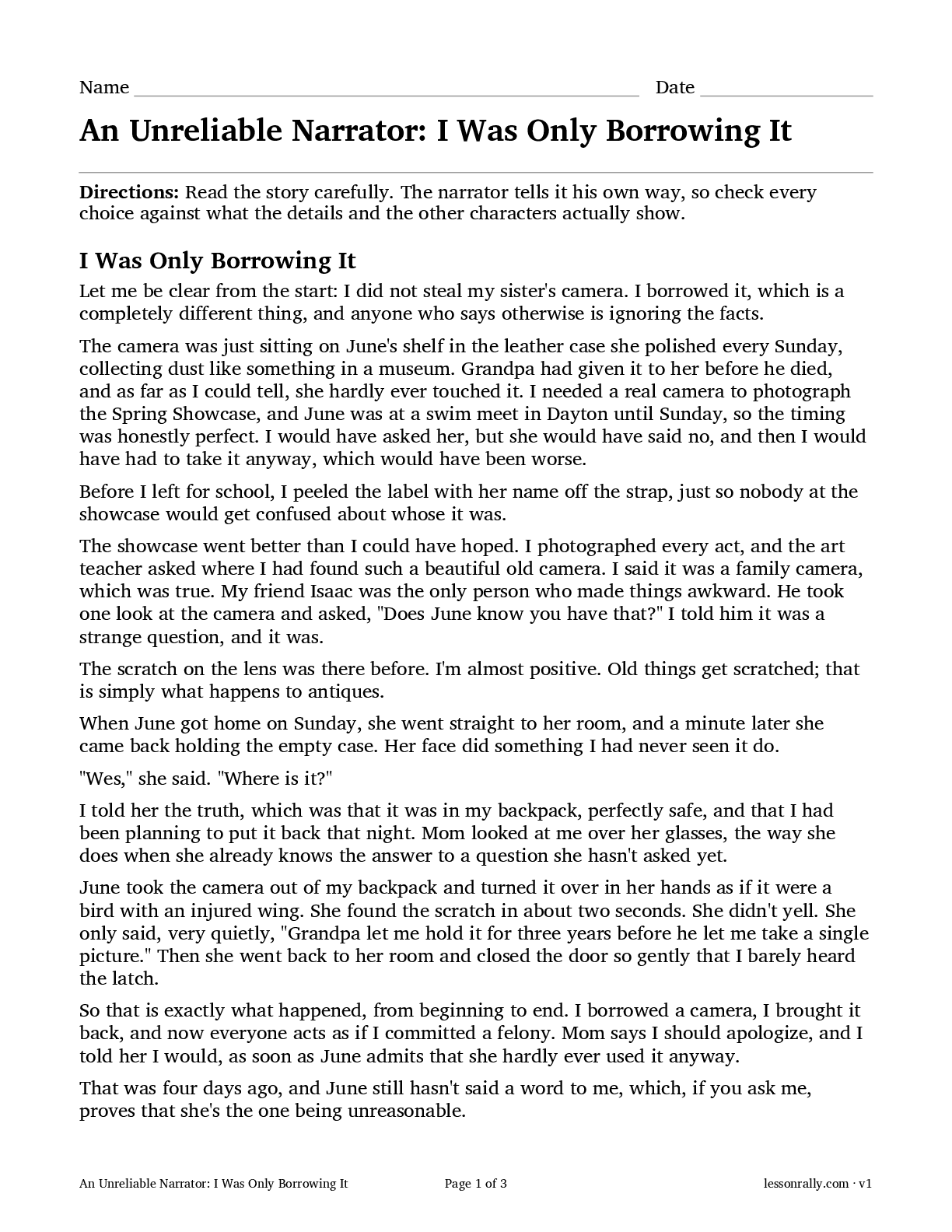
Read the story carefully. The narrator tells it his own way, so check every choice against what the details and the other characters actually show.

I Was Only Borrowing It

Let me be clear from the start: I did not steal my sister's camera. I borrowed it, which is a completely different thing, and anyone who says otherwise is ignoring the facts.

The camera was just sitting on June's shelf in the leather case she polished every Sunday, collecting dust like something in a museum. Grandpa had given it to her before he died, and as far as I could tell, she hardly ever touched it. I needed a real camera to photograph the Spring Showcase, and June was at a swim meet in Dayton until Sunday, so the timing was honestly perfect. I would have asked her, but she would have said no, and then I would have had to take it anyway, which would have been worse.

Before I left for school, I peeled the label with her name off the strap, just so nobody at the showcase would get confused about whose it was.

The showcase went better than I could have hoped. I photographed every act, and the art teacher asked where I had found such a beautiful old camera. I said it was a family camera, which was true. My friend Isaac was the only person who made things awkward. He took one look at the camera and asked, "Does June know you have that?" I told him it was a strange question, and it was.

The scratch on the lens was there before. I'm almost positive. Old things get scratched; that is simply what happens to antiques.

When June got home on Sunday, she went straight to her room, and a minute later she came back holding the empty case. Her face did something I had never seen it do.

"Wes," she said. "Where is it?"

I told her the truth, which was that it was in my backpack, perfectly safe, and that I had been planning to put it back that night. Mom looked at me over her glasses, the way she does when she already knows the answer to a question she hasn't asked yet.

June took the camera out of my backpack and turned it over in her hands as if it were a bird with an injured wing. She found the scratch in about two seconds. She didn't yell. She only said, very quietly, "Grandpa let me hold it for three years before he let me take a single picture." Then she went back to her room and closed the door so gently that I barely heard the latch.

So that is exactly what happened, from beginning to end. I borrowed a camera, I brought it back, and now everyone acts as if I committed a felony. Mom says I should apologize, and I told her I would, as soon as June admits that she hardly ever used it anyway.

That was four days ago, and June still hasn't said a word to me, which, if you ask me, proves that she's the one being unreasonable.


Question 1

Which of these does the narrator of "I Was Only Borrowing It" state directly, instead of leaving it for readers to infer from other details?

Choose one answer.

  • He peeled the label with June's name off the camera strap.
  • Mom does not believe his version of events.
  • He caused the scratch on the camera's lens.
  • June no longer trusts him.

Question 2

Which quotation best shows that the narrator understood, before he ever took the camera, that his sister would refuse to lend it to him?

Choose one answer.

  • "I told her the truth, which was that it was in my backpack, perfectly safe, and that I had been planning to put it back that night."
  • "The camera was just sitting on June's shelf in the leather case she polished every Sunday, collecting dust like something in a museum."
  • "I would have asked her, but she would have said no, and then I would have had to take it anyway, which would have been worse."
  • "Before I left for school, I peeled the label with her name off the strap, just so nobody at the showcase would get confused about whose it was."

Question 3

The narrator claims the camera was "collecting dust" and that June "hardly ever touched it." Yet he also describes the camera as sitting in "the leather case she polished every Sunday" on her shelf. What does this detail suggest about the reliability of his claims?

Choose one answer.

  • June polishes the case only because Grandpa instructed her to.
  • June is secretly planning to sell the camera.
  • The camera really was covered in thick dust when he borrowed it.
  • June takes regular, careful care of the camera, so his picture of it as forgotten is unreliable.

Question 4

The narrator says he peeled off June's name label "just so nobody at the showcase would get confused about whose it was." What does this detail reveal about his motives that the narrator himself does not admit?

Choose one answer.

  • He intended to replace the label with a more attractive one.
  • He wanted to make sure nobody mixed up his camera with someone else's.
  • He was worried that the label would be damaged at the showcase.
  • He did not want anyone at the showcase to know that the camera was June's.

Question 5

At the showcase, Isaac takes one look at the camera and asks, "Does June know you have that?" What does his question suggest about how the situation looks to an outsider?

Choose one answer.

  • Isaac is concerned that June will miss her swimming competition.
  • Isaac thinks the narrator's photographs are better than June's.
  • Even a friend recognizes the camera as June's and doubts that the narrator had permission.
  • Isaac wants to borrow the camera for himself.

Question 6

The narrator insists that the scratch on the lens "was there before." Then he adds, "I'm almost positive." How does the word "almost" affect what readers can reasonably conclude about the scratch?

Choose one answer.

  • It shows that he is not truly sure, which gives readers reason to doubt his claim.
  • It shows that June was the one who scratched it.
  • It proves that he scratched the lens himself.
  • It demonstrates that he has evidence the scratch already existed.

Question 7

When the narrator explains where the camera is, Mom looks at him "over her glasses, the way she does when she already knows the answer to a question she hasn't asked yet." What does her reaction suggest about how she views his explanation?

Choose one answer.

  • She is irritated with June for leaving the camera unprotected.
  • She is genuinely confused about where the camera is.
  • She completely accepts that he did nothing wrong.
  • She suspects that his version of events leaves out the truth.

Question 8

June says, very quietly, "Grandpa let me hold it for three years before he let me take a single picture." What gap does this line reveal between the way June and the narrator see the camera?

Choose one answer.

  • June is explaining that the camera is too old to take pictures.
  • June is bragging that Grandpa liked her more than the narrator.
  • To June, the camera is a trust she had to earn, while the narrator treated it as something to grab and use.
  • June thinks she takes better pictures than the narrator does.

Question 9

Which two details from the scene after June discovers that the camera is missing show that she is deeply hurt, not just angry? Select two.

Choose 2 answers.

  • "When June got home on Sunday, she went straight to her room, and a minute later she came back holding the empty case."
  • "June took the camera out of my backpack and turned it over in her hands as if it were a bird with an injured wing."
  • "Mom says I should apologize, and I told her I would, as soon as June admits that she hardly ever used it anyway."
  • "Then she went back to her room and closed the door so gently that I barely heard the latch."
  • "She found the scratch in about two seconds."

Question 10

The story ends, "June still hasn't said a word to me, which, if you ask me, proves that she's the one being unreasonable." How does this final sentence affect the reader's opinion of the narrator's reliability?

Choose one answer.

  • His self-serving reasoning makes readers trust his judgment even less.
  • It convinces readers that June is being unreasonable.
  • It reveals that June has already forgiven him.
  • It shows that the narrator finally understands June's feelings.

Reviews

No reviews yet.

Reviews come from teachers who assigned this activity to a class.

Sign in to write a review

Have a topic of your own? Make a printable worksheet and online quiz, free.

Create an activity

Answer key

Answer keys come with Premium

Print this worksheet with the correct answers marked. The key includes any explanations, sample answers, and rubrics supplied with the activity.

Answer keys aren't public: only teachers with Premium and the people who can edit an activity can download one, so students can't get a ready-to-print key from this page.

Premium includes:

  • No ads for you, and no ads for your students on the assignments you post.
  • Answer keys for printable worksheets, with the correct answers marked and any explanations, sample answers, and rubrics.
  • Create with AI: up to 100 activities a year (5 during the free trial), with every answer checked before you see the draft.

$29 a year, plus sales tax where it applies.

New Premium teachers can try it free for 7 days. A card or other payment method is needed to start. Unless you cancel before the trial ends, you are charged then and the plan renews every year.

Already have Premium or edit this activity? Sign in