A Narrator's Point of View: The New Kid Tells It

8 questions · 8 points · Grade 6 · English · Preview the 8 questions

Made by Claire Fenwood · LessonRally (AI-assisted)

Digital classroom activity

What is a digital classroom activity?

Teachers who sign in can assign LessonRally activities to their Google Classroom classes: students open them in Classroom and answer online, and their grades go to the teacher's Classroom gradebook. Practice lets you try it first, the way students see it.

Free for teachers. Sign in to assign activities to your Google Classroom classes.

Printable worksheet

Students read an original short scene told by a new student at lunch on the first day at a new school. They identify the point of view as first person, explain how the narrator's thoughts, worries and word choices shape the story, and decide what would change if another character were the narrator.

Learning goal: Identify a narrator's point of view and explain how the author develops it through the narrator's thoughts, word choices and limited knowledge.

Estimated reading level 6.4

  1. Grade 4Hard
  2. Grade 5Stretch
  3. Grade 6On level
  4. Grade 7Easier
  5. Grade 8Easy
About this estimate

The estimate is the middle score of five readability formulas. Their scores run from 4.5 to 7.5.

  • Flesch-Kincaid GradeSentence length and syllables per word4.6
  • Gunning FogSentence length and words of three or more syllables7.5
  • Coleman-Liau Middle scoreLetters per word and sentences per 100 words6.4
  • Automated Readability IndexCharacters per word and words per sentence4.5
  • SMOGWords of three or more syllables, for texts of 30 sentences or more7.5
Flesch Reading Ease
84.2 on a 0 to 100 scale where higher is easier: easy. Not part of the estimate.
Text measured
792 words, 37 sentences

Adapted from common readability formulas (Flesch-Kincaid, Gunning Fog, Coleman-Liau and ARI, plus SMOG for long texts), which look at sentence length and word length. Answer choices count toward word length only. Grades below the estimate will likely find the text harder, grades above it easier. It does not measure ideas, background knowledge or images.

Common Core

Closest anchor: CCRA.R.6 Assess how point of view or purpose shapes the content and style of a text.Anchor Standards for ReadingShow 3 matched standardsHide matched standards

Matched standards

  • RL.6.6

    Explain how an author develops the point of view of the narrator or speaker in a text.

    Student preview questions 2, 5, 6, 7

  • RL.6.3

    Describe how a particular story's or drama's plot unfolds in a series of episodes as well as how the characters respond or change as the plot moves toward a resolution.

    Student preview question 8

  • RL.6.4

    Determine the meaning of words and phrases as they are used in a text, including figurative and connotative meanings; analyze the impact of a specific word choice on meaning and tone

    Student preview question 3

Matched independently by two AI models from this activity's questions.

© Copyright 2010. National Governors Association Center for Best Practices and Council of Chief State School Officers. All rights reserved.

Topic: Point of View Chosen by LessonRally

Question types: multiple choice, select all that apply.

Student preview

The questions as students see them, without the answers.

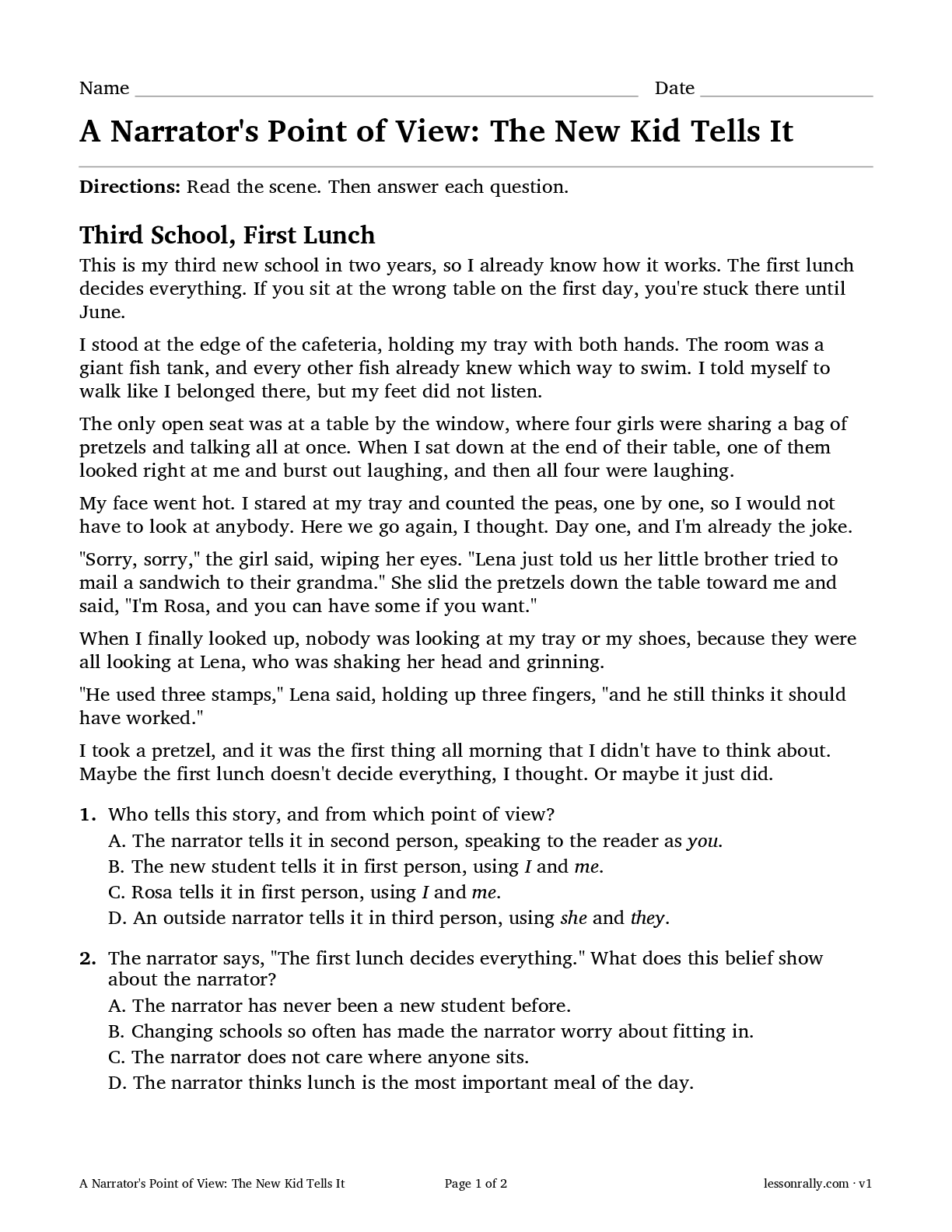
Read the scene. Then answer each question.

Third School, First Lunch

This is my third new school in two years, so I already know how it works. The first lunch decides everything. If you sit at the wrong table on the first day, you're stuck there until June.

I stood at the edge of the cafeteria, holding my tray with both hands. The room was a giant fish tank, and every other fish already knew which way to swim. I told myself to walk like I belonged there, but my feet did not listen.

The only open seat was at a table by the window, where four girls were sharing a bag of pretzels and talking all at once. When I sat down at the end of their table, one of them looked right at me and burst out laughing, and then all four were laughing.

My face went hot. I stared at my tray and counted the peas, one by one, so I would not have to look at anybody. Here we go again, I thought. Day one, and I'm already the joke.

"Sorry, sorry," the girl said, wiping her eyes. "Lena just told us her little brother tried to mail a sandwich to their grandma." She slid the pretzels down the table toward me and said, "I'm Rosa, and you can have some if you want."

When I finally looked up, nobody was looking at my tray or my shoes, because they were all looking at Lena, who was shaking her head and grinning.

"He used three stamps," Lena said, holding up three fingers, "and he still thinks it should have worked."

I took a pretzel, and it was the first thing all morning that I didn't have to think about. Maybe the first lunch doesn't decide everything, I thought. Or maybe it just did.


Question 1

Who tells this story, and from which point of view?

Choose one answer.

  • Rosa tells it in first person, using I and me.
  • The new student tells it in first person, using I and me.
  • An outside narrator tells it in third person, using she and they.
  • The narrator tells it in second person, speaking to the reader as you.

Question 2

The narrator says, "The first lunch decides everything." What does this belief show about the narrator?

Choose one answer.

  • The narrator thinks lunch is the most important meal of the day.
  • Changing schools so often has made the narrator worry about fitting in.
  • The narrator does not care where anyone sits.
  • The narrator has never been a new student before.

Question 3

Read this sentence from the scene: "The room was a giant fish tank, and every other fish already knew which way to swim." What does it reveal about how the narrator sees the cafeteria?

Choose one answer.

  • The cafeteria smells like fish and needs to be cleaned.
  • The cafeteria has a large fish tank by the window.
  • The narrator feels calm, like a fish floating in water.
  • Everyone else seems to know where to go, but the narrator feels lost.

Question 4

Which two details show how uncomfortable the narrator feels when the girls start laughing? Select two.

Choose 2 answers.

  • "I took a pretzel"
  • "I stared at my tray and counted the peas"
  • "they were all looking at Lena, who was shaking her head and grinning"
  • "four girls were sharing a bag of pretzels"
  • "My face went hot."

Question 5

Which words from the scene tell the narrator's thoughts instead of describing an action?

Choose one answer.

  • "Here we go again, I thought."
  • "When I finally looked up"
  • "I stood at the edge of the cafeteria, holding my tray with both hands."
  • "I took a pretzel"

Question 6

When the girls laugh, the narrator thinks, "Day one, and I'm already the joke." What does the rest of the scene show about this thought?

Choose one answer.

  • It was right, because Rosa tells the narrator to find another seat.
  • It was wrong, because the girls were laughing at Lena's story.
  • It was wrong, because the girls were laughing at a video on a phone.
  • It was right, because the girls were laughing at the narrator's shoes.

Question 7

Suppose Rosa told this scene instead of the new student. What would the reader find out sooner?

Choose one answer.

  • What the new student was thinking while counting the peas
  • Which table the new student will sit at in June
  • Why the new student's family keeps moving
  • Why the four girls burst out laughing

Question 8

The scene ends: "Maybe the first lunch doesn't decide everything, I thought. Or maybe it just did." How does this ending fit with the rest of the scene?

Choose one answer.

  • It shows that the narrator is sure another move is coming soon.
  • It shows that the narrator still feels like the joke of the table.
  • It shows the narrator starting to feel hopeful after expecting the worst.
  • It shows that the narrator plans to sit somewhere else tomorrow.

Reviews

No reviews yet.

Reviews come from teachers who assigned this activity to a class.

Sign in to write a review

Have a topic of your own? Make a printable worksheet and online quiz, free.

Create an activity

Answer key

Answer keys come with Premium

Print this worksheet with the correct answers marked. The key includes any explanations, sample answers, and rubrics supplied with the activity.

Answer keys aren't public: only teachers with Premium and the people who can edit an activity can download one, so students can't get a ready-to-print key from this page.

Premium includes:

  • No ads for you, and no ads for your students on the assignments you post.
  • Answer keys for printable worksheets, with the correct answers marked and any explanations, sample answers, and rubrics.
  • Create with AI: up to 100 activities a year (5 during the free trial), with every answer checked before you see the draft.

$29 a year, plus sales tax where it applies.

New Premium teachers can try it free for 7 days. A card or other payment method is needed to start. Unless you cancel before the trial ends, you are charged then and the plan renews every year.

Already have Premium or edit this activity? Sign in