How a Narrator's Point of View Shapes a Story and Theme: The Day the Power Went Out

7 questions · 7 points · Grade 5 · English · Preview the 7 questions

Made by Andre Whitaker · LessonRally (AI-assisted)

Digital classroom activity

What is a digital classroom activity?

Teachers who sign in can assign LessonRally activities to their Google Classroom classes: students open them in Classroom and answer online, and their grades go to the teacher's Classroom gradebook. Practice lets you try it first, the way students see it.

Free for teachers. Sign in to assign activities to your Google Classroom classes.

Printable worksheet

Students read an original short story narrated by a girl whose house loses power on a Saturday afternoon. They choose the theme, choose the detail the story gives for each of two ideas, select two details that show a change and answer three questions on how the narrator's point of view shapes the way events are presented. Grade 5 reading comprehension practice on a narrator's point of view.

Learning goal: Describe how a narrator's point of view influences the way events in a story are described.

Estimated reading level 4.8

  1. Grade 2Hard
  2. Grade 3Stretch
  3. Grade 4On level
  4. Grade 5Easier
  5. Grade 6Easy
About this estimate

The estimate is the middle score of five readability formulas. Their scores run from 2.3 to 6.4.

  • Flesch-Kincaid GradeSentence length and syllables per word2.5
  • Gunning Fog Middle scoreSentence length and words of three or more syllables4.8
  • Coleman-LiauLetters per word and sentences per 100 words4.8
  • Automated Readability IndexCharacters per word and words per sentence2.3
  • SMOGWords of three or more syllables, for texts of 30 sentences or more6.4
Flesch Reading Ease
93.3 on a 0 to 100 scale where higher is easier: very easy. Not part of the estimate.
Text measured
627 words, 42 sentences

Adapted from common readability formulas (Flesch-Kincaid, Gunning Fog, Coleman-Liau and ARI, plus SMOG for long texts), which look at sentence length and word length. Answer choices count toward word length only. Grades below the estimate will likely find the text harder, grades above it easier. It does not measure ideas, background knowledge or images.

Common Core

Closest anchor: CCRA.R.6 Assess how point of view or purpose shapes the content and style of a text.Anchor Standards for ReadingShow 2 matched standardsHide matched standards

Matched standards

  • RL.5.6

    Describe how a narrator's or speaker's point of view influences how events are described.

    Student preview questions 2, 3, 4, 6, 7

  • RL.5.2

    Determine a theme of a story, drama, or poem from details in the text, including how characters in a story or drama respond to challenges or how the speaker in a poem reflects upon a topic; summarize the text.

    Student preview question 1

Matched independently by two AI models from this activity's questions.

© Copyright 2010. National Governors Association Center for Best Practices and Council of Chief State School Officers. All rights reserved.

Topics: Point of View, Theme, Characterization Chosen by LessonRally

Question types: multiple choice, select all that apply.

Student preview

The questions as students see them, without the answers.

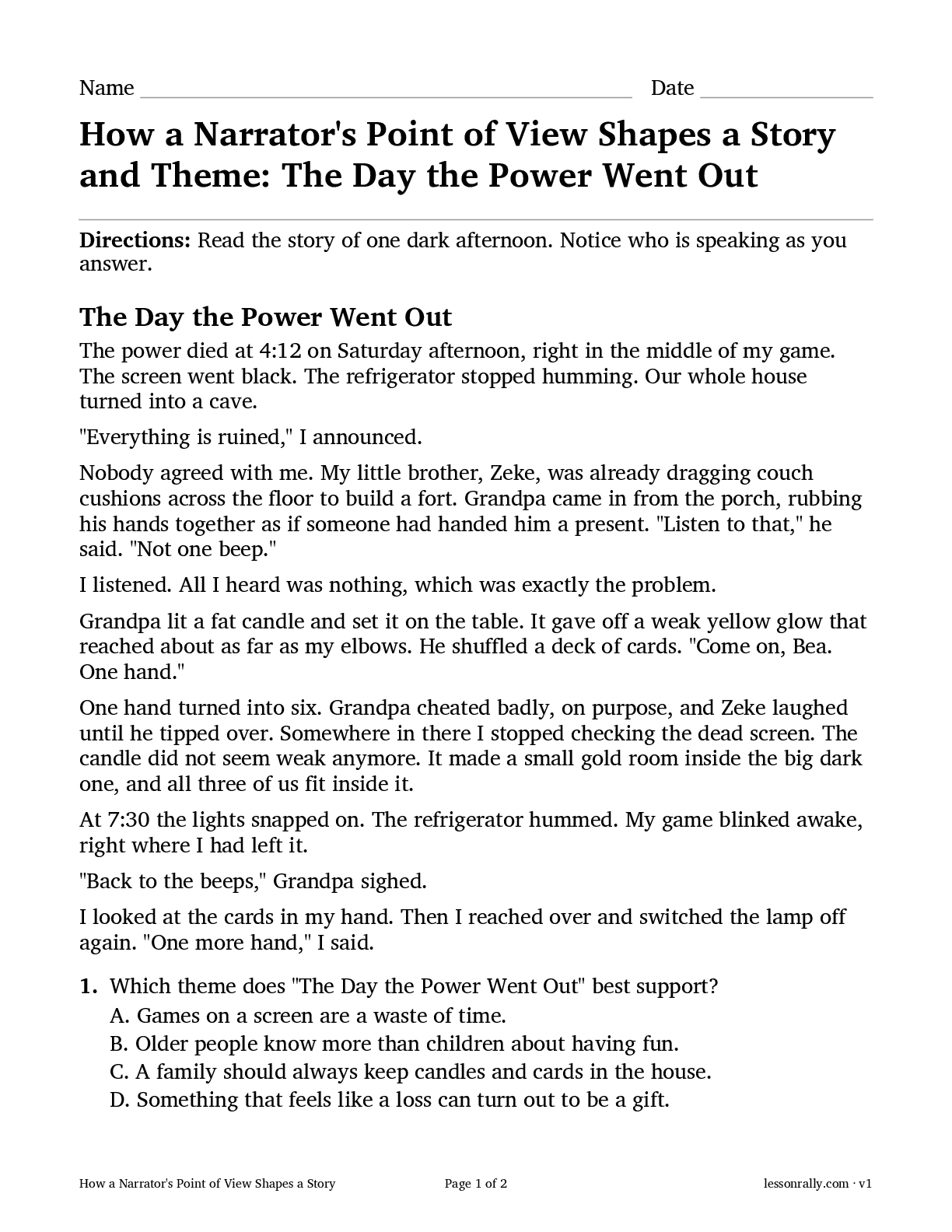
Read the story of one dark afternoon. Notice who is speaking as you answer.

The Day the Power Went Out

The power died at 4:12 on Saturday afternoon, right in the middle of my game. The screen went black. The refrigerator stopped humming. Our whole house turned into a cave.

"Everything is ruined," I announced.

Nobody agreed with me. My little brother, Zeke, was already dragging couch cushions across the floor to build a fort. Grandpa came in from the porch, rubbing his hands together as if someone had handed him a present. "Listen to that," he said. "Not one beep."

I listened. All I heard was nothing, which was exactly the problem.

Grandpa lit a fat candle and set it on the table. It gave off a weak yellow glow that reached about as far as my elbows. He shuffled a deck of cards. "Come on, Bea. One hand."

One hand turned into six. Grandpa cheated badly, on purpose, and Zeke laughed until he tipped over. Somewhere in there I stopped checking the dead screen. The candle did not seem weak anymore. It made a small gold room inside the big dark one, and all three of us fit inside it.

At 7:30 the lights snapped on. The refrigerator hummed. My game blinked awake, right where I had left it.

"Back to the beeps," Grandpa sighed.

I looked at the cards in my hand. Then I reached over and switched the lamp off again. "One more hand," I said.


Question 1

Which theme does "The Day the Power Went Out" best support?

Choose one answer.

  • Games on a screen are a waste of time.
  • A family should always keep candles and cards in the house.
  • Something that feels like a loss can turn out to be a gift.
  • Older people know more than children about having fun.

Question 2

Bea is upset when the power dies, and her words make the outage sound huge. Which detail from the story shows her doing this?

Choose one answer.

  • She says the outage lasted a hundred years.
  • She says the candle was as bright as the sun.
  • She says the whole house turned into a cave.
  • She says the fort filled the whole room.

Question 3

At first, Grandpa does not see the outage the way Bea does. Which detail does the story give to show the difference?

Choose one answer.

  • He says he has waited all week long for a big storm.
  • He rubs his hands together as if he had been handed a present.
  • He says that screens are bad for a young person's eyes.
  • He unplugs the refrigerator so that it will stay quiet.

Question 4

How does Bea describe the candle's light when Grandpa first lights it, and what does that show?

Choose one answer.

  • She calls it blinding, which shows she is ready for bed.
  • She calls it weak, which shows she still wants the power back.
  • She calls it cozy, which shows she has forgotten her game.
  • She calls it weak, which shows she is afraid of the dark.

Question 5

By the end, Bea sees the outage in a new way. Which two details from the story show the change? Select two.

Choose 2 answers.

  • She builds a fort with Zeke.
  • She asks Grandpa to fix the lights.
  • She switches the lamp off again.
  • She hides the deck of cards.
  • She stops checking the dead screen.

Question 6

How would the first part of the story most likely sound if Grandpa were the one narrating it?

Choose one answer.

  • The dark would sound like a punishment.
  • The quiet would sound like a treat.
  • The quiet would sound like a danger.
  • The cards would sound like a chore.

Question 7

Because Bea narrates the story, what must a reader work out from clues?

Choose one answer.

  • what time the power went out
  • what Bea hears when she stops to listen
  • what Zeke builds on the floor
  • what Grandpa and Zeke are thinking

Reviews

No reviews yet.

Reviews come from teachers who assigned this activity to a class.

Sign in to write a review

Have a topic of your own? Make a printable worksheet and online quiz, free.

Create an activity

Answer key

Answer keys come with Premium

Print this worksheet with the correct answers marked. The key includes any explanations, sample answers, and rubrics supplied with the activity.

Answer keys aren't public: only teachers with Premium and the people who can edit an activity can download one, so students can't get a ready-to-print key from this page.

Premium includes:

  • No ads for you, and no ads for your students on the assignments you post.
  • Answer keys for printable worksheets, with the correct answers marked and any explanations, sample answers, and rubrics.
  • Create with AI: up to 100 activities a year (5 during the free trial), with every answer checked before you see the draft.

$29 a year, plus sales tax where it applies.

New Premium teachers can try it free for 7 days. A card or other payment method is needed to start. Unless you cancel before the trial ends, you are charged then and the plan renews every year.

Already have Premium or edit this activity? Sign in