An Author's Points, Reasons and Evidence: Should Recess Be Longer?

7 questions · 9 points · Grade 5 · English · Preview the 7 questions

Made by Andre Whitaker · LessonRally (AI-assisted)

Digital classroom activity

What is a digital classroom activity?

Teachers who sign in can assign LessonRally activities to their Google Classroom classes: students open them in Classroom and answer online, and their grades go to the teacher's Classroom gradebook. Practice lets you try it first, the way students see it.

Free for teachers. Sign in to assign activities to your Google Classroom classes.

Printable worksheet

Students read an original opinion passage that argues for a longer school recess. They choose the author's main idea, match three reasons to their support, choose the detail the author gives for each of two points, select two details that come from one study and answer two questions on how the author builds the argument. Grade 5 reading comprehension practice on an author's points, reasons and evidence.

Learning goal: Explain how an author uses reasons and evidence to support points, matching each reason to its support.

Estimated reading level 5.0

  1. Grade 3Hard
  2. Grade 4Stretch
  3. Grade 5On level
  4. Grade 6Easier
  5. Grade 7Easy
About this estimate

The estimate is the middle score of five readability formulas. Their scores run from 4.0 to 6.8.

  • Flesch-Kincaid GradeSentence length and syllables per word4.0
  • Gunning Fog Middle scoreSentence length and words of three or more syllables5.0
  • Coleman-LiauLetters per word and sentences per 100 words6.8
  • Automated Readability IndexCharacters per word and words per sentence4.5
  • SMOGWords of three or more syllables, for texts of 30 sentences or more5.2
Flesch Reading Ease
86.0 on a 0 to 100 scale where higher is easier: easy. Not part of the estimate.
Text measured
694 words, 37 sentences

Adapted from common readability formulas (Flesch-Kincaid, Gunning Fog, Coleman-Liau and ARI, plus SMOG for long texts), which look at sentence length and word length. Answer choices count toward word length only. Grades below the estimate will likely find the text harder, grades above it easier. It does not measure ideas, background knowledge or images.

Common Core

Closest anchor: CCRA.R.8 Delineate and evaluate the argument and specific claims in a text, including the validity of the reasoning as well as the relevance and sufficiency of the evidence.Anchor Standards for ReadingShow 1 matched standardHide matched standard

Matched standard

  • RI.5.8

    Explain how an author uses reasons and evidence to support particular points in a text, identifying which reasons and evidence support which point(s).

    Student preview questions 2, 3, 5

Matched independently by two AI models from this activity's questions.

© Copyright 2010. National Governors Association Center for Best Practices and Council of Chief State School Officers. All rights reserved.

Topics: Author's Claims and Evidence, Main Idea and Key Details Chosen by LessonRally

Question types: multiple choice, matching, select all that apply.

Student preview

The questions as students see them, without the answers.

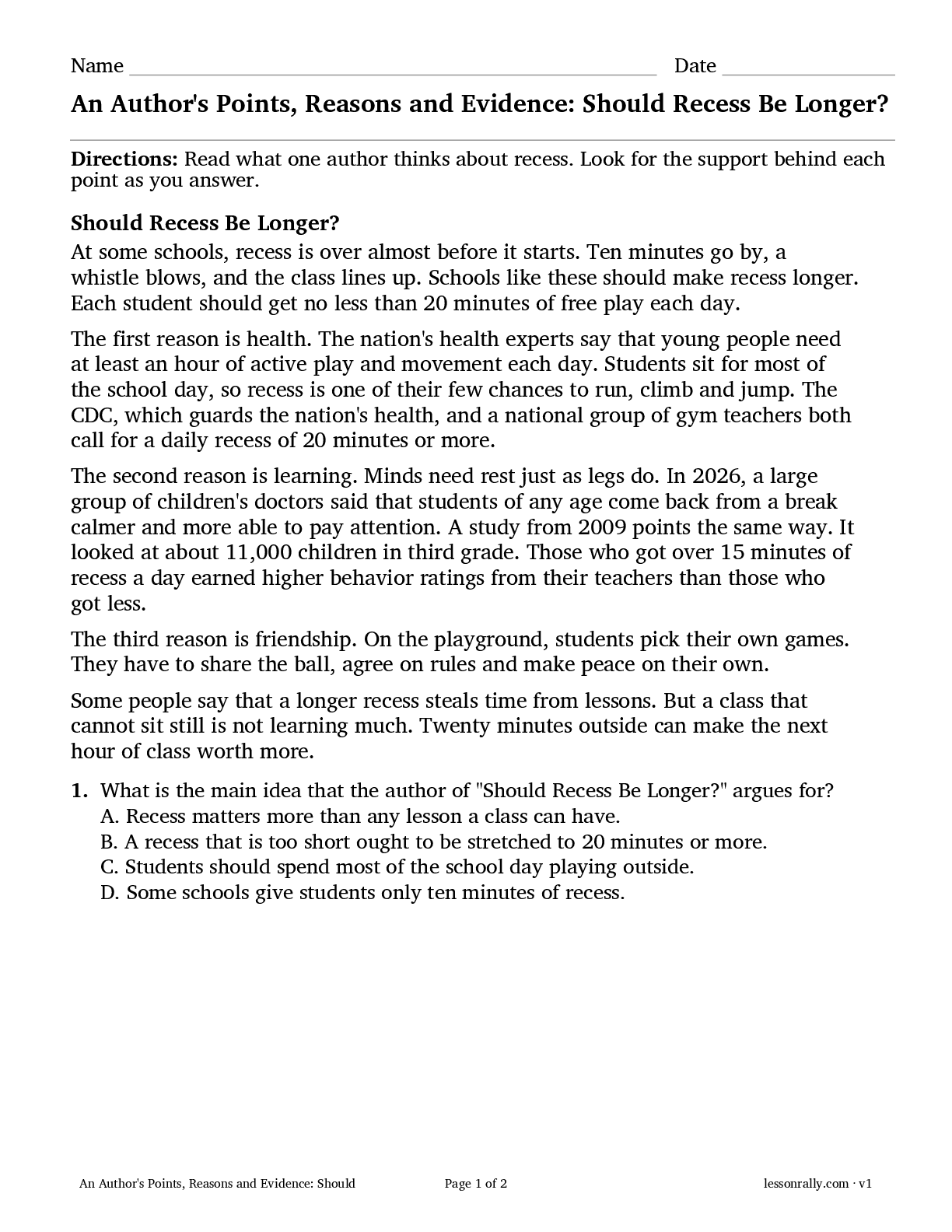
Read what one author thinks about recess. Look for the support behind each point as you answer.

Should Recess Be Longer?

At some schools, recess is over almost before it starts. Ten minutes go by, a whistle blows, and the class lines up. Schools like these should make recess longer. Each student should get no less than 20 minutes of free play each day.

The first reason is health. The nation's health experts say that young people need at least an hour of active play and movement each day. Students sit for most of the school day, so recess is one of their few chances to run, climb and jump. The CDC, which guards the nation's health, and a national group of gym teachers both call for a daily recess of 20 minutes or more.

The second reason is learning. Minds need rest just as legs do. In 2026, a large group of children's doctors said that students of any age come back from a break calmer and more able to pay attention. A study from 2009 points the same way. It looked at about 11,000 children in third grade. Those who got over 15 minutes of recess a day earned higher behavior ratings from their teachers than those who got less.

The third reason is friendship. On the playground, students pick their own games. They have to share the ball, agree on rules and make peace on their own.

Some people say that a longer recess steals time from lessons. But a class that cannot sit still is not learning much. Twenty minutes outside can make the next hour of class worth more.


Question 1

What is the main idea that the author of "Should Recess Be Longer?" argues for?

Choose one answer.

  • Students should spend most of the school day playing outside.
  • Some schools give students only ten minutes of recess.
  • Recess matters more than any lesson a class can have.
  • A recess that is too short ought to be stretched to 20 minutes or more.

Question 2

The author gives three reasons for a longer recess. Match each reason to the support the author gives for it. Two of the choices will not be used.

Match each item to an option.

Items

  1. health
  2. learning
  3. friendship

Options

  1. Students sit for most of the school day.
  2. Third graders with more recess earned higher behavior ratings.
  3. Students who play outside sleep better at night.
  4. Teachers use recess to plan their lessons.
  5. Students pick their own games.

Question 3

The author says that a break helps students learn. Which detail does the author give to support this point?

Choose one answer.

  • The doctors said recess should not be taken away to punish a student.
  • The doctors said students return from a break more able to pay attention.
  • The doctors said recess helps students hold on to what they have just been taught.
  • The CDC says recess can help students remember and focus.

Question 4

Some people say that a longer recess steals time from lessons. How does the author answer them?

Choose one answer.

  • Most lessons run longer than students really need them to.
  • Recess can double as extra reading time on most days.
  • A class learns more in the hour after a real break.
  • Schools in other countries have shorter days and do fine.

Question 5

The author uses a study of third graders for support. Which two details in the passage come from that study? Select two.

Choose 2 answers.

  • about 11,000 students
  • a daily recess of 20 minutes or more
  • over 15 minutes of recess a day
  • a report made in 2026
  • ten minutes of recess

Question 6

Recess is good for the body, in the author's view. Which detail does the passage give about how much young people should move?

Choose one answer.

  • The movement should be brisk, not just a slow walk.
  • They need at least an hour of active play and movement each day.
  • Schools can help students get enough daily movement.
  • Recess is a set part of the school day for moving and playing.

Question 7

Why does the author begin with a recess that lasts only ten minutes?

Choose one answer.

  • to show that students waste recess by lining up
  • to prove that most schools have a recess of ten minutes
  • to show the problem that the passage goes on to argue against
  • to give the rule that schools must follow

Reviews

No reviews yet.

Reviews come from teachers who assigned this activity to a class.

Sign in to write a review

Have a topic of your own? Make a printable worksheet and online quiz, free.

Create an activity

Answer key

Answer keys come with Premium

Print this worksheet with the correct answers marked. The key includes any explanations, sample answers, and rubrics supplied with the activity.

Answer keys aren't public: only teachers with Premium and the people who can edit an activity can download one, so students can't get a ready-to-print key from this page.

Premium includes:

  • No ads for you, and no ads for your students on the assignments you post.
  • Answer keys for printable worksheets, with the correct answers marked and any explanations, sample answers, and rubrics.
  • Create with AI: up to 100 activities a year (5 during the free trial), with every answer checked before you see the draft.

$29 a year, plus sales tax where it applies.

New Premium teachers can try it free for 7 days. A card or other payment method is needed to start. Unless you cancel before the trial ends, you are charged then and the plan renews every year.

Already have Premium or edit this activity? Sign in