Comparing Text Structures and Main Idea: Two Accounts of the Johnstown Flood

8 questions · 8 points · Grade 5 · English · Preview the 8 questions

Made by Andre Whitaker · LessonRally (AI-assisted)

Digital classroom activity

What is a digital classroom activity?

Teachers who sign in can assign LessonRally activities to their Google Classroom classes: students open them in Classroom and answer online, and their grades go to the teacher's Classroom gradebook. Practice lets you try it first, the way students see it.

Free for teachers. Sign in to assign activities to your Google Classroom classes.

Printable worksheet

Students read two short original accounts of the Johnstown Flood of 1889, each organized in a different way. They choose the main idea the accounts share, choose how each account is organized, select two details that guide a reader, choose the quoted sentence that fits a description, answer two questions that compare the accounts and choose one supporting detail. Grade 5 reading comprehension practice on comparing text structures in informational texts.

Learning goal: Compare and contrast the overall structure of two informational accounts of the same event.

Estimated reading level 5.1

  1. Grade 3Hard
  2. Grade 4Stretch
  3. Grade 5On level
  4. Grade 6Easier
  5. Grade 7Easy
About this estimate

The estimate is the middle score of five readability formulas. Their scores run from 3.2 to 5.4.

  • Flesch-Kincaid GradeSentence length and syllables per word3.2
  • Gunning Fog Middle scoreSentence length and words of three or more syllables5.1
  • Coleman-LiauLetters per word and sentences per 100 words5.4
  • Automated Readability IndexCharacters per word and words per sentence3.5
  • SMOGWords of three or more syllables, for texts of 30 sentences or more5.4
Flesch Reading Ease
92.3 on a 0 to 100 scale where higher is easier: very easy. Not part of the estimate.
Text measured
790 words, 39 sentences

Adapted from common readability formulas (Flesch-Kincaid, Gunning Fog, Coleman-Liau and ARI, plus SMOG for long texts), which look at sentence length and word length. Answer choices count toward word length only. Grades below the estimate will likely find the text harder, grades above it easier. It does not measure ideas, background knowledge or images.

Common Core

Closest anchor: CCRA.R.5 Analyze the structure of texts, including how specific sentences, paragraphs, and larger portions of the text (e.g., a section, chapter, scene, or stanza) relate to each other and the whole.Anchor Standards for ReadingShow 1 matched standardHide matched standard

Matched standard

  • RI.5.5

    Compare and contrast the overall structure (e.g., chronology, comparison, cause/effect, problem/solution) of events, ideas, concepts, or information in two or more texts.

    Student preview questions 2, 3

Matched independently by two AI models from this activity's questions.

© Copyright 2010. National Governors Association Center for Best Practices and Council of Chief State School Officers. All rights reserved.

Topics: Text Structure, Main Idea and Key Details, Comparing Texts Chosen by LessonRally

Question types: multiple choice, select all that apply.

Student preview

The questions as students see them, without the answers.

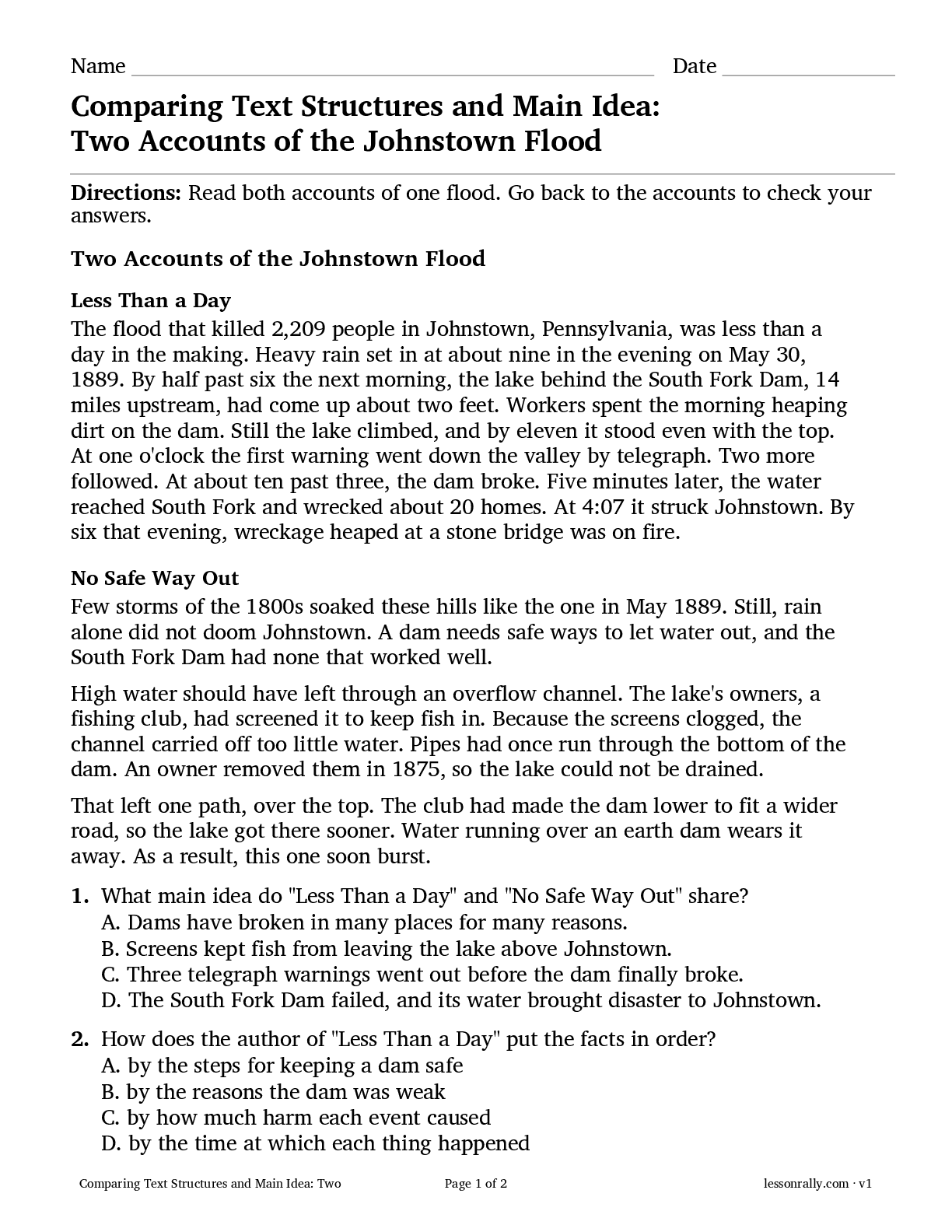
Read both accounts of one flood. Go back to the accounts to check your answers.

Two Accounts of the Johnstown Flood

Less Than a Day

The flood that killed 2,209 people in Johnstown, Pennsylvania, was less than a day in the making. Heavy rain set in at about nine in the evening on May 30, 1889. By half past six the next morning, the lake behind the South Fork Dam, 14 miles upstream, had come up about two feet. Workers spent the morning heaping dirt on the dam. Still the lake climbed, and by eleven it stood even with the top. At one o'clock the first warning went down the valley by telegraph. Two more followed. At about ten past three, the dam broke. Five minutes later, the water reached South Fork and wrecked about 20 homes. At 4:07 it struck Johnstown. By six that evening, wreckage heaped at a stone bridge was on fire.

No Safe Way Out

Few storms of the 1800s soaked these hills like the one in May 1889. Still, rain alone did not doom Johnstown. A dam needs safe ways to let water out, and the South Fork Dam had none that worked well.

High water should have left through an overflow channel. The lake's owners, a fishing club, had screened it to keep fish in. Because the screens clogged, the channel carried off too little water. Pipes had once run through the bottom of the dam. An owner removed them in 1875, so the lake could not be drained.

That left one path, over the top. The club had made the dam lower to fit a wider road, so the lake got there sooner. Water running over an earth dam wears it away. As a result, this one soon burst.


Question 1

What main idea do "Less Than a Day" and "No Safe Way Out" share?

Choose one answer.

  • The South Fork Dam failed, and its water brought disaster to Johnstown.
  • Screens kept fish from leaving the lake above Johnstown.
  • Dams have broken in many places for many reasons.
  • Three telegraph warnings went out before the dam finally broke.

Question 2

How does the author of "Less Than a Day" put the facts in order?

Choose one answer.

  • by the steps for keeping a dam safe
  • by the time at which each thing happened
  • by how much harm each event caused
  • by the reasons the dam was weak

Question 3

What plan does the author of "No Safe Way Out" follow in laying out the facts?

Choose one answer.

  • Each owner of the dam is taken in turn, from first to last.
  • Each hour of the storm is taken in turn, from night to evening.
  • Each town in the valley is taken in turn, from the dam down to Johnstown.
  • Each way for water to leave the lake is taken in turn, with what went wrong.

Question 4

Small phrases can guide a reader through an account. Which two details from "Less Than a Day" help a reader keep the events in order? Select two.

Choose 2 answers.

  • even with the top
  • 14 miles upstream
  • the lake behind the South Fork Dam
  • Five minutes later
  • By half past six the next morning

Question 5

An author can put a cause and its effect into one sentence. Which sentence from "No Safe Way Out" does this?

Choose one answer.

  • "A dam needs safe ways to let water out, and the South Fork Dam had none that worked well."
  • "Because the screens clogged, the channel carried off too little water."
  • "High water should have left through an overflow channel."
  • "Pipes had once run through the bottom of the dam."

Question 6

Both accounts say that the lake reached the top of the dam. What does each account add about that moment?

Choose one answer.

  • The first gives the hour, and the second gives a reason.
  • The first names the workers, and the second names the club's leader.
  • The first gives the depth of the lake, and the second gives the width of the road.
  • The first gives the hour, and the second gives the height of the dam.

Question 7

A reader wants to know how long the water took to travel from the dam to Johnstown. Which account helps more, and why?

Choose one answer.

  • the second account, because it tells what slowed the water down
  • the first account, because it gives the time for each end of the trip
  • the first account, because it gives the speed of the water
  • the second account, because it lists the towns along the way

Question 8

In "No Safe Way Out," the author shows that people had made the dam less safe before the storm. Which detail does that account give as an example?

Choose one answer.

  • A tower that controlled the pipes burned and was not replaced.
  • An owner removed the pipes at the bottom of the dam.
  • The dam had already failed once, in 1862.
  • Work on the dam stopped for years while it was half built.

Reviews

No reviews yet.

Reviews come from teachers who assigned this activity to a class.

Sign in to write a review

Have a topic of your own? Make a printable worksheet and online quiz, free.

Create an activity

Answer key

Answer keys come with Premium

Print this worksheet with the correct answers marked. The key includes any explanations, sample answers, and rubrics supplied with the activity.

Answer keys aren't public: only teachers with Premium and the people who can edit an activity can download one, so students can't get a ready-to-print key from this page.

Premium includes:

  • No ads for you, and no ads for your students on the assignments you post.
  • Answer keys for printable worksheets, with the correct answers marked and any explanations, sample answers, and rubrics.
  • Create with AI: up to 100 activities a year (5 during the free trial), with every answer checked before you see the draft.

$29 a year, plus sales tax where it applies.

New Premium teachers can try it free for 7 days. A card or other payment method is needed to start. Unless you cancel before the trial ends, you are charged then and the plan renews every year.

Already have Premium or edit this activity? Sign in