Theme from a Character's Response to a Challenge: The Spelling Bee

7 questions · 7 points · Grade 5 · English · Preview the 7 questions

Made by Andre Whitaker · LessonRally (AI-assisted)

Digital classroom activity

What is a digital classroom activity?

Teachers who sign in can assign LessonRally activities to their Google Classroom classes: students open them in Classroom and answer online, and their grades go to the teacher's Classroom gradebook. Practice lets you try it first, the way students see it.

Free for teachers. Sign in to assign activities to your Google Classroom classes.

Printable worksheet

Students read an original short story about a girl who misses a word at a school spelling bee. They choose the theme, choose the detail the story gives for each of two ideas, select two details that show a feeling, answer two questions on how the characters respond to a hard moment and choose the best summary. Grade 5 reading comprehension practice on theme, character response and summarizing fiction.

Learning goal: Determine the theme of a story from how a character responds to a challenge, and summarize the story.

Estimated reading level 4.9

  1. Grade 2Hard
  2. Grade 3Stretch
  3. Grade 4On level
  4. Grade 5Easier
  5. Grade 6Easy
About this estimate

The estimate is the middle score of five readability formulas. Their scores run from 2.8 to 7.0.

  • Flesch-Kincaid GradeSentence length and syllables per word3.4
  • Gunning FogSentence length and words of three or more syllables5.9
  • Coleman-Liau Middle scoreLetters per word and sentences per 100 words4.9
  • Automated Readability IndexCharacters per word and words per sentence2.8
  • SMOGWords of three or more syllables, for texts of 30 sentences or more7.0
Flesch Reading Ease
90.4 on a 0 to 100 scale where higher is easier: very easy. Not part of the estimate.
Text measured
726 words, 33 sentences

Adapted from common readability formulas (Flesch-Kincaid, Gunning Fog, Coleman-Liau and ARI, plus SMOG for long texts), which look at sentence length and word length. Answer choices count toward word length only. Grades below the estimate will likely find the text harder, grades above it easier. It does not measure ideas, background knowledge or images.

Common Core

Closest anchor: CCRA.R.2 Determine central ideas or themes of a text and analyze their development; summarize the key supporting details and ideas.Anchor Standards for ReadingShow 3 matched standardsHide matched standards

Matched standards

  • RL.5.2

    Determine a theme of a story, drama, or poem from details in the text, including how characters in a story or drama respond to challenges or how the speaker in a poem reflects upon a topic; summarize the text.

    Student preview questions 1, 7

  • RL.5.1

    Quote accurately from a text when explaining what the text says explicitly and when drawing inferences from the text.

    Student preview question 5

  • RL.5.3

    Compare and contrast two or more characters, settings, or events in a story or drama, drawing on specific details in the text (e.g., how characters interact).

    Student preview question 4

Matched independently by two AI models from this activity's questions.

© Copyright 2010. National Governors Association Center for Best Practices and Council of Chief State School Officers. All rights reserved.

Topics: Theme, Summarizing Chosen by LessonRally

Question types: multiple choice, select all that apply.

Student preview

The questions as students see them, without the answers.

Read the story about a spelling bee. Find support in the story for each answer you choose.

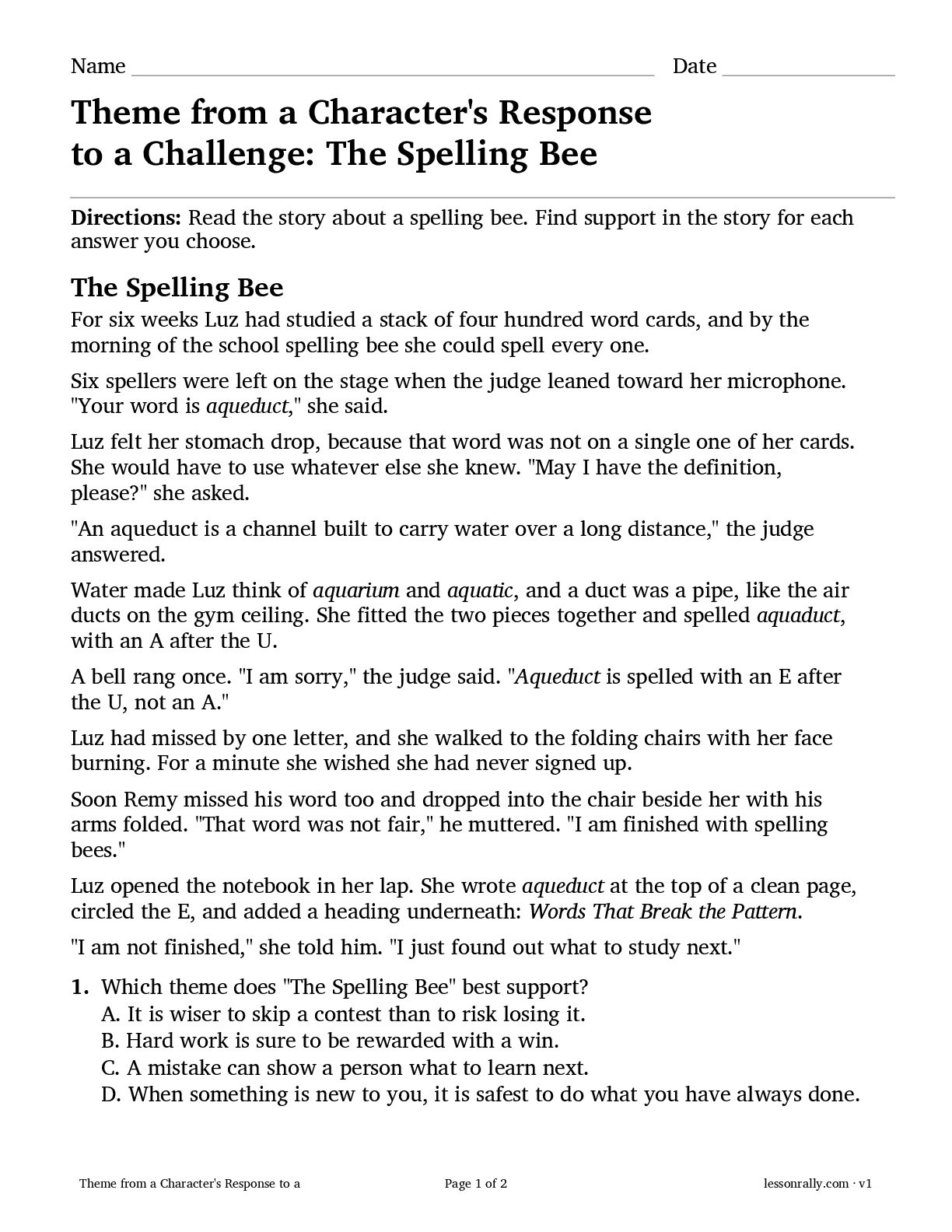
The Spelling Bee

For six weeks Luz had studied a stack of four hundred word cards, and by the morning of the school spelling bee she could spell every one.

Six spellers were left on the stage when the judge leaned toward her microphone. "Your word is aqueduct," she said.

Luz felt her stomach drop, because that word was not on a single one of her cards. She would have to use whatever else she knew. "May I have the definition, please?" she asked.

"An aqueduct is a channel built to carry water over a long distance," the judge answered.

Water made Luz think of aquarium and aquatic, and a duct was a pipe, like the air ducts on the gym ceiling. She fitted the two pieces together and spelled aquaduct, with an A after the U.

A bell rang once. "I am sorry," the judge said. "Aqueduct is spelled with an E after the U, not an A."

Luz had missed by one letter, and she walked to the folding chairs with her face burning. For a minute she wished she had never signed up.

Soon Remy missed his word too and dropped into the chair beside her with his arms folded. "That word was not fair," he muttered. "I am finished with spelling bees."

Luz opened the notebook in her lap. She wrote aqueduct at the top of a clean page, circled the E, and added a heading underneath: Words That Break the Pattern.

"I am not finished," she told him. "I just found out what to study next."

Question 1

Which theme does "The Spelling Bee" best support?

Choose one answer.

  • When something is new to you, it is safest to do what you have always done.
  • Hard work is sure to be rewarded with a win.
  • It is wiser to skip a contest than to risk losing it.
  • A mistake can show a person what to learn next.

Question 2

How does Luz come up with her spelling of the judge's word?

Choose one answer.

  • She sounds it out one letter at a time.
  • She repeats the way the judge said each part.
  • She joins two word parts that she already knows.
  • She pictures a page where she once saw it.

Question 3

Luz's weeks of study do not cover everything. Which detail from the story shows this?

Choose one answer.

  • The word she must spell is not on a single one of her cards.
  • She skips the cards with the longest words on them.
  • She studies one stack of cards and leaves a second stack untouched.
  • Time runs out before she can finish her cards.

Question 4

After each of them misses a word, how do Remy and Luz respond?

Choose one answer.

  • Remy sits down without a word, and Luz says she wants to go home.
  • Remy and Luz each ask the judge for another try.
  • Remy asks the judge for another try, and Luz starts a page of words to study.
  • Remy says he is finished with spelling bees, and Luz starts a page of words to study.

Question 5

Right after the bell, Luz is upset. Which two details from the story show this? Select two.

Choose 2 answers.

  • She hurries out of the gym.
  • She drops her notebook on the floor.
  • Her face burns as she walks to the chairs.
  • She covers her eyes with her hands.
  • She wishes she had never signed up.

Question 6

Luz does not guess blindly at the judge's word. Which detail does the story give that shows this?

Choose one answer.

  • She asks the judge to say the word again.
  • She asks to hear the word in a sentence.
  • She asks which language the word comes from.
  • She asks for the definition.

Question 7

Which choice is the best summary of "The Spelling Bee"?

Choose one answer.

  • Luz and Remy each miss a word at the spelling bee. Remy says the word he was given was not fair.
  • Luz studies four hundred word cards for six weeks. At the school spelling bee, she is one of six spellers left on the stage.
  • At the spelling bee, Luz misses an unfamiliar word by one letter and feels upset. She opens her notebook to a clean page and tells Remy she is not finished.
  • At the spelling bee, Luz misses an unfamiliar word by one letter and feels upset. She opens her notebook to a clean page and asks Remy to study with her.

Reviews

No reviews yet.

Reviews come from teachers who assigned this activity to a class.

Sign in to write a review

Have a topic of your own? Make a printable worksheet and online quiz, free.

Create an activity

Answer key

Answer keys come with Premium

Print this worksheet with the correct answers marked. The key includes any explanations, sample answers, and rubrics supplied with the activity.

Answer keys aren't public: only teachers with Premium and the people who can edit an activity can download one, so students can't get a ready-to-print key from this page.

Premium includes:

  • No ads for you, and no ads for your students on the assignments you post.
  • Answer keys for printable worksheets, with the correct answers marked and any explanations, sample answers, and rubrics.
  • Create with AI: up to 100 activities a year (5 during the free trial), with every answer checked before you see the draft.

$29 a year, plus sales tax where it applies.

New Premium teachers can try it free for 7 days. A card or other payment method is needed to start. Unless you cancel before the trial ends, you are charged then and the plan renews every year.

Already have Premium or edit this activity? Sign in