Main Idea and Key Details: Why Beavers Build Dams

7 questions · 7 points · Grade 4 · English · Preview the 7 questions

Made by Andre Whitaker · LessonRally (AI-assisted)

Digital classroom activity

What is a digital classroom activity?

Teachers who sign in can assign LessonRally activities to their Google Classroom classes: students open them in Classroom and answer online, and their grades go to the teacher's Classroom gradebook. Practice lets you try it first, the way students see it.

Free for teachers. Sign in to assign activities to your Google Classroom classes.

Printable worksheet

Students read a grade 4 informational passage about beavers and their dams. They find the main idea, choose details that support it and pick an accurate summary. Grade 4 reading comprehension practice with a nonfiction text on main ideas, key details and summarizing.

Learning goal: Determine the main idea of an informational passage, explain how key details support it, and choose an accurate summary.

Estimated reading level 5.5

  1. Grade 3Hard
  2. Grade 4Stretch
  3. Grade 5On level
  4. Grade 6Easier
  5. Grade 7Easy
About this estimate

The estimate is the middle score of five readability formulas. Their scores run from 4.1 to 6.5.

  • Flesch-Kincaid GradeSentence length and syllables per word4.1
  • Gunning Fog Middle scoreSentence length and words of three or more syllables5.5
  • Coleman-LiauLetters per word and sentences per 100 words6.3
  • Automated Readability IndexCharacters per word and words per sentence4.2
  • SMOGWords of three or more syllables, for texts of 30 sentences or more6.5
Flesch Reading Ease
86.5 on a 0 to 100 scale where higher is easier: easy. Not part of the estimate.
Text measured
747 words, 32 sentences

Adapted from common readability formulas (Flesch-Kincaid, Gunning Fog, Coleman-Liau and ARI, plus SMOG for long texts), which look at sentence length and word length. Answer choices count toward word length only. Grades below the estimate will likely find the text harder, grades above it easier. It does not measure ideas, background knowledge or images.

Common Core

Closest anchor: CCRA.R.2 Determine central ideas or themes of a text and analyze their development; summarize the key supporting details and ideas.Anchor Standards for ReadingShow 2 matched standardsHide matched standards

Matched standards

  • RI.4.2

    Determine the main idea of a text and explain how it is supported by key details; summarize the text.

    Student preview questions 1, 7

  • RI.4.1

    Refer to details and examples in a text when explaining what the text says explicitly and when drawing inferences from the text.

    Student preview questions 2, 3, 4, 6

Matched independently by two AI models from this activity's questions.

© Copyright 2010. National Governors Association Center for Best Practices and Council of Chief State School Officers. All rights reserved.

Topic: Main Idea and Key Details Chosen by LessonRally

Question types: multiple choice, select all that apply.

Student preview

The questions as students see them, without the answers.

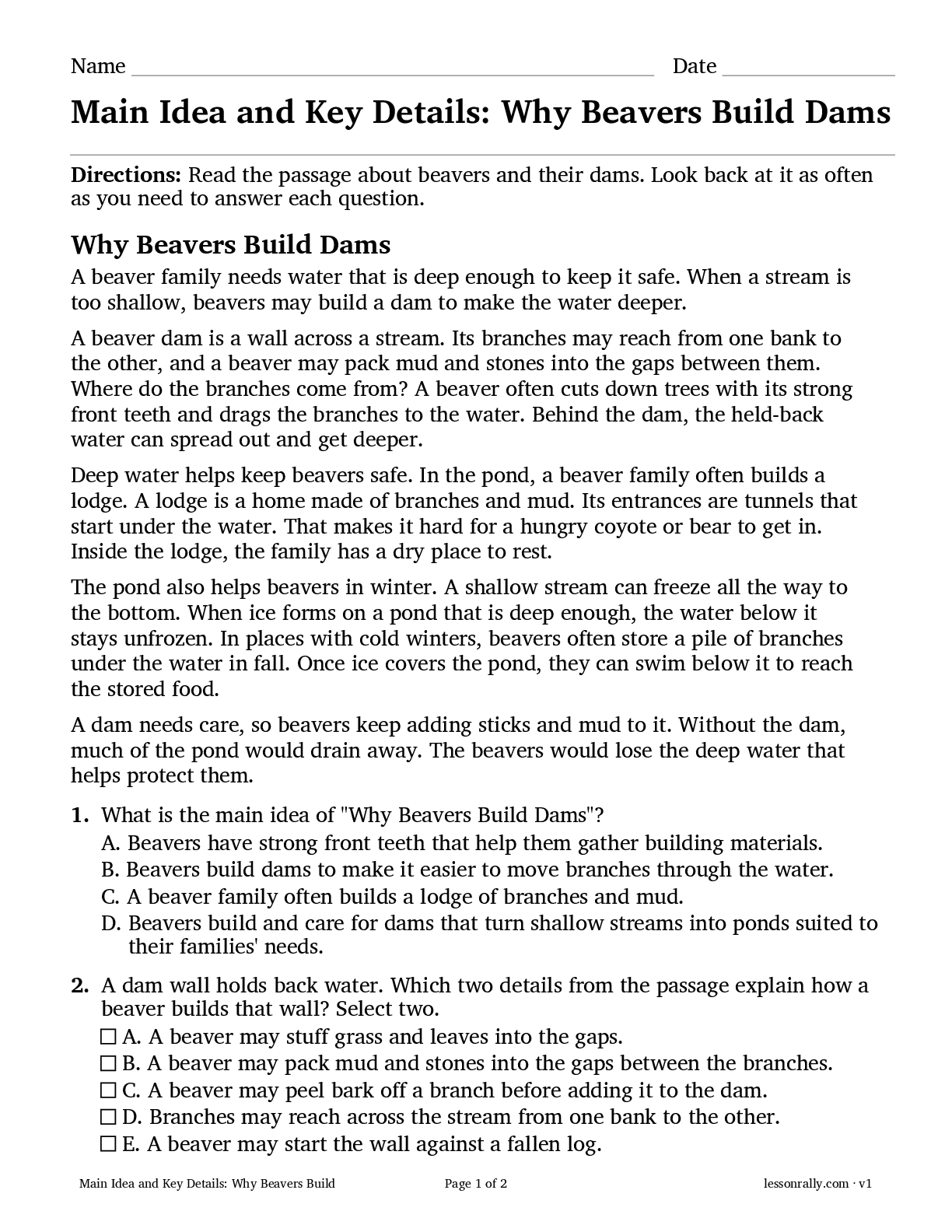
Read the passage about beavers and their dams. Look back at it as often as you need to answer each question.

Why Beavers Build Dams

A beaver family needs water that is deep enough to keep it safe. When a stream is too shallow, beavers may build a dam to make the water deeper.

A beaver dam is a wall across a stream. Its branches may reach from one bank to the other, and a beaver may pack mud and stones into the gaps between them. Where do the branches come from? A beaver often cuts down trees with its strong front teeth and drags the branches to the water. Behind the dam, the held-back water can spread out and get deeper.

Deep water helps keep beavers safe. In the pond, a beaver family often builds a lodge. A lodge is a home made of branches and mud. Its entrances are tunnels that start under the water. That makes it hard for a hungry coyote or bear to get in. Inside the lodge, the family has a dry place to rest.

The pond also helps beavers in winter. A shallow stream can freeze all the way to the bottom. When ice forms on a pond that is deep enough, the water below it stays unfrozen. In places with cold winters, beavers often store a pile of branches under the water in fall. Once ice covers the pond, they can swim below it to reach the stored food.

A dam needs care, so beavers keep adding sticks and mud to it. Without the dam, much of the pond would drain away. The beavers would lose the deep water that helps protect them.


Question 1

What is the main idea of "Why Beavers Build Dams"?

Choose one answer.

  • A beaver family often builds a lodge of branches and mud.
  • Beavers have strong front teeth that help them gather building materials.
  • Beavers build dams to make it easier to move branches through the water.
  • Beavers build and care for dams that turn shallow streams into ponds suited to their families' needs.

Question 2

A dam wall holds back water. Which two details from the passage explain how a beaver builds that wall? Select two.

Choose 2 answers.

  • A beaver may peel bark off a branch before adding it to the dam.
  • Branches may reach across the stream from one bank to the other.
  • A beaver may pack mud and stones into the gaps between the branches.
  • A beaver may stuff grass and leaves into the gaps.
  • A beaver may start the wall against a fallen log.

Question 3

Which detail does the author use to show that a coyote on shore would have trouble getting into the lodge?

Choose one answer.

  • The tunnels open below the surface of the pond.
  • The mud on the walls can harden in cold weather.
  • An entry tunnel slopes up to the room inside.
  • Some lodges stand in the middle of a pond.

Question 4

In the winter paragraph, what do the beavers go out to get while the top of the pond is frozen?

Choose one answer.

  • Fresh branches still growing along the bank
  • Roots growing at the bottom of the pond
  • Stems from plants growing in the pond
  • Branches they stored under the water in the fall

Question 5

Why does the dam work described in the last paragraph matter to the beaver family?

Choose one answer.

  • Beavers build a second dam downstream to give themselves more room to swim.
  • Beavers dig a channel beside the pond to bring branches back by water.
  • Beavers raise the top of the dam to hold back more water.
  • Beavers add sticks and mud to keep the pond from draining away.

Question 6

What change in the stream does the building paragraph describe?

Choose one answer.

  • The current can slow and mud can settle on the bottom.
  • The stream can get deeper and stay narrow.
  • The stream can get wider and deeper.
  • The water can trickle through small gaps in the wall.

Question 7

Which choice accurately sums up the passage?

Choose one answer.

  • Beavers often cut trees for branches to build a dam. Their pond gives them a safer place to rest and a way to reach food in winter.
  • Beavers may start a dam by pushing branches into the streambed. Their pond helps them move branches by water and reach food in winter.
  • Beavers may start a dam by pushing branches into the streambed. Their pond gives them a safer place to rest and a way to reach food in winter.
  • Beavers often cut trees for branches to build a dam. Their pond helps them move branches by water and reach food in winter.

Reviews

No reviews yet.

Reviews come from teachers who assigned this activity to a class.

Sign in to write a review

Have a topic of your own? Make a printable worksheet and online quiz, free.

Create an activity

Answer key

Answer keys come with Premium

Print this worksheet with the correct answers marked. The key includes any explanations, sample answers, and rubrics supplied with the activity.

Answer keys aren't public: only teachers with Premium and the people who can edit an activity can download one, so students can't get a ready-to-print key from this page.

Premium includes:

  • No ads for you, and no ads for your students on the assignments you post.
  • Answer keys for printable worksheets, with the correct answers marked and any explanations, sample answers, and rubrics.
  • Create with AI: up to 100 activities a year (5 during the free trial), with every answer checked before you see the draft.

$29 a year, plus sales tax where it applies.

New Premium teachers can try it free for 7 days. A card or other payment method is needed to start. Unless you cancel before the trial ends, you are charged then and the plan renews every year.

Already have Premium or edit this activity? Sign in