Question 1
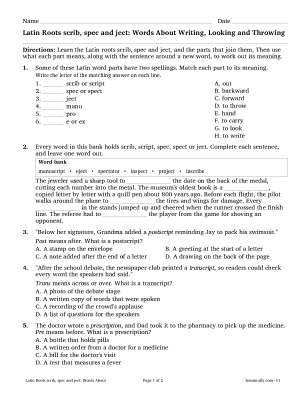
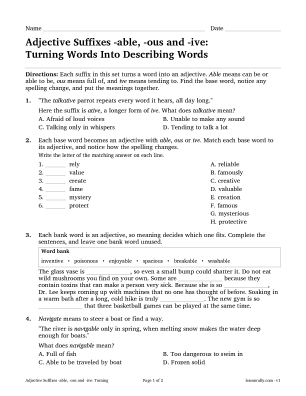
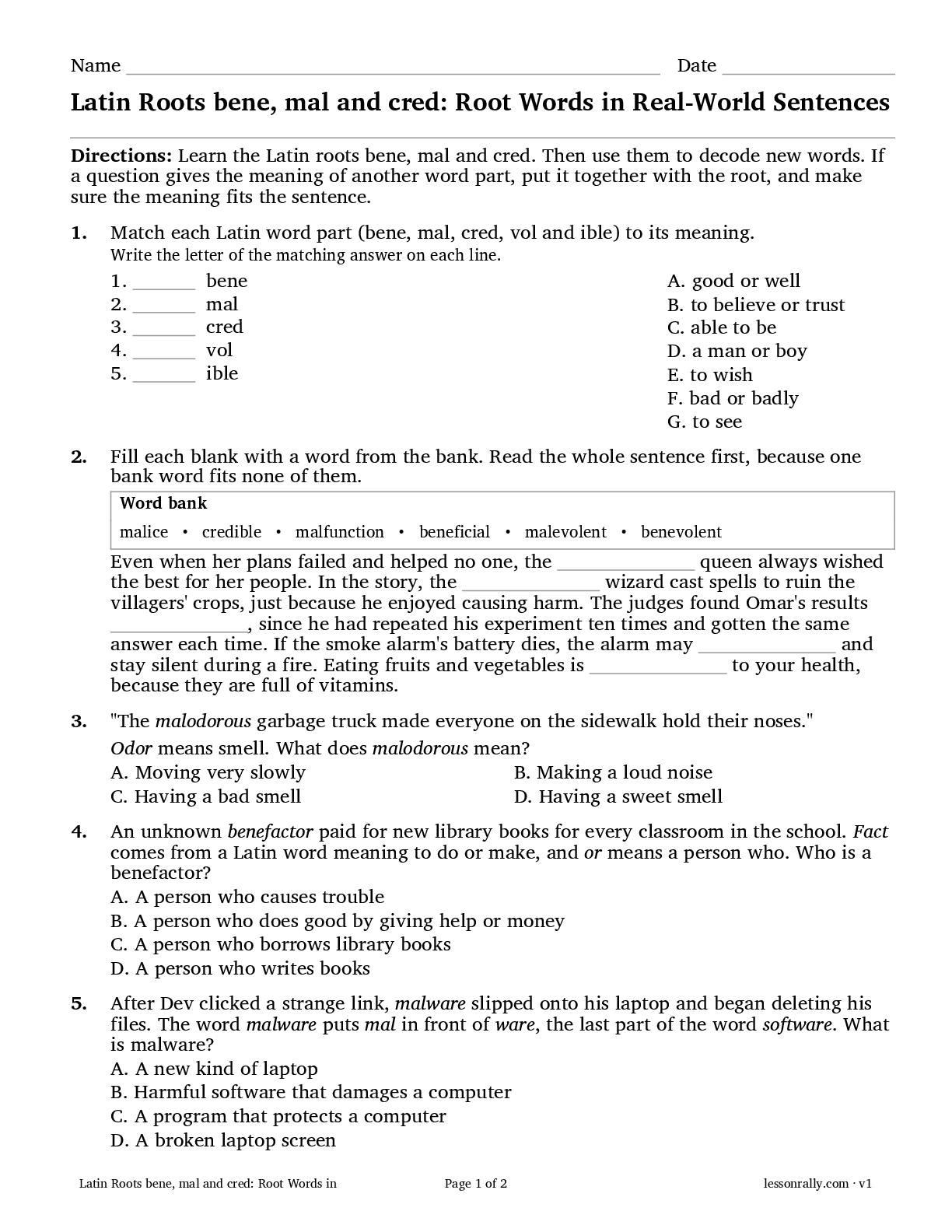
Match each Latin word part (bene, mal, cred, vol and ible) to its meaning.
Match each item to an option.
Items
- bene
- mal
- cred
- vol
- ible
Options


Teachers who sign in can assign LessonRally activities to their Google Classroom classes: students open them in Classroom and answer online, and their grades go to the teacher's Classroom gradebook. Practice lets you try it first, the way students see it.
Free for teachers. Sign in to assign activities to your Google Classroom classes.
 (opens in a new tab)
2 pages · Student copy, no answers
Print worksheet (opens in a new tab)Answer keyPremiumStudents learn the Latin roots bene, mal and cred, along with vol and ible. They match each word part to its meaning, complete sentences with root words from a word bank, then use a root and context clues to decode unfamiliar words about computers, science fairs, rumors and more. Explanations break each word into parts and point out look-alikes such as male and mall.
Learning goal: Use the Latin roots bene, mal and cred, along with context clues, to determine the meanings of unfamiliar words.
The estimate is the middle score of five readability formulas. Their scores run from 5.4 to 8.5.
Adapted from common readability formulas (Flesch-Kincaid, Gunning Fog, Coleman-Liau and ARI, plus SMOG for long texts), which look at sentence length and word length. Answer choices count toward word length only. Grades below the estimate will likely find the text harder, grades above it easier. It does not measure ideas, background knowledge or images.
Use common, grade-appropriate Greek or Latin affixes and roots as clues to the meaning of a word (e.g., belligerent, bellicose, rebel).
Student preview questions 1, 2, 3, 4, 5, 6, 7, 8, 9, 10, 11, 12
Use context (e.g., the overall meaning of a sentence or paragraph; a word's position or function in a sentence) as a clue to the meaning of a word or phrase.
Matched independently by two AI models from this activity's questions.
© Copyright 2010. National Governors Association Center for Best Practices and Council of Chief State School Officers. All rights reserved.
Topics: Prefixes, Suffixes and Roots, Context Clues Chosen by LessonRally
Question types: matching, fill in the blank, multiple choice.
The questions as students see them, without the answers.
Learn the Latin roots bene, mal and cred. Then use them to decode new words. If a question gives the meaning of another word part, put it together with the root, and make sure the meaning fits the sentence.
Match each Latin word part (bene, mal, cred, vol and ible) to its meaning.
Match each item to an option.
Items
Options
Fill each blank with a word from the bank. Read the whole sentence first, because one bank word fits none of them.
Fill in each blank.
Even when her plans failed and helped no one, the blank 1 queen always wished the best for her people. In the story, the blank 2 wizard cast spells to ruin the villagers' crops, just because he enjoyed causing harm. The judges found Omar's results blank 3, since he had repeated his experiment ten times and gotten the same answer each time. If the smoke alarm's battery dies, the alarm may blank 4 and stay silent during a fire. Eating fruits and vegetables is blank 5 to your health, because they are full of vitamins.
Word bank
"The malodorous garbage truck made everyone on the sidewalk hold their noses."
Odor means smell. What does malodorous mean?
Choose one answer.
An unknown benefactor paid for new library books for every classroom in the school. Fact comes from a Latin word meaning to do or make, and or means a person who. Who is a benefactor?
Choose one answer.
After Dev clicked a strange link, malware slipped onto his laptop and began deleting his files. The word malware puts mal in front of ware, the last part of the word software. What is malware?
Choose one answer.
"Mom gave Max an incredulous look when he said he had cleaned his whole room in two minutes."
In means not. What does incredulous mean?
Choose one answer.
"The animal shelter was the beneficiary of the bake sale, receiving every dollar the students raised."
What is a beneficiary?
Choose one answer.
"After a dry summer, the apple tree grew small, malformed apples with twisted, lumpy shapes."
What does malformed mean?
Choose one answer.
"Before the new nurse could start work, the hospital checked her credentials, including her license and her nursing degree."
What are credentials?
Choose one answer.
The malicious rumor spread quickly, and it hurt Lena's feelings because it was meant to embarrass her. What does malicious mean?
Choose one answer.
"The new photos discredited the rumor that a monster lived in the lake, since they showed it was only a floating log."
Dis can mean the opposite of. What did the photos do to the rumor?
Choose one answer.
"The island's benign climate, with mild winters and gentle summers, lets oranges grow all year."
Based on its root and the sentence, what does benign mean here?
Choose one answer.
No reviews yet.
Reviews come from teachers who assigned this activity to a class.
Have a topic of your own? Make a printable worksheet and online quiz, free.
Create an activityCommon Core L.7.4b
Made by Simone Thornbury · LessonRally (AI-assisted)
Common Core L.7.4a
Made by Simone Thornbury · LessonRally (AI-assisted)
Common Core L.7.5a
Made by Claire Fenwood · LessonRally (AI-assisted)
Common Core RL.7.2
Made by Claire Fenwood · LessonRally (AI-assisted)