Made by Claire Fenwood · LessonRally (AI-assisted)
Digital classroom activity
What is a digital classroom activity?
Teachers who sign in can assign LessonRally activities to their Google Classroom classes: students open them in Classroom and answer online, and their grades go to the teacher's Classroom gradebook. Practice lets you try it first, the way students see it.
Students read short conversations between friends and family and decide when speakers use hyperbole, or exaggeration, and when they use understatement, which makes something sound smaller than it is. They explain what each line really means, how it adds humor or modesty, and how it differs from a simile or a literal statement.
Learning goal: Interpret hyperbole and understatement in dialogue and explain what each suggests about the speaker and the situation.
Estimated reading level5.7
Grade 3Hard
Grade 4Stretch
Grade 5On level
Grade 6Easier
Grade 7Easy
About this estimate
The estimate is the middle score of five readability formulas. Their scores run from 2.8 to 7.2.
Flesch-Kincaid GradeSentence length and syllables per word3.4
Gunning Fog Middle scoreSentence length and words of three or more syllables5.7
Coleman-LiauLetters per word and sentences per 100 words5.7
Automated Readability IndexCharacters per word and words per sentence2.8
SMOGWords of three or more syllables, for texts of 30 sentences or more7.2
Grade 181216
Flesch Reading Ease
84.4 on a 0 to 100 scale where higher is easier: easy. Not part of the estimate.
Text measured
602 words, 33 sentences
Adapted from common readability formulas (Flesch-Kincaid, Gunning Fog, Coleman-Liau and ARI, plus SMOG for long texts), which look at sentence length and word length. Answer choices count toward word length only. Grades below the estimate will likely find the text harder, grades above it easier. It does not measure ideas, background knowledge or images.
Common Core
Press Ctrl+C or Command+C to copy.
Closest anchor:CCRA.L.5Demonstrate understanding of figurative language, word relationships, and nuances in word meanings.Anchor Standards for LanguageShow 1 matched standardHide matched standard
Question types: multiple choice, select all that apply, matching.
Student preview
The questions as students see them, without the answers.
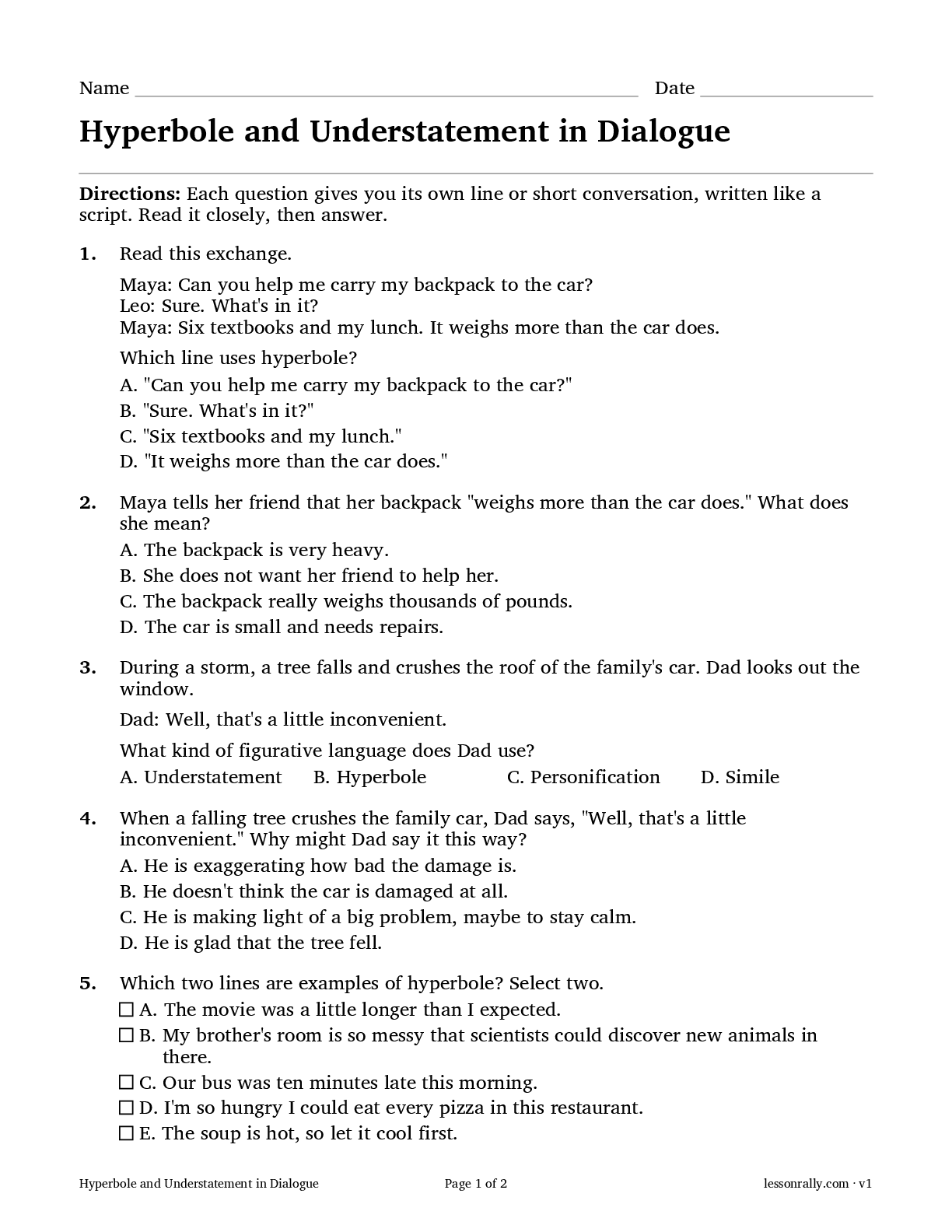
Each question gives you its own line or short conversation, written like a script. Read it closely, then answer.
Question 1
Read this exchange.
Maya: Can you help me carry my backpack to the car? Leo: Sure. What's in it? Maya: Six textbooks and my lunch. It weighs more than the car does.
Which line uses hyperbole?
Choose one answer.
"Six textbooks and my lunch."
"It weighs more than the car does."
"Sure. What's in it?"
"Can you help me carry my backpack to the car?"
Question 2
Maya tells her friend that her backpack "weighs more than the car does." What does she mean?
Choose one answer.
The backpack really weighs thousands of pounds.
The car is small and needs repairs.
She does not want her friend to help her.
The backpack is very heavy.
Question 3
During a storm, a tree falls and crushes the roof of the family's car. Dad looks out the window.
Dad: Well, that's a little inconvenient.
What kind of figurative language does Dad use?
Choose one answer.
Personification
Simile
Understatement
Hyperbole
Question 4
When a falling tree crushes the family car, Dad says, "Well, that's a little inconvenient." Why might Dad say it this way?
Choose one answer.
He is exaggerating how bad the damage is.
He is glad that the tree fell.
He is making light of a big problem, maybe to stay calm.
He doesn't think the car is damaged at all.
Question 5
Which two lines are examples of hyperbole? Select two.
Choose 2 answers.
The soup is hot, so let it cool first.
My brother's room is so messy that scientists could discover new animals in there.
I'm so hungry I could eat every pizza in this restaurant.
The movie was a little longer than I expected.
Our bus was ten minutes late this morning.
Question 6
Jordan scored 31 points and made the winning shot. Afterward, a reporter for the school paper asks how he played.
Jordan: I did all right, I guess.
What does Jordan's understatement suggest?
Choose one answer.
He is being modest about an outstanding game.
He scored only a few points.
He did not hear the reporter's question.
He is bragging about the winning shot.
Question 7
Grandpa: When I was your age, I walked four hours to school every morning, through snow taller than a house.
What does Grandpa's hyperbole show?
Choose one answer.
He is playfully exaggerating how hard his childhood was.
He really walked four hours a day through very deep snow.
He is upset that his grandchild takes the bus.
His town did not have any schools.
Question 8
Which of these lines contains understatement?
Choose one answer.
After a big win, Jo cheers: That was a great game!
At the beach, Ana dips a toe in and says: The water is cold today.
Waiting in a long line, Sam groans: We've been standing here for a hundred years.
After a hurricane floods the first floor of their house, Aunt Lisa says: Looks like we got a little rain.
Question 9
Match each line to the kind of language it uses.
Match each item to an option.
Items
I'm so tired I could sleep until next summer.
Theo, gritting his teeth an hour after breaking his arm in two places: My arm's a little sore.
His sneeze sounded like a goose honking.
The library closes at six tonight.
Options
Understatement
Literal statement
Hyperbole
Simile
Question 10
Read this conversation.
Mia: How was the camping trip? Omar: The tent collapsed, raccoons ate our dinner, and it rained all night. Mia: Oh no. Omar: Yeah. It wasn't my favorite weekend.
How does Omar's last line fit the conversation?
Choose one answer.
It shows that Omar actually enjoyed the trip.
It plays down a disastrous weekend, which makes his list of problems sound even funnier.