Question 1
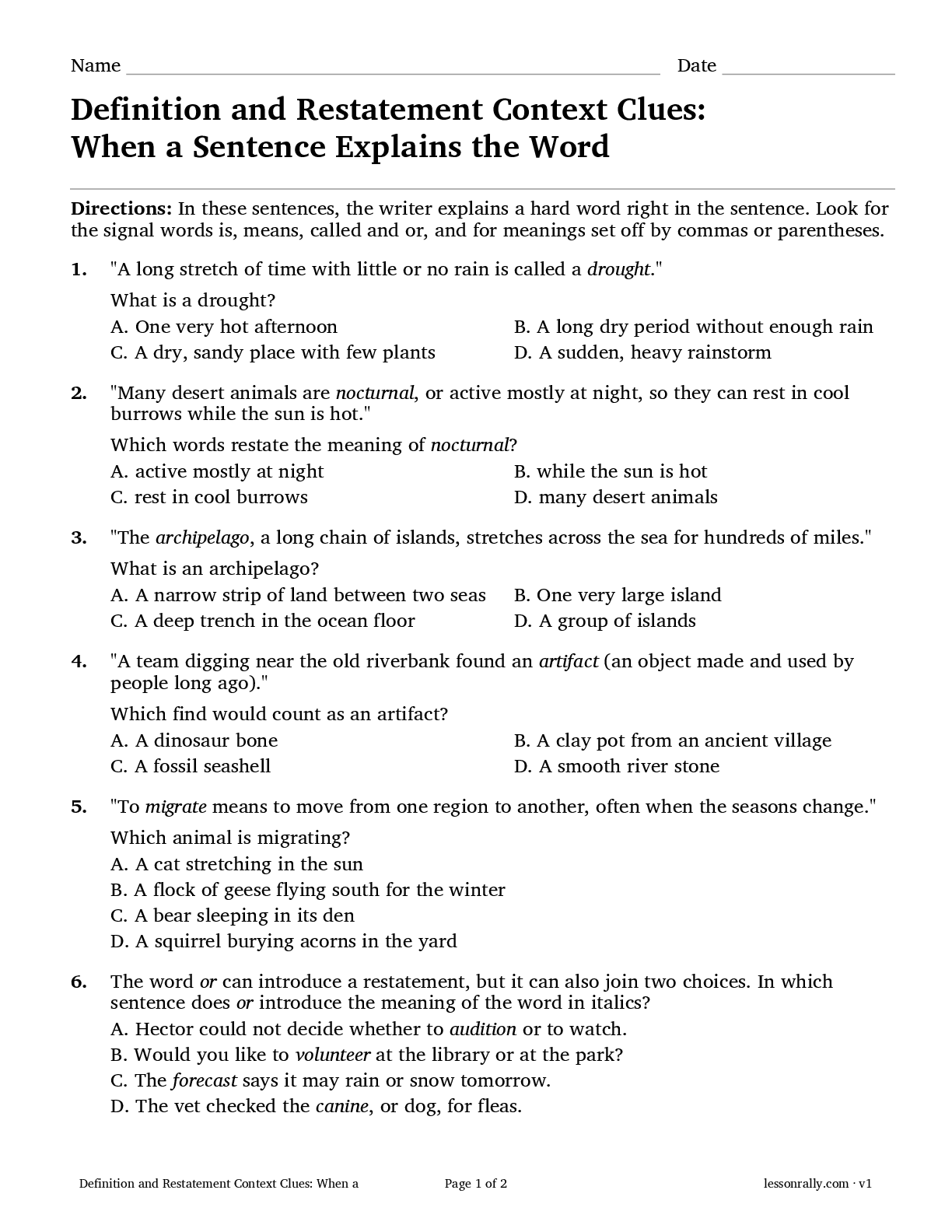
"A long stretch of time with little or no rain is called a drought."
What is a drought?
Choose one answer.
- A sudden, heavy rainstorm
- A long dry period without enough rain
- One very hot afternoon
- A dry, sandy place with few plants


Teachers who sign in can assign LessonRally activities to their Google Classroom classes: students open them in Classroom and answer online, and their grades go to the teacher's Classroom gradebook. Practice lets you try it first, the way students see it.
Free for teachers. Sign in to assign activities to your Google Classroom classes.
 (opens in a new tab)
2 pages · Student copy, no answers
Print worksheet (opens in a new tab)Answer keyPremiumStudents use definition and restatement clues to work out unfamiliar words from science and social studies. They spot the signal words is, means, called and or, notice meanings set off by commas or parentheses, apply each meaning to a new example, and tell a restatement apart from other kinds of context clues. Ends with a mixed review in which each context clue names its word.
Learning goal: Use definition and restatement clues, and the signal words and punctuation that introduce them, to determine the meaning of an unfamiliar word.
The estimate is halfway between the two middle scores of four readability formulas. Their scores run from 4.9 to 8.1.
Adapted from common readability formulas (Flesch-Kincaid, Gunning Fog, Coleman-Liau and ARI, plus SMOG for long texts), which look at sentence length and word length. Answer choices count toward word length only. Grades below the estimate will likely find the text harder, grades above it easier. It does not measure ideas, background knowledge or images.
Use context (e.g., the overall meaning of a sentence or paragraph; a word's position or function in a sentence) as a clue to the meaning of a word or phrase.
Matched independently by two AI models from this activity's questions.
© Copyright 2010. National Governors Association Center for Best Practices and Council of Chief State School Officers. All rights reserved.
Topic: Context Clues Chosen by LessonRally
Question types: multiple choice, matching.
The questions as students see them, without the answers.
In these sentences, the writer explains a hard word right in the sentence. Look for the signal words is, means, called and or, and for meanings set off by commas or parentheses.
"A long stretch of time with little or no rain is called a drought."
What is a drought?
Choose one answer.
"Many desert animals are nocturnal, or active mostly at night, so they can rest in cool burrows while the sun is hot."
Which words restate the meaning of nocturnal?
Choose one answer.
"The archipelago, a long chain of islands, stretches across the sea for hundreds of miles."
What is an archipelago?
Choose one answer.
"A team digging near the old riverbank found an artifact (an object made and used by people long ago)."
Which find would count as an artifact?
Choose one answer.
"To migrate means to move from one region to another, often when the seasons change."
Which animal is migrating?
Choose one answer.
The word or can introduce a restatement, but it can also join two choices. In which sentence does or introduce the meaning of the word in italics?
Choose one answer.
"Erosion means the slow wearing away of rock and soil by wind, water or ice."
Which event is an example of erosion?
Choose one answer.
"A peninsula is land that is almost surrounded by water but still joined to a larger piece of land."
Which description fits a peninsula?
Choose one answer.
Which sentence gives a definition or restatement clue for camouflage?
Choose one answer.
Each sentence explains its word in italics with a definition or restatement clue. Match each sentence to the meaning of that word.
Match each item to an option.
Items
Options
No reviews yet.
Reviews come from teachers who assigned this activity to a class.
Have a topic of your own? Make a printable worksheet and online quiz, free.
Create an activityCommon Core L.6.4a
Made by Simone Thornbury · LessonRally (AI-assisted)
Common Core L.6.4b
Made by Simone Thornbury · LessonRally (AI-assisted)
Common Core L.6.4b
Made by Simone Thornbury · LessonRally (AI-assisted)
Common Core L.6.4b
Made by Simone Thornbury · LessonRally (AI-assisted)