Question 1
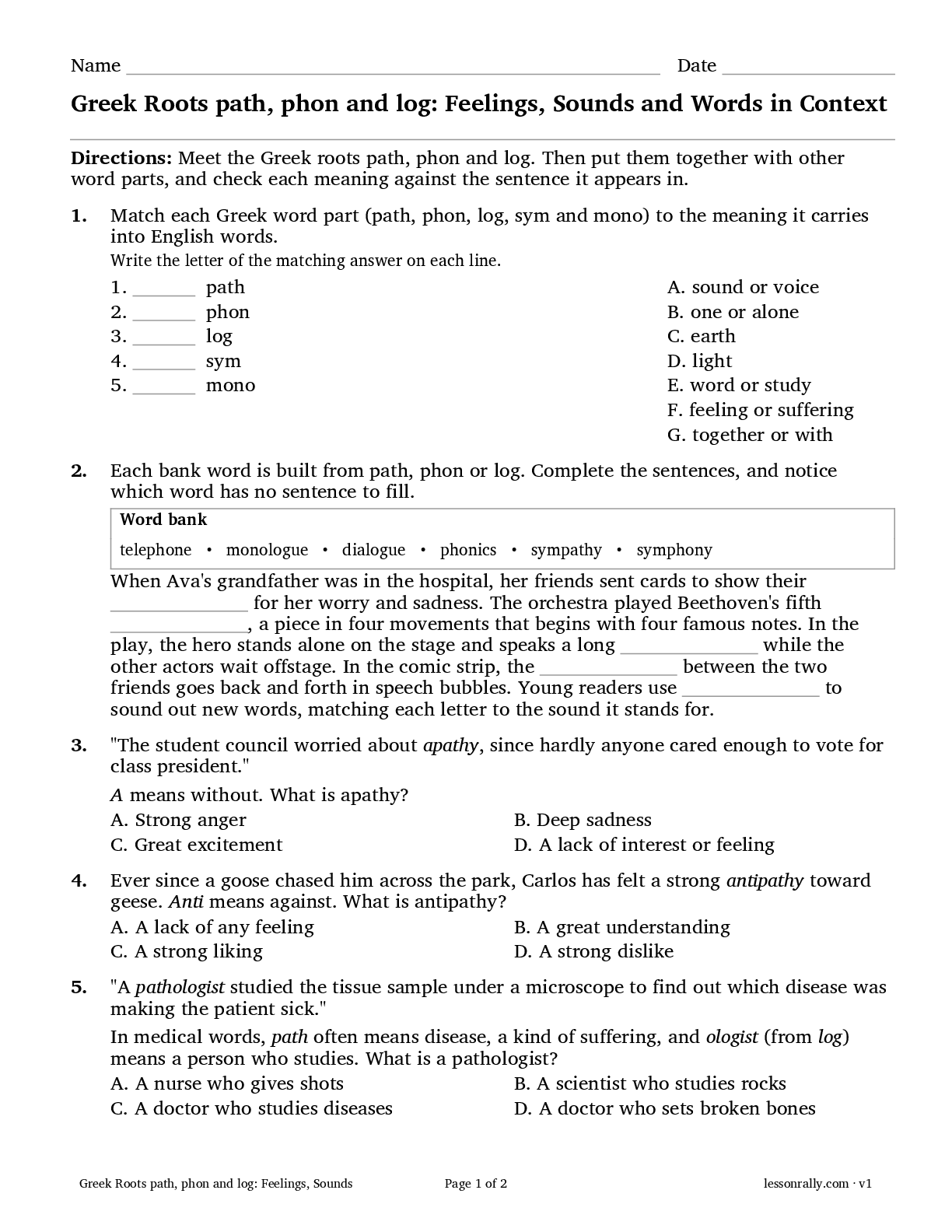
Match each Greek word part (path, phon, log, sym and mono) to the meaning it carries into English words.
Match each item to an option.
Items
- path
- phon
- log
- sym
- mono
Options


Teachers who sign in can assign LessonRally activities to their Google Classroom classes: students open them in Classroom and answer online, and their grades go to the teacher's Classroom gradebook. Practice lets you try it first, the way students see it.
Free for teachers. Sign in to assign activities to your Google Classroom classes.
 (opens in a new tab)
2 pages · Student copy, no answers
Print worksheet (opens in a new tab)Answer keyPremiumStudents learn the Greek roots path (feeling or suffering), phon (sound) and log (word or study), along with sym and mono. They match each word part to its meaning, complete sentences with root words from a word bank, then decode unfamiliar words such as apathy, cacophony and neologism in context. Explanations point out look-alikes, such as the English word path.
Learning goal: Use the Greek roots path, phon and log, along with sentence context, to work out the meanings of unfamiliar words.
The estimate is the middle score of five readability formulas. Their scores run from 4.9 to 8.4.
Adapted from common readability formulas (Flesch-Kincaid, Gunning Fog, Coleman-Liau and ARI, plus SMOG for long texts), which look at sentence length and word length. Answer choices count toward word length only. Grades below the estimate will likely find the text harder, grades above it easier. It does not measure ideas, background knowledge or images.
Use common, grade-appropriate Greek or Latin affixes and roots as clues to the meaning of a word (e.g., precede, recede, secede).
Student preview questions 1, 2, 3, 4, 5, 6, 7, 8, 9, 10, 11, 12
Use context (e.g., the overall meaning of a sentence or paragraph; a word's position or function in a sentence) as a clue to the meaning of a word or phrase.
Matched independently by two AI models from this activity's questions.
© Copyright 2010. National Governors Association Center for Best Practices and Council of Chief State School Officers. All rights reserved.
Topics: Prefixes, Suffixes and Roots, Context Clues Chosen by LessonRally
Question types: matching, fill in the blank, multiple choice.
The questions as students see them, without the answers.
Meet the Greek roots path, phon and log. Then put them together with other word parts, and check each meaning against the sentence it appears in.
Match each Greek word part (path, phon, log, sym and mono) to the meaning it carries into English words.
Match each item to an option.
Items
Options
Each bank word is built from path, phon or log. Complete the sentences, and notice which word has no sentence to fill.
Fill in each blank.
When Ava's grandfather was in the hospital, her friends sent cards to show their blank 1 for her worry and sadness. The orchestra played Beethoven's fifth blank 2, a piece in four movements that begins with four famous notes. In the play, the hero stands alone on the stage and speaks a long blank 3 while the other actors wait offstage. In the comic strip, the blank 4 between the two friends goes back and forth in speech bubbles. Young readers use blank 5 to sound out new words, matching each letter to the sound it stands for.
Word bank
"The student council worried about apathy, since hardly anyone cared enough to vote for class president."
A means without. What is apathy?
Choose one answer.
Ever since a goose chased him across the park, Carlos has felt a strong antipathy toward geese. Anti means against. What is antipathy?
Choose one answer.
"A pathologist studied the tissue sample under a microscope to find out which disease was making the patient sick."
In medical words, path often means disease, a kind of suffering, and ologist (from log) means a person who studies. What is a pathologist?
Choose one answer.
In her speech, Rosa used pathos, describing one shivering, hungry puppy so the audience would feel moved to help the animal shelter. What is pathos?
Choose one answer.
"The cacophony of honking horns, barking dogs and blaring radios made it hard to think."
Caco comes from a Greek word meaning bad. What is a cacophony?
Choose one answer.
The words pair and pear are homophones. Homo means same. What are homophones?
Choose one answer.
"Coach Ruiz shouted through a megaphone so every runner on the field could hear her."
Mega means large or great. What is a megaphone?
Choose one answer.
The novel opens with a short prologue that tells what happened to the hero's family years before the main story begins. Pro means before. What is a prologue?
Choose one answer.
"After reading the first book of the trilogy, Maya could not wait to see how the story ended in the other two."
Tri means three. What is a trilogy?
Choose one answer.
The word selfie began as a neologism in the early 2000s, and today it appears in many dictionaries. Neo means new. What is a neologism?
Choose one answer.
No reviews yet.
Reviews come from teachers who assigned this activity to a class.
Have a topic of your own? Make a printable worksheet and online quiz, free.
Create an activityCommon Core L.8.5c
Made by Simone Thornbury · LessonRally (AI-assisted)
Common Core L.8.4a
Made by Simone Thornbury · LessonRally (AI-assisted)
Common Core L.8.5a
Made by Claire Fenwood · LessonRally (AI-assisted)
Common Core RL.8.6
Made by Claire Fenwood · LessonRally (AI-assisted)