Made by Simone Thornbury · LessonRally (AI-assisted)
Digital classroom activity
What is a digital classroom activity?
Teachers who sign in can assign LessonRally activities to their Google Classroom classes: students open them in Classroom and answer online, and their grades go to the teacher's Classroom gradebook. Practice lets you try it first, the way students see it.
Students compare words with similar denotations but different connotations, such as firm, stubborn, persistent, tenacious, headstrong and bullheaded. Each question has a sentence that settles the speaker's feeling, so students choose the word that fits an attitude, rank words where dictionaries agree, and explain what a word choice suggests. A grade 8 shades of meaning and connotation set.
Learning goal: Distinguish among the connotations of words with similar denotations, such as stubborn, firm and persistent, and choose the word that fits a speaker's attitude.
Estimated reading level8.4
Grade 6Hard
Grade 7Stretch
Grade 8On level
Grade 9Easier
Grade 10Easy
About this estimate
The estimate is halfway between the two middle scores of four readability formulas. Their scores run from 6.4 to 10.5.
Flesch-Kincaid GradeSentence length and syllables per word6.4
Gunning Fog Middle scoreSentence length and words of three or more syllables9.1
Coleman-LiauLetters per word and sentences per 100 words10.5
Automated Readability Index Middle scoreCharacters per word and words per sentence7.7
Grade 181216
Flesch Reading Ease
70.9 on a 0 to 100 scale where higher is easier: fairly easy. Not part of the estimate.
Text measured
588 words, 29 sentences
Adapted from common readability formulas (Flesch-Kincaid, Gunning Fog, Coleman-Liau and ARI, plus SMOG for long texts), which look at sentence length and word length. Answer choices count toward word length only. Grades below the estimate will likely find the text harder, grades above it easier. It does not measure ideas, background knowledge or images.
Common Core
Press Ctrl+C or Command+C to copy.
Closest anchor:CCRA.L.5Demonstrate understanding of figurative language, word relationships, and nuances in word meanings.Anchor Standards for LanguageShow 1 matched standardHide matched standard
Distinguish among the connotations (associations) of words with similar denotations (definitions) (e.g., bullheaded, willful, firm, persistent, resolute).
The questions as students see them, without the answers.
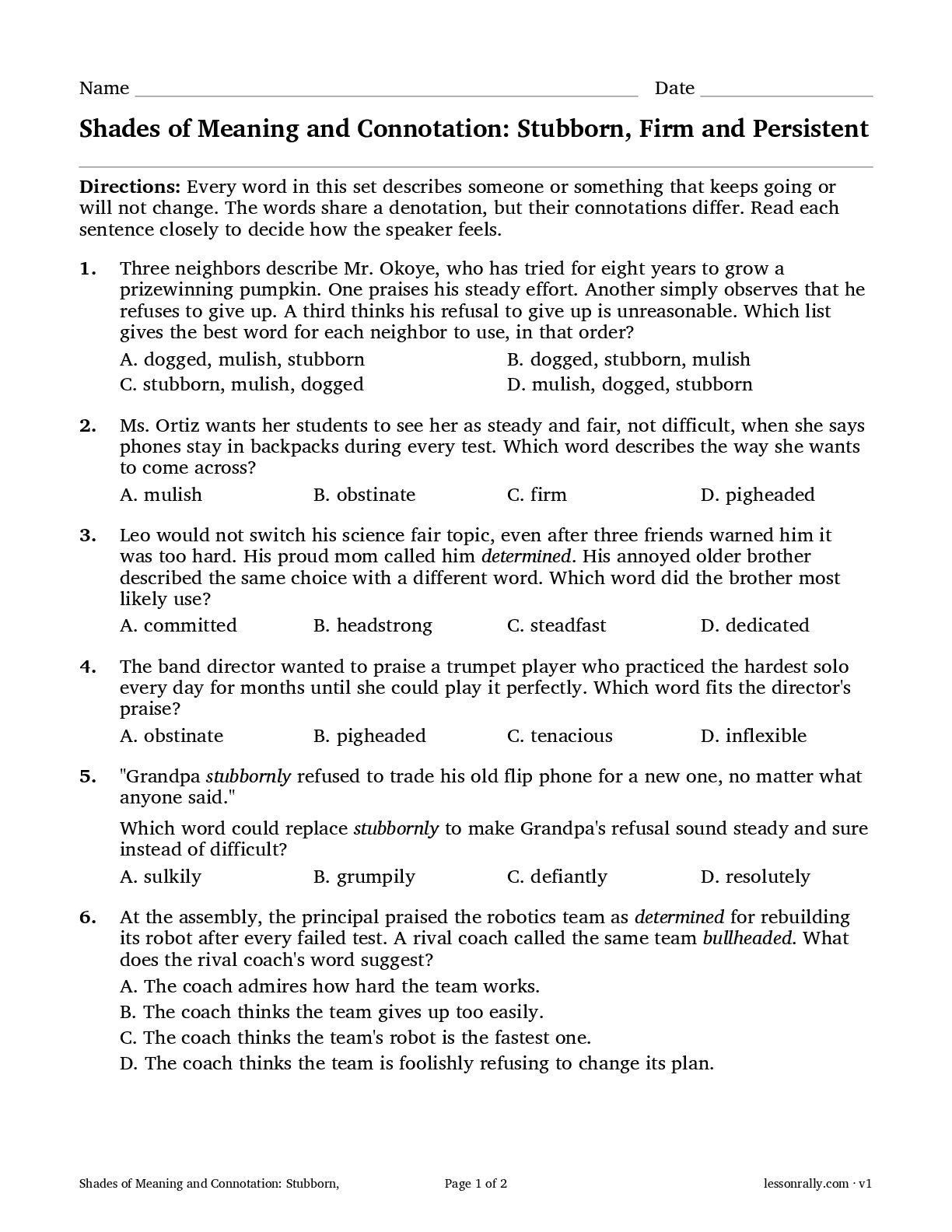
Every word in this set describes someone or something that keeps going or will not change. The words share a denotation, but their connotations differ. Read each sentence closely to decide how the speaker feels.
Question 1
Three neighbors describe Mr. Okoye, who has tried for eight years to grow a prizewinning pumpkin. One praises his steady effort. Another simply observes that he refuses to give up. A third thinks his refusal to give up is unreasonable. Which list gives the best word for each neighbor to use, in that order?
Choose one answer.
dogged, stubborn, mulish
mulish, dogged, stubborn
stubborn, mulish, dogged
dogged, mulish, stubborn
Question 2
Ms. Ortiz wants her students to see her as steady and fair, not difficult, when she says phones stay in backpacks during every test. Which word describes the way she wants to come across?
Choose one answer.
pigheaded
mulish
firm
obstinate
Question 3
Leo would not switch his science fair topic, even after three friends warned him it was too hard. His proud mom called him determined. His annoyed older brother described the same choice with a different word. Which word did the brother most likely use?
Choose one answer.
headstrong
dedicated
committed
steadfast
Question 4
The band director wanted to praise a trumpet player who practiced the hardest solo every day for months until she could play it perfectly. Which word fits the director's praise?
Choose one answer.
obstinate
tenacious
inflexible
pigheaded
Question 5
"Grandpa stubbornly refused to trade his old flip phone for a new one, no matter what anyone said."
Which word could replace stubbornly to make Grandpa's refusal sound steady and sure instead of difficult?
Choose one answer.
grumpily
defiantly
sulkily
resolutely
Question 6
At the assembly, the principal praised the robotics team as determined for rebuilding its robot after every failed test. A rival coach called the same team bullheaded. What does the rival coach's word suggest?
Choose one answer.
The coach thinks the team gives up too easily.
The coach thinks the team is foolishly refusing to change its plan.
The coach thinks the team's robot is the fastest one.
The coach admires how hard the team works.
Question 7
Persistent can sound admiring or annoyed, depending on what a person keeps doing. In which sentence does the speaker sound annoyed?
Choose one answer.
The persistent salesman called the house every evening for two weeks, even after the family said no.
The persistent volunteers kept cleaning the beach until every bottle was gone.
The persistent detective kept digging until she solved the old case.
Thanks to her persistent practice, Mei finally landed a backflip.
Question 8
Stubborn usually criticizes, but it can also be a compliment. In which sentence does stubborn praise the people it describes?
Choose one answer.
The stubborn stain on Dad's shirt would not come out, no matter how hard he scrubbed.
The firefighters' stubborn courage kept them battling the blaze long after midnight.
Ben's stubborn refusal to apologize made the argument drag on for days.
Her stubborn habit of interrupting drove her teammates crazy.
Question 9
"The willful puppy kept digging under the fence, no matter how many times Ty called it back."
What feeling does the word willful show toward the puppy?
Choose one answer.
Worry about a pet that is sick
Pride in a pet that is brave
Frustration with a pet that will not obey
Surprise at a pet that is very fast
Question 10
"Through months of practice and three straight losses, Coach Lin's belief in her team stayed unwavering."
What does the writer's word choice suggest?
Choose one answer.
The writer admires how steady Coach Lin's belief stayed.
The writer is making fun of Coach Lin.
The writer thinks Coach Lin should have given up.
The writer thinks Coach Lin changed her mind every week.