Made by Claire Fenwood · LessonRally (AI-assisted)
Digital classroom activity
What is a digital classroom activity?
Teachers who sign in can assign LessonRally activities to their Google Classroom classes: students open them in Classroom and answer online, and their grades go to the teacher's Classroom gradebook. Practice lets you try it first, the way students see it.
Students read short lines and conversations and decide when a speaker uses verbal irony, saying the opposite of what they mean, and when a writer uses a pun, a play on a word with two meanings. They use context clues to find each speaker's real meaning and explain the double meanings behind each pun.
Learning goal: Interpret verbal irony and puns in context, using clues to find a speaker's real meaning and the double meanings behind wordplay.
Estimated reading level6.2
Grade 4Hard
Grade 5Stretch
Grade 6On level
Grade 7Easier
Grade 8Easy
About this estimate
The estimate is halfway between the two middle scores of four readability formulas. Their scores run from 5.2 to 8.0.
Flesch-Kincaid GradeSentence length and syllables per word5.2
Gunning FogSentence length and words of three or more syllables8.0
Coleman-Liau Middle scoreLetters per word and sentences per 100 words7.2
Automated Readability Index Middle scoreCharacters per word and words per sentence5.2
Grade 181216
Flesch Reading Ease
80.2 on a 0 to 100 scale where higher is easier: easy. Not part of the estimate.
Text measured
793 words, 29 sentences
Adapted from common readability formulas (Flesch-Kincaid, Gunning Fog, Coleman-Liau and ARI, plus SMOG for long texts), which look at sentence length and word length. Answer choices count toward word length only. Grades below the estimate will likely find the text harder, grades above it easier. It does not measure ideas, background knowledge or images.
Common Core
Press Ctrl+C or Command+C to copy.
Closest anchor:CCRA.L.5Demonstrate understanding of figurative language, word relationships, and nuances in word meanings.Anchor Standards for LanguageShow 1 matched standardHide matched standard
Question types: multiple choice, select all that apply, matching.
Student preview
The questions as students see them, without the answers.
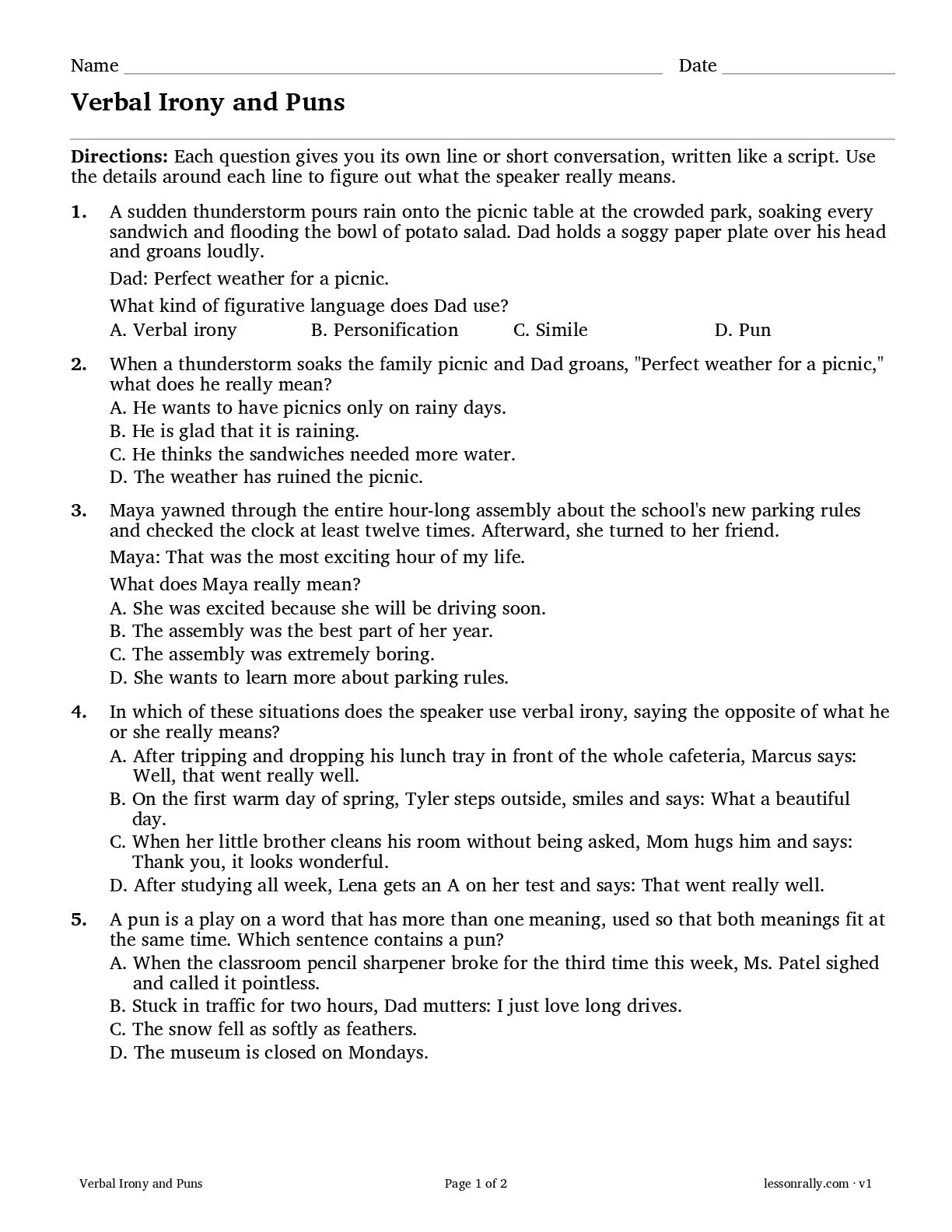
Each question gives you its own line or short conversation, written like a script. Use the details around each line to figure out what the speaker really means.
Question 1
A sudden thunderstorm pours rain onto the picnic table at the crowded park, soaking every sandwich and flooding the bowl of potato salad. Dad holds a soggy paper plate over his head and groans loudly.
Dad: Perfect weather for a picnic.
What kind of figurative language does Dad use?
Choose one answer.
Simile
Personification
Verbal irony
Pun
Question 2
When a thunderstorm soaks the family picnic and Dad groans, "Perfect weather for a picnic," what does he really mean?
Choose one answer.
He thinks the sandwiches needed more water.
He wants to have picnics only on rainy days.
The weather has ruined the picnic.
He is glad that it is raining.
Question 3
Maya yawned through the entire hour-long assembly about the school's new parking rules and checked the clock at least twelve times. Afterward, she turned to her friend.
Maya: That was the most exciting hour of my life.
What does Maya really mean?
Choose one answer.
She was excited because she will be driving soon.
She wants to learn more about parking rules.
The assembly was extremely boring.
The assembly was the best part of her year.
Question 4
In which of these situations does the speaker use verbal irony, saying the opposite of what he or she really means?
Choose one answer.
After studying all week, Lena gets an A on her test and says: That went really well.
After tripping and dropping his lunch tray in front of the whole cafeteria, Marcus says: Well, that went really well.
On the first warm day of spring, Tyler steps outside, smiles and says: What a beautiful day.
When her little brother cleans his room without being asked, Mom hugs him and says: Thank you, it looks wonderful.
Question 5
A pun is a play on a word that has more than one meaning, used so that both meanings fit at the same time. Which sentence contains a pun?
Choose one answer.
The museum is closed on Mondays.
Stuck in traffic for two hours, Dad mutters: I just love long drives.
When the classroom pencil sharpener broke for the third time this week, Ms. Patel sighed and called it pointless.
The snow fell as softly as feathers.
Question 6
When the classroom pencil sharpener broke for the third time this week, Ms. Patel sighed and called it "pointless." Which two meanings of the word does the sentence play on?
Choose one answer.
It does no good, and it cannot put a point on a pencil.
It does no good, and nobody wants to buy it.
It cannot put a point on a pencil, and it is very old.
It is broken, and Ms. Patel is angry about it.
Question 7
Before the race, the track coach promised the team that it would be a breeze, since a steady wind would be at the runners' backs the whole way. What makes the coach's comment a pun?
Choose one answer.
The coach is comparing the race to a summer day.
The coach means the opposite of what she says.
The coach is exaggerating how fast the runners will go.
Breeze can mean something easy and also a light wind, and both meanings fit.
Question 8
Which two of these sentences play on a word that has two different meanings at the same time? Select two.
Choose 2 answers.
The bus was so crowded that we stood like sardines.
The gym was packed with fans, but it was still sweltering inside.
When the teacher hands out a surprise quiz, Leo groans: Oh, great. My favorite thing.
The owner of the cheese shop told such cheesy jokes that customers groaned.
The library closes at eight on Fridays.
Question 9
Read each line carefully, then match it to the kind of language it uses: verbal irony, a pun, hyperbole or a literal statement.
Match each item to an option.
Items
After the power goes out during the championship game, Nia says: Oh, wonderful. Just what I wanted.
The pitcher on our softball team brought a pitcher of lemonade to the game.
This line is so long that I'll be in high school before we reach the front.
The school play starts at seven o'clock.
Options
Pun
Hyperbole
Verbal irony
Literal statement
Question 10
Jae and Priya are talking on the phone after a long, rainy afternoon. Read their conversation.
Jae: The bus broke down on the highway, so we waited an hour in the pouring rain for another one. Priya: And then? Jae: Then, when I finally got to the field, I found out that practice was canceled anyway. Priya: Wow. Sounds like a great day.
How does Priya's last line fit the conversation?
Choose one answer.
She uses verbal irony to agree that Jae's day was awful.