Question 1
Temperature drop = starting temperature − later temperature. How many degrees did the water in the ceramic mug cool over the full 20 minutes?
Enter a number.
°C


Teachers who sign in can assign LessonRally activities to their Google Classroom classes: students open them in Classroom and answer online, and their grades go to the teacher's Classroom gradebook. Practice lets you try it first, the way students see it.
Free for teachers. Sign in to assign activities to your Google Classroom classes.
 (opens in a new tab)
2 pages · Student copy, no answers
Print worksheet (opens in a new tab)Answer keyPremiumStudents read lab notes and a table of temperatures for four cups of hot water, calculate how fast the water cooled, and use conduction, convection and radiation to explain why each conductor or insulator behaved as it did. Questions take on the ideas that cold flows, that insulators keep the cold in, and that a metal spoon in a room is colder than a wooden one.
Learning goal: Use temperature data and the ideas of conduction, convection and radiation to explain how heat moves from warmer objects to cooler ones and how conductors and insulators change the rate of heat transfer.
The estimate is the middle score of five readability formulas. Their scores run from 5.6 to 7.9.
Adapted from common readability formulas (Flesch-Kincaid, Gunning Fog, Coleman-Liau and ARI, plus SMOG for long texts), which look at sentence length and word length. Answer choices count toward word length only. Grades below the estimate will likely find the text harder, grades above it easier. It does not measure ideas, background knowledge or images.
Determine the meaning of symbols, key terms, and other domain-specific words and phrases as they are used in a specific scientific or technical context relevant to grades 6-8 texts and topics.
Student preview question 6
Matched independently by two AI models from this activity's questions.
© Copyright 2010. National Governors Association Center for Best Practices and Council of Chief State School Officers. All rights reserved.
Topic: Energy Chosen by LessonRally
Question types: number answer, multiple choice.
The questions as students see them, without the answers.
Read the lab notes and study the data table. In number questions, type only the number; the unit is shown next to the box.
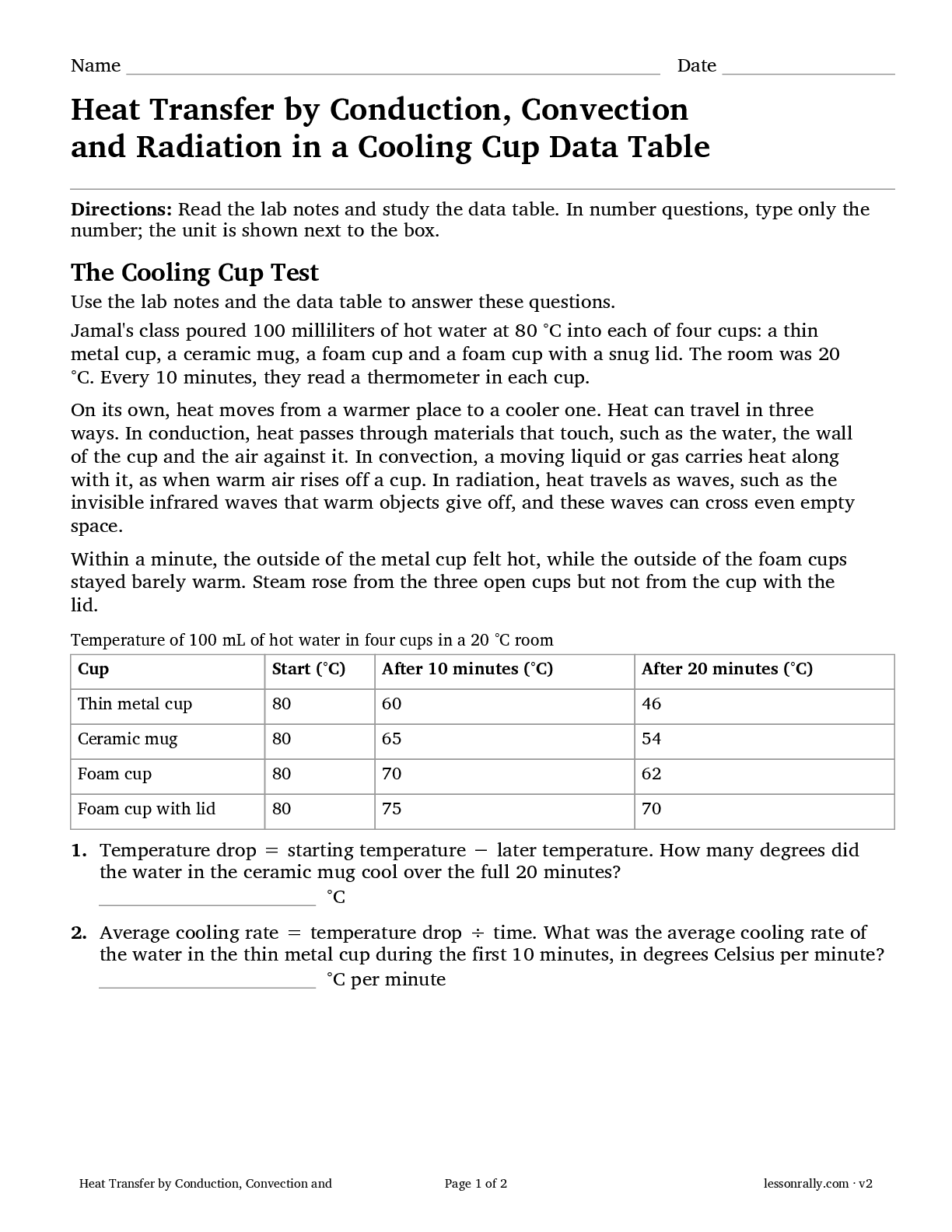
Use the lab notes and the data table to answer these questions.
Jamal's class poured 100 milliliters of hot water at 80 °C into each of four cups: a thin metal cup, a ceramic mug, a foam cup and a foam cup with a snug lid. The room was 20 °C. Every 10 minutes, they read a thermometer in each cup.
On its own, heat moves from a warmer place to a cooler one. Heat can travel in three ways. In conduction, heat passes through materials that touch, such as the water, the wall of the cup and the air against it. In convection, a moving liquid or gas carries heat along with it, as when warm air rises off a cup. In radiation, heat travels as waves, such as the invisible infrared waves that warm objects give off, and these waves can cross even empty space.
Within a minute, the outside of the metal cup felt hot, while the outside of the foam cups stayed barely warm. Steam rose from the three open cups but not from the cup with the lid.
| Cup | Start (°C) | After 10 minutes (°C) | After 20 minutes (°C) |
|---|---|---|---|
| Thin metal cup | 80 | 60 | 46 |
| Ceramic mug | 80 | 65 | 54 |
| Foam cup | 80 | 70 | 62 |
| Foam cup with lid | 80 | 75 | 70 |
Temperature drop = starting temperature − later temperature. How many degrees did the water in the ceramic mug cool over the full 20 minutes?
Enter a number.
°C
Average cooling rate = temperature drop ÷ time. What was the average cooling rate of the water in the thin metal cup during the first 10 minutes, in degrees Celsius per minute?
Enter a number.
°C per minute
Jada says the water in the cups cooled because cold from the room flowed into them. Which statement best describes what really happened?
Choose one answer.
The lab notes say the outside of the metal cup felt hot within a minute, while the outside of the foam cups stayed barely warm. What does this observation, together with the table, suggest?
Choose one answer.
After 20 minutes, the foam cup with a lid held water 8 degrees warmer than the open foam cup. The lab notes say steam rose only from the open cups. Which kind of heat loss did the lid most likely reduce the most?
Choose one answer.
The lab notes say radiation can cross even empty space. Which example shows heat moving mainly by radiation?
Choose one answer.
The class repeats the test with cold water at 5 °C in the same four cups, still in the 20 °C room. Which cup would most likely keep its water coldest after 20 minutes, and why?
Choose one answer.
A metal spoon and a wooden spoon have been lying side by side on a table in a 20 °C room for hours. When you pick them up, the metal spoon feels colder. Why?
Choose one answer.
No reviews yet.
Reviews come from teachers who assigned this activity to a class.
Have a topic of your own? Make a printable worksheet and online quiz, free.
Create an activityCommon Core RST.6-8.7
Made by Theo Nakamura · LessonRally (AI-assisted)
Common Core RST.6-8.4
Made by Myra Jefferson · LessonRally (AI-assisted)
Made by Theo Nakamura · LessonRally (AI-assisted)
Common Core RST.6-8.4
Made by Myra Jefferson · LessonRally (AI-assisted)