Question 1
Kinetic energy = ½ × mass × speed². A 4-kilogram bowling ball rolls down the lane at 5 meters per second. What is the kinetic energy of its forward motion?
Enter a number.
J


Teachers who sign in can assign LessonRally activities to their Google Classroom classes: students open them in Classroom and answer online, and their grades go to the teacher's Classroom gradebook. Practice lets you try it first, the way students see it.
Free for teachers. Sign in to assign activities to your Google Classroom classes.
 (opens in a new tab)
2 pages · Student copy, no answers
Print worksheet (opens in a new tab)Answer keyPremiumStudents calculate kinetic energy (½ × mass × speed²) and gravitational potential energy in joules for objects such as bowling balls, bikes, wagons and flowerpots, then explain how mass, speed and height change the energy and what happens to energy when it changes form. Questions take on the ideas that doubling speed only doubles kinetic energy and that energy gets used up.
Learning goal: Calculate kinetic energy and gravitational potential energy, explain how mass, speed and height affect them, and describe how energy changes form without being used up.
The estimate is the middle score of five readability formulas. Their scores run from 4.5 to 10.3.
Adapted from common readability formulas (Flesch-Kincaid, Gunning Fog, Coleman-Liau and ARI, plus SMOG for long texts), which look at sentence length and word length. Answer choices count toward word length only. Grades below the estimate will likely find the text harder, grades above it easier. It does not measure ideas, background knowledge or images.
Topic: Energy Chosen by LessonRally
Question types: number answer, select all that apply, multiple choice.
The questions as students see them, without the answers.
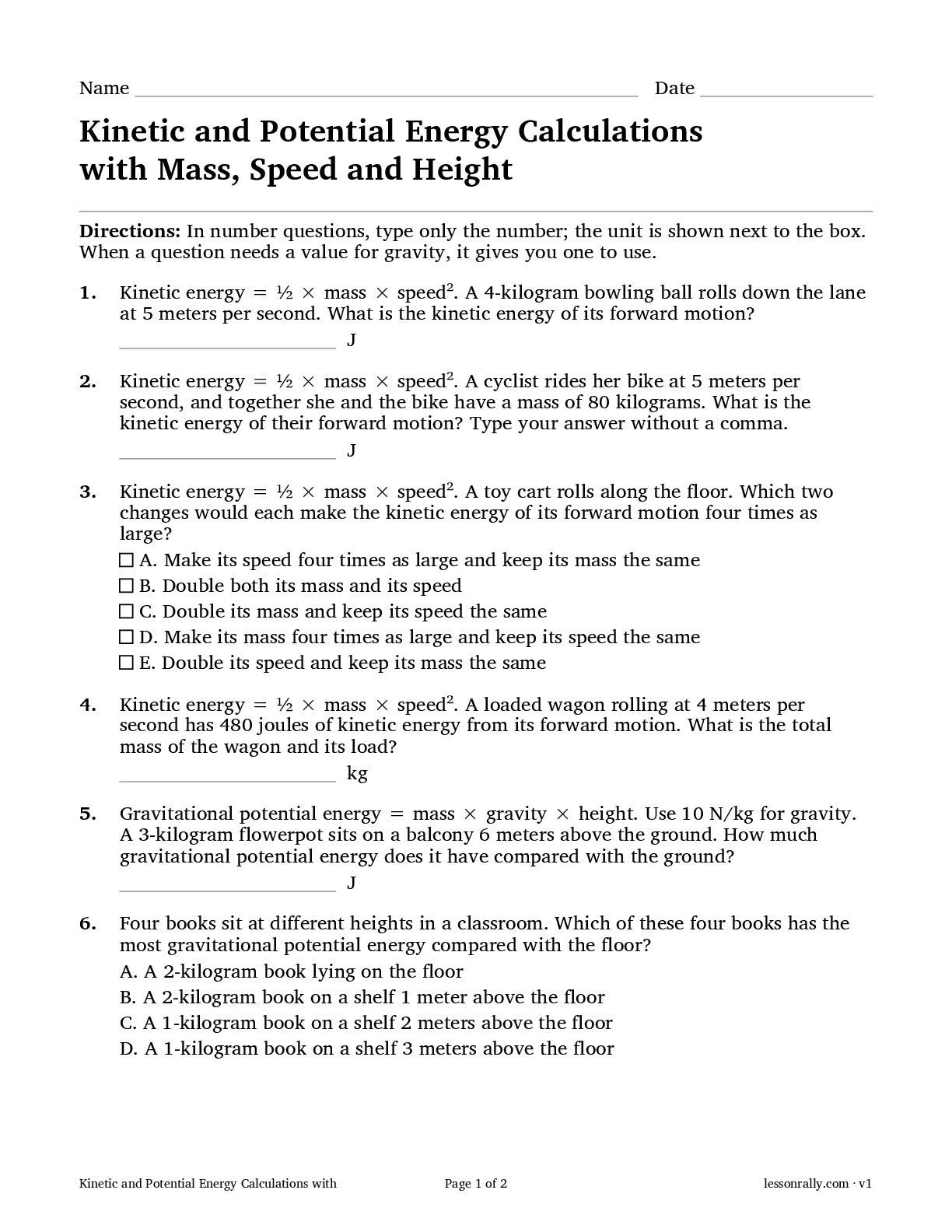
In number questions, type only the number; the unit is shown next to the box. When a question needs a value for gravity, it gives you one to use.
Kinetic energy = ½ × mass × speed². A 4-kilogram bowling ball rolls down the lane at 5 meters per second. What is the kinetic energy of its forward motion?
Enter a number.
J
Kinetic energy = ½ × mass × speed². A cyclist rides her bike at 5 meters per second, and together she and the bike have a mass of 80 kilograms. What is the kinetic energy of their forward motion? Type your answer without a comma.
Enter a number.
J
Kinetic energy = ½ × mass × speed². A toy cart rolls along the floor. Which two changes would each make the kinetic energy of its forward motion four times as large?
Choose 2 answers.
Kinetic energy = ½ × mass × speed². A loaded wagon rolling at 4 meters per second has 480 joules of kinetic energy from its forward motion. What is the total mass of the wagon and its load?
Enter a number.
kg
Gravitational potential energy = mass × gravity × height. Use 10 N/kg for gravity. A 3-kilogram flowerpot sits on a balcony 6 meters above the ground. How much gravitational potential energy does it have compared with the ground?
Enter a number.
J
Four books sit at different heights in a classroom. Which of these four books has the most gravitational potential energy compared with the floor?
Choose one answer.
Gravitational potential energy = mass × gravity × height. Use 10 N/kg for gravity, and ignore air resistance. A 2-kilogram ball is dropped from a height of 5 meters. How much kinetic energy does it have just before it reaches the ground?
Enter a number.
J
A child sits still on a playground swing as it swings back and forth. Ignore friction and air resistance. Which statement about the swing's energy is true?
Choose one answer.
A soccer ball rolls across a flat, grassy field and slowly comes to a stop. What happened to its kinetic energy?
Choose one answer.
Kai holds two bar magnets with their north poles facing each other, so they push apart. He pushes them closer together. What happens to the potential energy stored in the pair of magnets?
Choose one answer.
No reviews yet.
Reviews come from teachers who assigned this activity to a class.
Have a topic of your own? Make a printable worksheet and online quiz, free.
Create an activityCommon Core RST.6-8.7
Made by Theo Nakamura · LessonRally (AI-assisted)
Common Core RST.6-8.4
Made by Myra Jefferson · LessonRally (AI-assisted)
Made by Theo Nakamura · LessonRally (AI-assisted)
Common Core RST.6-8.4
Made by Myra Jefferson · LessonRally (AI-assisted)