Question 1
According to the passage, what gave heat to the metal spoon?
Choose one answer.
- The cool air in the kitchen
- The wooden spoon
- The hot soup
- Ben's fingers


Teachers who sign in can assign LessonRally activities to their Google Classroom classes: students open them in Classroom and answer online, and their grades go to the teacher's Classroom gradebook. Practice lets you try it first, the way students see it.
Free for teachers. Sign in to assign activities to your Google Classroom classes.
 (opens in a new tab)
2 pages · Student copy, no answers
Print worksheet (opens in a new tab)Answer keyPremiumStudents read about a metal spoon and a wooden spoon in a bowl of hot soup and explain heat transfer: heat moves from a warmer thing to a cooler thing. Questions cover heat, temperature, conductors and insulators, why a metal spoon feels cold, and why it is heat, not cold, that moves.
Learning goal: Explain that heat moves from a warmer object to a cooler one, and that heat moves through most metals more easily than through wood.
The estimate is halfway between the two middle scores of four readability formulas. Their scores run from 3.6 to 6.0.
Adapted from common readability formulas (Flesch-Kincaid, Gunning Fog, Coleman-Liau and ARI, plus SMOG for long texts), which look at sentence length and word length. Answer choices count toward word length only. Grades below the estimate will likely find the text harder, grades above it easier. It does not measure ideas, background knowledge or images.
Explain events, procedures, ideas, or concepts in a historical, scientific, or technical text, including what happened and why, based on specific information in the text.
Refer to details and examples in a text when explaining what the text says explicitly and when drawing inferences from the text.
Student preview question 1
Determine the meaning of general academic and domain-specific words or phrases in a text relevant to a grade 4 topic or subject area.
Student preview question 2
Matched independently by two AI models from this activity's questions.
© Copyright 2010. National Governors Association Center for Best Practices and Council of Chief State School Officers. All rights reserved.
Topic: Energy Chosen by LessonRally
Question types: multiple choice, matching, fill in the blank.
The questions as students see them, without the answers.
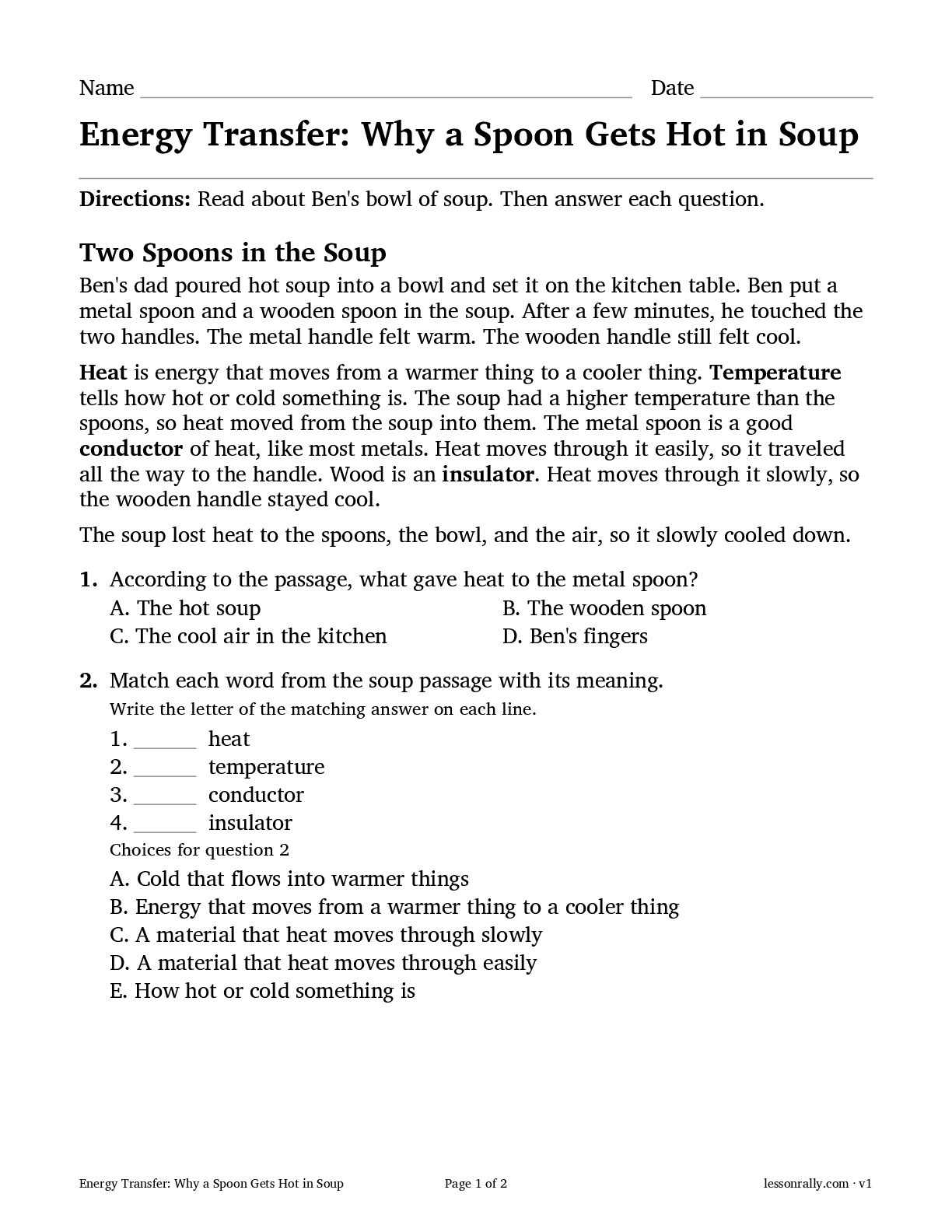
Read about Ben's bowl of soup. Then answer each question.
Ben's dad poured hot soup into a bowl and set it on the kitchen table. Ben put a metal spoon and a wooden spoon in the soup. After a few minutes, he touched the two handles. The metal handle felt warm. The wooden handle still felt cool.
Heat is energy that moves from a warmer thing to a cooler thing. Temperature tells how hot or cold something is. The soup had a higher temperature than the spoons, so heat moved from the soup into them. The metal spoon is a good conductor of heat, like most metals. Heat moves through it easily, so it traveled all the way to the handle. Wood is an insulator. Heat moves through it slowly, so the wooden handle stayed cool.
The soup lost heat to the spoons, the bowl, and the air, so it slowly cooled down.
According to the passage, what gave heat to the metal spoon?
Choose one answer.
Match each word from the soup passage with its meaning.
Match each item to an option.
Items
Options
How did heat get from the soup all the way up to the metal spoon's handle?
Choose one answer.
Why did the wooden spoon's handle stay cool?
Choose one answer.
Use the word bank to finish the sentence about holding an ice cube.
Fill in each blank.
When Ben holds an ice cube, heat moves from his blank 1 into the blank 2.
Word bank
What happened to the soup's temperature as it sat on the table?
Choose one answer.
A metal spoon and a wooden spoon have been on the counter all night, so they are the same temperature. When Ben picks them up, the metal one feels colder. Why?
Choose one answer.
What would happen if Ben put a metal spoon from the drawer into a bowl of soup that had cooled all the way to room temperature?
Choose one answer.
No reviews yet.
Reviews come from teachers who assigned this activity to a class.
Have a topic of your own? Make a printable worksheet and online quiz, free.
Create an activityCommon Core RI.4.3
Made by Wes Calloway · LessonRally (AI-assisted)
Common Core RI.4.3
Made by Wes Calloway · LessonRally (AI-assisted)
Common Core RI.4.1
Made by Wes Calloway · LessonRally (AI-assisted)
Common Core RI.4.4
Made by Wes Calloway · LessonRally (AI-assisted)