Teachers who sign in can assign LessonRally activities to their Google Classroom classes: students open them in Classroom and answer online, and their grades go to the teacher's Classroom gradebook. Practice lets you try it first, the way students see it.
Students track energy on roller coasters, crates, sleds, a thrown ball and a swing, using energy inventories and the formulas for kinetic and gravitational potential energy, and explain each energy transfer when friction turns motion energy into thermal energy and sound. Questions take on the ideas that energy gets used up or destroyed and that a coaster can climb a later hill as tall as the first.
Learning goal: Use energy inventories to show that the total energy stays the same as energy changes form, and explain how energy is transferred to or from an object when its kinetic energy changes.
Estimated reading level7.3
Grade 5Hard
Grade 6Stretch
Grade 7On level
Grade 8Easier
Grade 9Easy
About this estimate
The estimate is the middle score of five readability formulas. Their scores run from 5.8 to 10.6.
Flesch-Kincaid GradeSentence length and syllables per word6.8
Gunning FogSentence length and words of three or more syllables10.6
Coleman-Liau Middle scoreLetters per word and sentences per 100 words7.3
Automated Readability IndexCharacters per word and words per sentence5.8
SMOGWords of three or more syllables, for texts of 30 sentences or more10.2
Grade 181216
Flesch Reading Ease
70.5 on a 0 to 100 scale where higher is easier: fairly easy. Not part of the estimate.
Text measured
736 words, 33 sentences
Adapted from common readability formulas (Flesch-Kincaid, Gunning Fog, Coleman-Liau and ARI, plus SMOG for long texts), which look at sentence length and word length. Answer choices count toward word length only. Grades below the estimate will likely find the text harder, grades above it easier. It does not measure ideas, background knowledge or images.
Question types: number answer, multiple choice, select all that apply.
Student preview
The questions as students see them, without the answers.
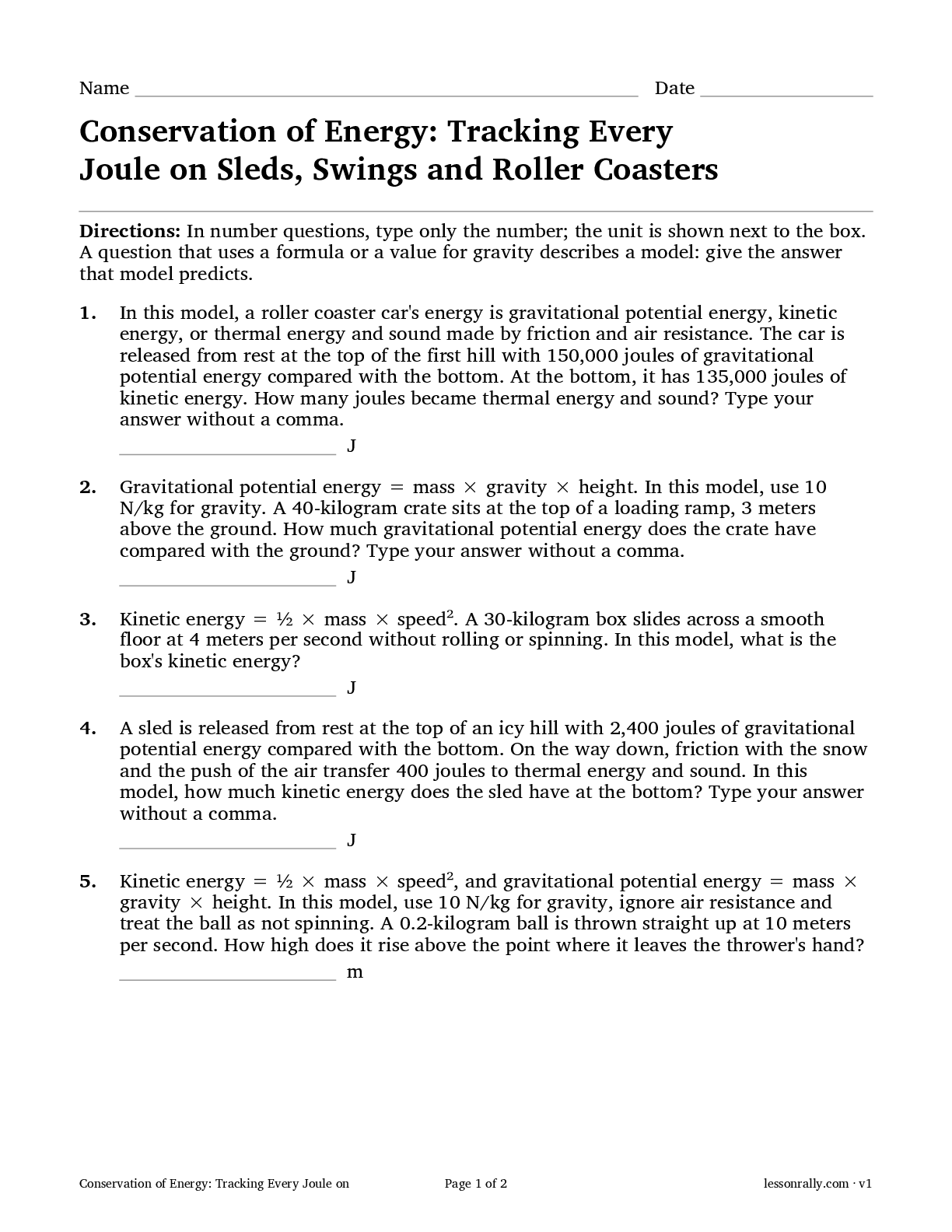
In number questions, type only the number; the unit is shown next to the box. A question that uses a formula or a value for gravity describes a model: give the answer that model predicts.
Question 1
In this model, a roller coaster car's energy is gravitational potential energy, kinetic energy, or thermal energy and sound made by friction and air resistance. The car is released from rest at the top of the first hill with 150,000 joules of gravitational potential energy compared with the bottom. At the bottom, it has 135,000 joules of kinetic energy. How many joules became thermal energy and sound? Type your answer without a comma.
Enter a number.
J
Question 2
Gravitational potential energy = mass × gravity × height. In this model, use 10 N/kg for gravity. A 40-kilogram crate sits at the top of a loading ramp, 3 meters above the ground. How much gravitational potential energy does the crate have compared with the ground? Type your answer without a comma.
Enter a number.
J
Question 3
Kinetic energy = ½ × mass × speed². A 30-kilogram box slides across a smooth floor at 4 meters per second without rolling or spinning. In this model, what is the box's kinetic energy?
Enter a number.
J
Question 4
A sled is released from rest at the top of an icy hill with 2,400 joules of gravitational potential energy compared with the bottom. On the way down, friction with the snow and the push of the air transfer 400 joules to thermal energy and sound. In this model, how much kinetic energy does the sled have at the bottom? Type your answer without a comma.
Enter a number.
J
Question 5
Kinetic energy = ½ × mass × speed², and gravitational potential energy = mass × gravity × height. In this model, use 10 N/kg for gravity, ignore air resistance and treat the ball as not spinning. A 0.2-kilogram ball is thrown straight up at 10 meters per second. How high does it rise above the point where it leaves the thrower's hand?
Enter a number.
m
Question 6
A child stops pumping her legs on a swing, and each swing gets a little lower until she comes to rest. What happened to the swing's energy?
Choose one answer.
It was used up, so there is now less energy in the world.
It was all stored in the swing as gravitational potential energy at the lowest point.
Gravity destroyed a little of it on every swing.
It was transferred, mostly as thermal energy and a little sound, to the air, the chains and the hooks the swing hangs from, and the total amount of energy stayed the same.
Question 7
Rosa's hockey stick hits a puck that was resting on the ice, and the puck slides away fast. Which statement best describes the energy?
Choose one answer.
The puck's kinetic energy came from the cold ice under it.
The puck created new energy at the moment it was hit.
Energy was transferred from the moving stick to the puck, so the puck's kinetic energy increased.
No energy moved, because the puck already had that kinetic energy while it was at rest.
Question 8
A bike rider on a flat road squeezes the brakes, and the bike slows to a stop. Which two statements are true?
Choose 2 answers.
The brakes destroyed the bike's kinetic energy.
Most of the bike's kinetic energy became thermal energy in the brake pads, the wheels and the air.
The bike's kinetic energy became gravitational potential energy.
The bike gained kinetic energy while it slowed down.
The total amount of energy stayed the same.
Question 9
On a cold morning, Luis rubs his palms together quickly, and they feel warmer. Which statement best explains this?
Choose one answer.
His hands warm up because rubbing takes energy away from them.
Rubbing pushes the cold out of his hands.
Rubbing makes new energy out of nothing.
Friction transfers the kinetic energy of his moving hands into thermal energy, so his skin warms up.
Question 10
A roller coaster car is pulled to the top of its first hill and released from rest, with no motor to help it after that. Why can't a later hill on the track be as tall as the first one?
Choose one answer.
The car uses up all of its energy on the first drop.
Some energy is transferred to thermal energy and sound along the way, so the car never again has as much motion energy and stored energy as it had at the start.
Gravity pulls harder on the car as the ride goes on.
The car gains energy on every drop, so later hills must be lower to slow it down.