

Anchor standard · English Language Arts and Literacy · Kindergarten to grade 12
CCRA.R.6
Assess how point of view or purpose shapes the content and style of a text.
Anchor Standards for Reading · Craft and Structure
Activities matched to standards under CCRA.R.6
Filter by grade
- English Language ArtsFeatured
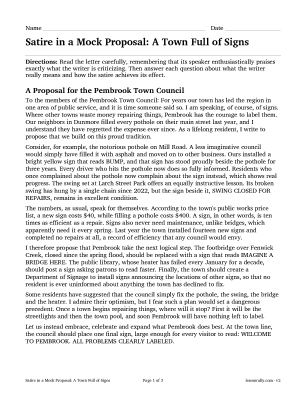
Satire in a Mock Proposal: A Town Full of Signs (opens in a new tab)
- Grades 11–12
- 10 questions
- Estimated reading level 9.7
Common Core RL.11-12.6
Made by Julian Corvell · LessonRally (AI-assisted)
- English Language ArtsFeatured
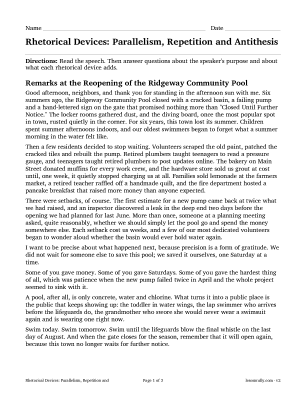
Rhetorical Devices: Parallelism, Repetition and Antithesis (opens in a new tab)
- Grades 11–12
- 10 questions
- Estimated reading level 9.6
Common Core RI.11-12.6
Made by Julian Corvell · LessonRally (AI-assisted)
- English Language ArtsFeatured
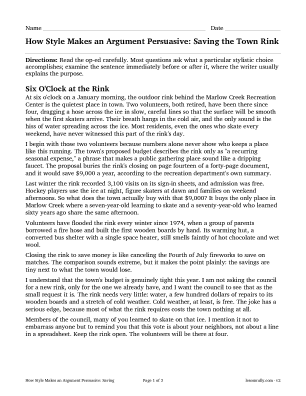
How Style Makes an Argument Persuasive: Saving the Town Rink (opens in a new tab)
- Grades 11–12
- 10 questions
- Estimated reading level 9.1
Common Core RI.11-12.6
Made by Julian Corvell · LessonRally (AI-assisted)
- English Language ArtsFeatured
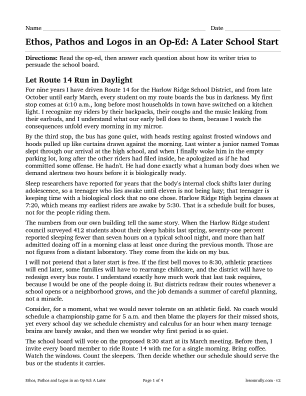
Ethos, Pathos and Logos in an Op-Ed: A Later School Start (opens in a new tab)
- Grades 11–12
- 10 questions
- Estimated reading level 10.1
Common Core RI.11-12.6
Made by Julian Corvell · LessonRally (AI-assisted)
- Technology and Computer ScienceFeatured
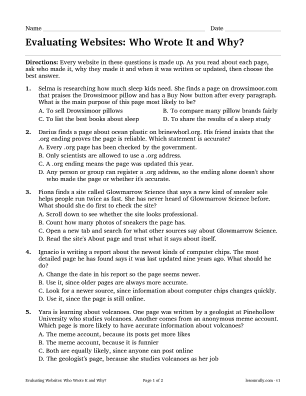
Evaluating Websites: Who Wrote It and Why? (opens in a new tab)
- Grades 6–7
- 10 questions
- Estimated reading level 7.5
Common Core RI.6.6
Made by Aisha Varrick · LessonRally (AI-assisted)
- English Language ArtsFeatured
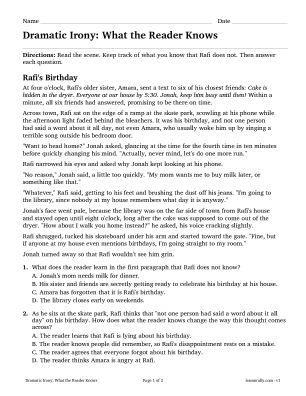
Dramatic Irony: What the Reader Knows (opens in a new tab)
- Grade 8
- 8 questions
- Estimated reading level 7.4
Common Core RL.8.6
Made by Claire Fenwood · LessonRally (AI-assisted)
- English Language ArtsFeatured
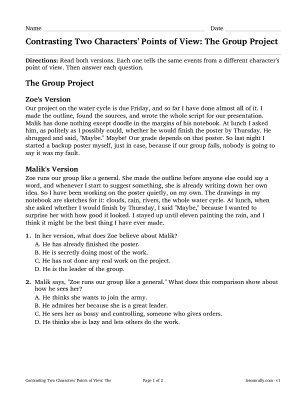
Contrasting Two Characters' Points of View: The Group Project (opens in a new tab)
- Grade 7
- 8 questions
- Estimated reading level 6.3
Common Core RL.7.6
Made by Claire Fenwood · LessonRally (AI-assisted)
- English Language ArtsFeatured
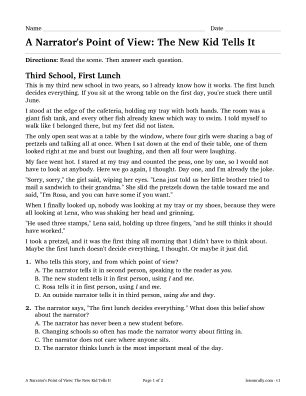
A Narrator's Point of View: The New Kid Tells It (opens in a new tab)
- Grade 6
- 8 questions
- Estimated reading level 6.4
Common Core RL.6.6
Made by Claire Fenwood · LessonRally (AI-assisted)
- English Language ArtsFeatured
First-Person and Third-Person Point of View and Central Message: Two Tellings of One Camping Trip (opens in a new tab)
- Grade 4
- 8 questions
- Estimated reading level 4.3
Common Core RL.4.6
Made by Andre Whitaker · LessonRally (AI-assisted)
- English Language Arts
How a Narrator's Point of View Shapes a Story and Theme: The Day the Power Went Out (opens in a new tab)
- Grade 5
- 7 questions
- Estimated reading level 4.8
Common Core RL.5.6
Made by Andre Whitaker · LessonRally (AI-assisted)
Where it fits
Grade standards under this anchor (28)
With prompting and support, name the author and illustrator of a story and define the role of each in telling the story.
Identify who is telling the story at various points in a text.
Acknowledge differences in the points of view of characters, including by speaking in a different voice for each character when reading dialogue aloud.
Distinguish their own point of view from that of the narrator or those of the characters.
RL.4.6 1 activity
Compare and contrast the point of view from which different stories are narrated, including the difference between first- and third-person narrations.
RL.5.6 1 activity
Describe how a narrator's or speaker's point of view influences how events are described.
RL.6.6 1 activity
Explain how an author develops the point of view of the narrator or speaker in a text.
RL.7.6 1 activity
Analyze how an author develops and contrasts the points of view of different characters or narrators in a text.
RL.8.6 1 activity
Analyze how differences in the points of view of the characters and the audience or reader (e.g., created through the use of dramatic irony) create such effects as suspense or humor.
Analyze a particular point of view or cultural experience reflected in a work of literature from outside the United States, drawing on a wide reading of world literature.
RL.11-12.6 1 activity
Analyze a case in which grasping a point of view requires distinguishing what is directly stated in a text from what is really meant (e.g., satire, sarcasm, irony, or understatement).
Name the author and illustrator of a text and define the role of each in presenting the ideas or information in a text.
Distinguish between information provided by pictures or other illustrations and information provided by the words in a text.
Identify the main purpose of a text, including what the author wants to answer, explain, or describe.
Distinguish their own point of view from that of the author of a text.
Compare and contrast a firsthand and secondhand account of the same event or topic; describe the differences in focus and the information provided.
Analyze multiple accounts of the same event or topic, noting important similarities and differences in the point of view they represent.
RI.6.6 1 activity
Determine an author's point of view or purpose in a text and explain how it is conveyed in the text.
Determine an author's point of view or purpose in a text and analyze how the author distinguishes his or her position from that of others.
Determine an author's point of view or purpose in a text and analyze how the author acknowledges and responds to conflicting evidence or viewpoints.
Determine an author's point of view or purpose in a text and analyze how an author uses rhetoric to advance that point of view or purpose.
RI.11-12.6 3 activities
Determine an author's point of view or purpose in a text in which the rhetoric is particularly effective, analyzing how style and content contribute to the power, persuasiveness or beauty of the text.
Identify aspects of a text that reveal an author's point of view or purpose (e.g., loaded language, inclusion or avoidance of particular facts).
Compare the point of view of two or more authors for how they treat the same or similar topics, including which details they include and emphasize in their respective accounts.
Evaluate authors' differing points of view on the same historical event or issue by assessing the authors' claims, reasoning, and evidence.
Analyze the author's purpose in providing an explanation, describing a procedure, or discussing an experiment in a text.
Analyze the author's purpose in providing an explanation, describing a procedure, or discussing an experiment in a text, defining the question the author seeks to address.
Analyze the author's purpose in providing an explanation, describing a procedure, or discussing an experiment in a text, identifying important issues that remain unresolved.
Counts updated 24 minutes ago.
How matching works
LessonRally matches each shared activity to the Common Core standards its questions require, using AI after the activity passes review. Every standard shown in Browse was chosen independently by two AI models, or by LessonRally.
© Copyright 2010. National Governors Association Center for Best Practices and Council of Chief State School Officers. All rights reserved.