Rhetorical Devices: Parallelism, Repetition and Antithesis

10 questions · 10 points · Grades 11–12 · English · Preview the 10 questions

Made by Julian Corvell · LessonRally (AI-assisted)

Digital classroom activity

What is a digital classroom activity?

Teachers who sign in can assign LessonRally activities to their Google Classroom classes: students open them in Classroom and answer online, and their grades go to the teacher's Classroom gradebook. Practice lets you try it first, the way students see it.

Free for teachers. Sign in to assign activities to your Google Classroom classes.

Printable worksheet

Students read an original speech given at the reopening of a community pool and analyze how its rhetorical devices work: parallelism, repetition, anaphora and antithesis. Most questions ask what a device does for the audience rather than what it is called, and one asks students to find two examples of anaphora in the speech.

Learning goal: Analyze how a speaker uses parallelism, repetition and antithesis to shape meaning and move an audience, and determine the speaker's purpose.

Estimated reading level 9.6

  1. Grade 7Hard
  2. Grade 8Stretch
  3. Grade 9On level
  4. Grade 10Easier
  5. Grade 11Easy
About this estimate

The estimate is the middle score of five readability formulas. Their scores run from 8.0 to 10.2.

  • Flesch-Kincaid GradeSentence length and syllables per word8.0
  • Gunning FogSentence length and words of three or more syllables10.2
  • Coleman-Liau Middle scoreLetters per word and sentences per 100 words9.6
  • Automated Readability IndexCharacters per word and words per sentence9.1
  • SMOGWords of three or more syllables, for texts of 30 sentences or more9.9
Flesch Reading Ease
69.2 on a 0 to 100 scale where higher is easier: standard. Not part of the estimate.
Text measured
1,368 words, 44 sentences

Adapted from common readability formulas (Flesch-Kincaid, Gunning Fog, Coleman-Liau and ARI, plus SMOG for long texts), which look at sentence length and word length. Answer choices count toward word length only. Grades below the estimate will likely find the text harder, grades above it easier. It does not measure ideas, background knowledge or images.

Common Core

Closest anchor: CCRA.R.6 Assess how point of view or purpose shapes the content and style of a text.Anchor Standards for ReadingShow 1 matched standardHide matched standard

Matched standard

  • RI.11-12.6

    Determine an author's point of view or purpose in a text in which the rhetoric is particularly effective, analyzing how style and content contribute to the power, persuasiveness or beauty of the text.

    Student preview questions 1, 7

Matched independently by two AI models from this activity's questions.

© Copyright 2010. National Governors Association Center for Best Practices and Council of Chief State School Officers. All rights reserved.

Topic: Author's Purpose Chosen by LessonRally

Question types: multiple choice, select all that apply.

Student preview

The questions as students see them, without the answers.

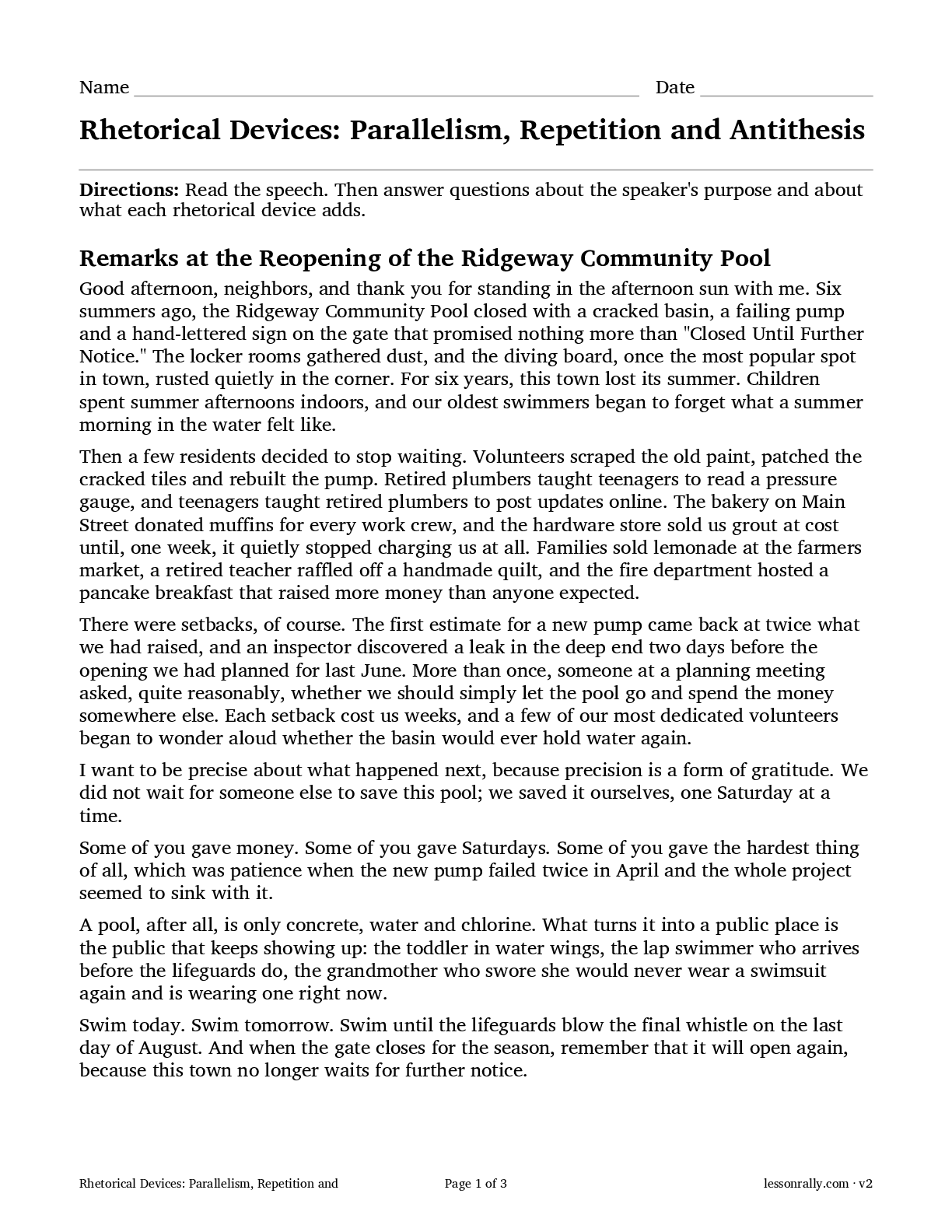
Read the speech. Then answer questions about the speaker's purpose and about what each rhetorical device adds.

Remarks at the Reopening of the Ridgeway Community Pool

Good afternoon, neighbors, and thank you for standing in the afternoon sun with me. Six summers ago, the Ridgeway Community Pool closed with a cracked basin, a failing pump and a hand-lettered sign on the gate that promised nothing more than "Closed Until Further Notice." The locker rooms gathered dust, and the diving board, once the most popular spot in town, rusted quietly in the corner. For six years, this town lost its summer. Children spent summer afternoons indoors, and our oldest swimmers began to forget what a summer morning in the water felt like.

Then a few residents decided to stop waiting. Volunteers scraped the old paint, patched the cracked tiles and rebuilt the pump. Retired plumbers taught teenagers to read a pressure gauge, and teenagers taught retired plumbers to post updates online. The bakery on Main Street donated muffins for every work crew, and the hardware store sold us grout at cost until, one week, it quietly stopped charging us at all. Families sold lemonade at the farmers market, a retired teacher raffled off a handmade quilt, and the fire department hosted a pancake breakfast that raised more money than anyone expected.

There were setbacks, of course. The first estimate for a new pump came back at twice what we had raised, and an inspector discovered a leak in the deep end two days before the opening we had planned for last June. More than once, someone at a planning meeting asked, quite reasonably, whether we should simply let the pool go and spend the money somewhere else. Each setback cost us weeks, and a few of our most dedicated volunteers began to wonder aloud whether the basin would ever hold water again.

I want to be precise about what happened next, because precision is a form of gratitude. We did not wait for someone else to save this pool; we saved it ourselves, one Saturday at a time.

Some of you gave money. Some of you gave Saturdays. Some of you gave the hardest thing of all, which was patience when the new pump failed twice in April and the whole project seemed to sink with it.

A pool, after all, is only concrete, water and chlorine. What turns it into a public place is the public that keeps showing up: the toddler in water wings, the lap swimmer who arrives before the lifeguards do, the grandmother who swore she would never wear a swimsuit again and is wearing one right now.

Swim today. Swim tomorrow. Swim until the lifeguards blow the final whistle on the last day of August. And when the gate closes for the season, remember that it will open again, because this town no longer waits for further notice.


Question 1

What is the speaker's main purpose in these remarks at the reopening of the Ridgeway pool?

Choose one answer.

  • To honor the volunteers and celebrate what the town accomplished together
  • To ask the town council to pay for a second public pool across town
  • To warn the audience that the pool may have to close again next year
  • To explain the new safety rules that swimmers must follow this summer

Question 2

In the opening paragraph, the speaker says, "For six years, this town lost its summer. Children spent summer afternoons indoors, and our oldest swimmers began to forget what a summer morning in the water felt like." What is the effect of repeating the word summer?

Choose one answer.

  • It signals that the speaker is about to turn to the town's plans for winter.
  • It shows that the speaker likes summer far better than the other seasons.
  • It suggests that the summer heat was what caused the damage to the pool.
  • It stresses how much of the town's shared life vanished while the pool was closed.

Question 3

Which device does the speaker rely on in the sentence "Volunteers scraped the old paint, patched the cracked tiles and rebuilt the pump"?

Choose one answer.

  • Parallelism: a series of phrases built in the same grammatical form
  • Antithesis: two opposing ideas set against each other
  • Rhetorical question: a question asked for effect rather than for an answer
  • Anaphora: the same words repeated at the start of successive clauses

Question 4

The speaker says, "Retired plumbers taught teenagers to read a pressure gauge, and teenagers taught retired plumbers to post updates online." What does the reversal in the second half of this sentence suggest about the relationship between the two groups of volunteers?

Choose one answer.

  • The young and old volunteers learned from each other as equals.
  • The teenagers did more of the repair work than the plumbers did.
  • The plumbers did not want to learn anything new from teenagers.
  • The project fell behind because the volunteers kept arguing.

Question 5

The speaker says, "We did not wait for someone else to save this pool; we saved it ourselves, one Saturday at a time." What does the contrast in this sentence emphasize?

Choose one answer.

  • Residents acted for themselves instead of waiting for others to rescue the pool.
  • The speaker regrets how long the repairs ended up taking the volunteers.
  • The volunteers finished all of the repairs in a single busy weekend.
  • The town government paid for most of the repairs that the old pool needed.

Question 6

Anaphora is the repetition of the same word or words at the start of successive sentences or clauses. Which two passages from the speech use anaphora?

Choose 2 answers.

  • "Retired plumbers taught teenagers to read a pressure gauge, and teenagers taught retired plumbers to post updates online."
  • "Some of you gave money. Some of you gave Saturdays. Some of you gave the hardest thing of all, which was patience when the new pump failed twice in April and the whole project seemed to sink with it."
  • "Volunteers scraped the old paint, patched the cracked tiles and rebuilt the pump."
  • "For six years, this town lost its summer. Children spent summer afternoons indoors, and our oldest swimmers began to forget what a summer morning in the water felt like."
  • "Swim today. Swim tomorrow. Swim until the lifeguards blow the final whistle on the last day of August."

Question 7

In the paragraph that begins "Some of you gave money," why does the speaker save patience for the last item?

Choose one answer.

  • To suggest that the money people gave mattered most to rebuilding the pool
  • To end on the gift the speaker calls the hardest, giving it the most weight
  • Because the new pump failed before anyone in town had given any money
  • Because patience was the gift that the fewest people in town were able to give

Question 8

How does the sentence "A pool, after all, is only concrete, water and chlorine" prepare for the sentence that follows it?

Choose one answer.

  • It complains about how much the new concrete and other materials for the pool cost.
  • It reduces the pool to its materials, setting up the claim that people make it public.
  • It warns swimmers that the chlorine in the water may sting their eyes this summer.
  • It explains how the volunteers kept the water clean while they made the repairs.

Question 9

The speaker says, "What turns it into a public place is the public that keeps showing up: the toddler in water wings, the lap swimmer who arrives before the lifeguards do, the grandmother who swore she would never wear a swimsuit again and is wearing one right now." What do the three examples after the colon add?

Choose one answer.

  • They criticize the swimmers who arrive at the pool before the lifeguards do.
  • They list the rules that every swimmer at the pool must follow this summer.
  • They name the volunteers who rebuilt the pump and patched the cracked tiles.
  • They make the public concrete by showing swimmers of different ages and habits.

Question 10

The speech's final sentence ends with the words "this town no longer waits for further notice." Why is this an effective way to close?

Choose one answer.

  • It echoes the sign from the opening paragraph and turns it into a statement of resolve.
  • It announces that the pool will close for good at the end of August this year.
  • It blames the lifeguards for closing the gate too early on summer evenings.
  • It introduces a new problem that the town will have to solve before next summer.

Reviews

No reviews yet.

Reviews come from teachers who assigned this activity to a class.

Sign in to write a review

Have a topic of your own? Make a printable worksheet and online quiz, free.

Create an activity

Answer key

Answer keys come with Premium

Print this worksheet with the correct answers marked. The key includes any explanations, sample answers, and rubrics supplied with the activity.

Answer keys aren't public: only teachers with Premium and the people who can edit an activity can download one, so students can't get a ready-to-print key from this page.

Premium includes:

  • No ads for you, and no ads for your students on the assignments you post.
  • Answer keys for printable worksheets, with the correct answers marked and any explanations, sample answers, and rubrics.
  • Create with AI: up to 100 activities a year (5 during the free trial), with every answer checked before you see the draft.

$29 a year, plus sales tax where it applies.

New Premium teachers can try it free for 7 days. A card or other payment method is needed to start. Unless you cancel before the trial ends, you are charged then and the plan renews every year.

Already have Premium or edit this activity? Sign in