How Style Makes an Argument Persuasive: Saving the Town Rink

10 questions · 10 points · Grades 11–12 · English · Preview the 10 questions

Made by Julian Corvell · LessonRally (AI-assisted)

Digital classroom activity

What is a digital classroom activity?

Teachers who sign in can assign LessonRally activities to their Google Classroom classes: students open them in Classroom and answer online, and their grades go to the teacher's Classroom gradebook. Practice lets you try it first, the way students see it.

Free for teachers. Sign in to assign activities to your Google Classroom classes.

Printable worksheet

Students analyze an original op-ed urging a town council to keep its outdoor skating rink open. Questions ask what each stylistic choice does for the argument: an opening scene, a quoted phrase, a loaded word, a rhetorical question, an analogy, a concession, a joke and direct address. For most of them, the op-ed itself states what the choice is meant to achieve.

Learning goal: Analyze how a writer's stylistic choices, including imagery, diction, analogy, humor and direct address, contribute to the persuasiveness of an argument and serve its purpose.

Estimated reading level 9.1

  1. Grade 7Hard
  2. Grade 8Stretch
  3. Grade 9On level
  4. Grade 10Easier
  5. Grade 11Easy
About this estimate

The estimate is the middle score of five readability formulas. Their scores run from 8.0 to 10.6.

  • Flesch-Kincaid GradeSentence length and syllables per word8.0
  • Gunning FogSentence length and words of three or more syllables10.6
  • Coleman-Liau Middle scoreLetters per word and sentences per 100 words9.1
  • Automated Readability IndexCharacters per word and words per sentence8.7
  • SMOGWords of three or more syllables, for texts of 30 sentences or more10.5
Flesch Reading Ease
68.6 on a 0 to 100 scale where higher is easier: standard. Not part of the estimate.
Text measured
1,207 words, 41 sentences

Adapted from common readability formulas (Flesch-Kincaid, Gunning Fog, Coleman-Liau and ARI, plus SMOG for long texts), which look at sentence length and word length. Answer choices count toward word length only. Grades below the estimate will likely find the text harder, grades above it easier. It does not measure ideas, background knowledge or images.

Common Core

Closest anchor: CCRA.R.6 Assess how point of view or purpose shapes the content and style of a text.Anchor Standards for ReadingShow 3 matched standardsHide matched standards

Matched standards

  • RI.11-12.6

    Determine an author's point of view or purpose in a text in which the rhetoric is particularly effective, analyzing how style and content contribute to the power, persuasiveness or beauty of the text.

    Student preview questions 1, 5, 6, 7, 9, 10

  • RI.11-12.1

    Cite strong and thorough textual evidence to support analysis of what the text says explicitly as well as inferences drawn from the text, including determining where the text leaves matters uncertain.

    Student preview question 4

  • RI.11-12.4

    Determine the meaning of words and phrases as they are used in a text, including figurative, connotative, and technical meanings; analyze how an author uses and refines the meaning of a key term or terms over the course of a text (e.g., how Madison defines faction in Federalist No. 10).

    Student preview question 3

Matched independently by two AI models from this activity's questions.

© Copyright 2010. National Governors Association Center for Best Practices and Council of Chief State School Officers. All rights reserved.

Topics: Author's Purpose, Figurative Language Chosen by LessonRally

Question types: multiple choice, select all that apply.

Student preview

The questions as students see them, without the answers.

Read the op-ed carefully. Most questions ask what a particular stylistic choice accomplishes; examine the sentence immediately before or after it, where the writer usually explains the purpose.

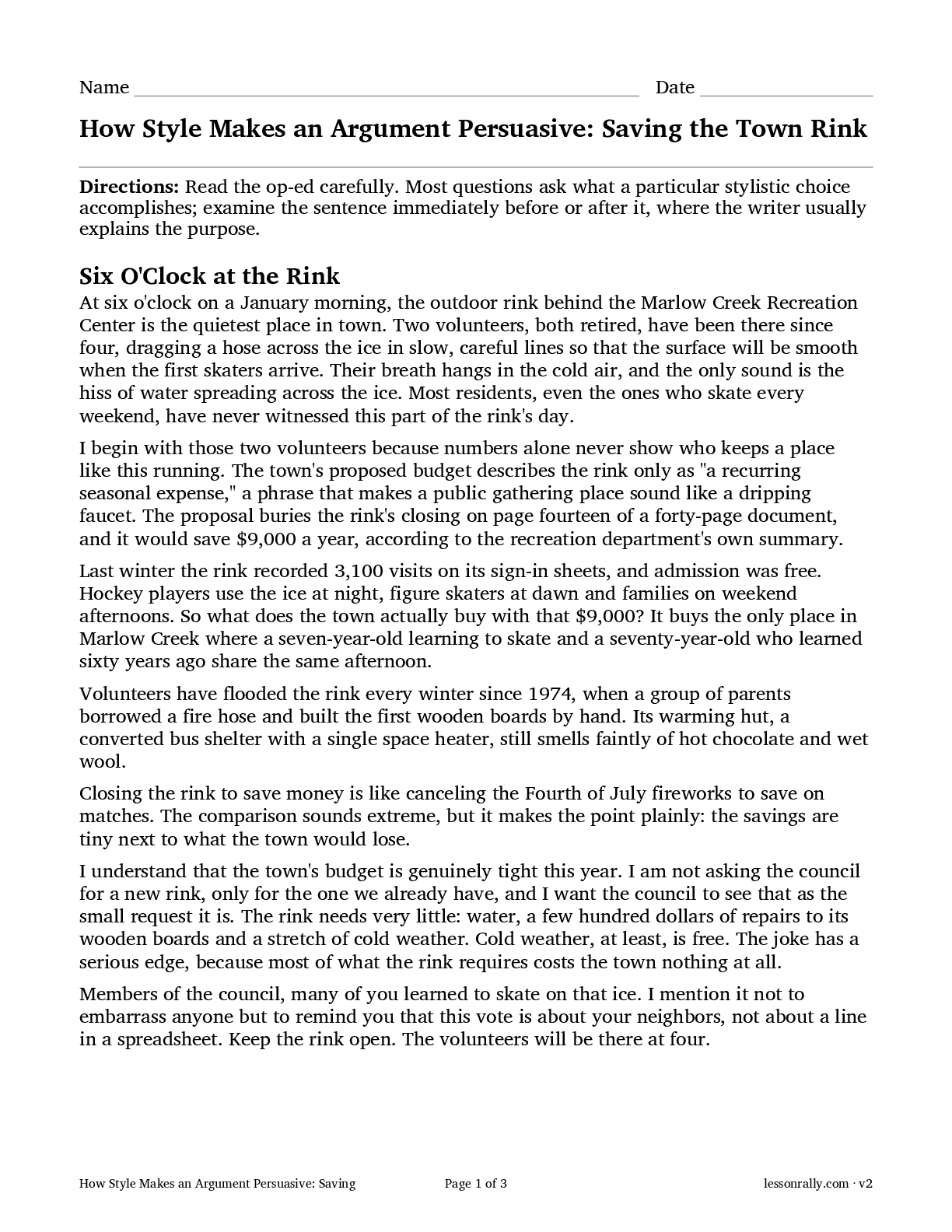
Six O'Clock at the Rink

At six o'clock on a January morning, the outdoor rink behind the Marlow Creek Recreation Center is the quietest place in town. Two volunteers, both retired, have been there since four, dragging a hose across the ice in slow, careful lines so that the surface will be smooth when the first skaters arrive. Their breath hangs in the cold air, and the only sound is the hiss of water spreading across the ice. Most residents, even the ones who skate every weekend, have never witnessed this part of the rink's day.

I begin with those two volunteers because numbers alone never show who keeps a place like this running. The town's proposed budget describes the rink only as "a recurring seasonal expense," a phrase that makes a public gathering place sound like a dripping faucet. The proposal buries the rink's closing on page fourteen of a forty-page document, and it would save $9,000 a year, according to the recreation department's own summary.

Last winter the rink recorded 3,100 visits on its sign-in sheets, and admission was free. Hockey players use the ice at night, figure skaters at dawn and families on weekend afternoons. So what does the town actually buy with that $9,000? It buys the only place in Marlow Creek where a seven-year-old learning to skate and a seventy-year-old who learned sixty years ago share the same afternoon.

Volunteers have flooded the rink every winter since 1974, when a group of parents borrowed a fire hose and built the first wooden boards by hand. Its warming hut, a converted bus shelter with a single space heater, still smells faintly of hot chocolate and wet wool.

Closing the rink to save money is like canceling the Fourth of July fireworks to save on matches. The comparison sounds extreme, but it makes the point plainly: the savings are tiny next to what the town would lose.

I understand that the town's budget is genuinely tight this year. I am not asking the council for a new rink, only for the one we already have, and I want the council to see that as the small request it is. The rink needs very little: water, a few hundred dollars of repairs to its wooden boards and a stretch of cold weather. Cold weather, at least, is free. The joke has a serious edge, because most of what the rink requires costs the town nothing at all.

Members of the council, many of you learned to skate on that ice. I mention it not to embarrass anyone but to remind you that this vote is about your neighbors, not about a line in a spreadsheet. Keep the rink open. The volunteers will be there at four.


Question 1

Why does the writer open the op-ed with two retired volunteers smoothing the ice before dawn?

Choose one answer.

  • To show the people that numbers alone leave out
  • To prove that the rink loses more and more money every winter
  • To trace the rink's long history from the day it first opened
  • To argue that the two retired volunteers deserve to be paid

Question 2

The writer quotes the budget's description of the rink as "a recurring seasonal expense." According to the writer, what effect does that bureaucratic phrase have?

Choose one answer.

  • It makes a public gathering place sound like a dripping faucet.
  • It proves that the rink costs far more than the council admits.
  • It shows that the volunteers wrote the budget themselves.
  • It gives readers an exact count of the rink's visitors.

Question 3

Read this sentence from the op-ed: "The proposal buries the rink's closing on page fourteen of a forty-page document, and it would save $9,000 a year, according to the recreation department's own summary." Which word itself suggests that the closing is being kept out of sight?

Choose one answer.

  • proposal
  • document
  • summary
  • buries

Question 4

Which two sentences back the argument with figures that the writer traces to a specific record?

Choose 2 answers.

  • "Last winter the rink recorded 3,100 visits on its sign-in sheets, and admission was free."
  • "Two volunteers, both retired, have been there since four, dragging a hose across the ice in slow, careful lines so that the surface will be smooth when the first skaters arrive."
  • "The rink needs very little: water, a few hundred dollars of repairs to its wooden boards and a stretch of cold weather."
  • "The proposal buries the rink's closing on page fourteen of a forty-page document, and it would save $9,000 a year, according to the recreation department's own summary."
  • "It buys the only place in Marlow Creek where a seven-year-old learning to skate and a seventy-year-old who learned sixty years ago share the same afternoon."

Question 5

What does the question "So what does the town actually buy with that $9,000?" set up?

Choose one answer.

  • An admission that the writer does not know how the money is spent
  • A challenge to the accuracy of the recreation department's figure
  • A request for readers to suggest other ways for the town to save money
  • The answer that follows: a place where young and old share the ice

Question 6

What point does the writer's comparison to "canceling the Fourth of July fireworks to save on matches" make about the proposal?

Choose one answer.

  • Fireworks matter more to the people of the town than the skating rink does.
  • The town should spend more on its Fourth of July celebration.
  • The money saved would be tiny next to what the town would lose.
  • Closing the rink would put local skaters in physical danger.

Question 7

What is the purpose of the writer's statement "I am not asking the council for a new rink, only for the one we already have"?

Choose one answer.

  • To blame the council for damaging the rink's wooden boards
  • To argue that the town's budget is not really tight
  • To present the request as small and reasonable
  • To propose building a second rink on the other side of town

Question 8

The writer jokes, "Cold weather, at least, is free." What serious point does the writer say the joke carries?

Choose one answer.

  • Most of what the rink requires costs the town nothing at all.
  • The volunteers are foolish to work outdoors in the cold.
  • Keeping the ice frozen is the largest part of the rink's budget.
  • The rink should simply close during unusually warm winters.

Question 9

In the final paragraph, the writer turns to the council and says, "Members of the council, many of you learned to skate on that ice." What does the writer say this direct address is meant to do?

Choose one answer.

  • Accuse the council of keeping its budget secret from residents
  • Remind the council that this vote is about its neighbors
  • Recruit council members to help the volunteers smooth the ice
  • Embarrass the council members in front of the whole town

Question 10

Which statement best describes the writer's purpose in the op-ed as a whole?

Choose one answer.

  • To propose a new admission fee for skaters that would pay for the rink's repairs
  • To criticize the retired volunteers for the slow, old-fashioned way they smooth the ice
  • To persuade the council to keep the rink open by showing its value in human terms
  • To inform readers about how the rink's ice is prepared before dawn each winter morning

Reviews

No reviews yet.

Reviews come from teachers who assigned this activity to a class.

Sign in to write a review

Have a topic of your own? Make a printable worksheet and online quiz, free.

Create an activity

Answer key

Answer keys come with Premium

Print this worksheet with the correct answers marked. The key includes any explanations, sample answers, and rubrics supplied with the activity.

Answer keys aren't public: only teachers with Premium and the people who can edit an activity can download one, so students can't get a ready-to-print key from this page.

Premium includes:

  • No ads for you, and no ads for your students on the assignments you post.
  • Answer keys for printable worksheets, with the correct answers marked and any explanations, sample answers, and rubrics.
  • Create with AI: up to 100 activities a year (5 during the free trial), with every answer checked before you see the draft.

$29 a year, plus sales tax where it applies.

New Premium teachers can try it free for 7 days. A card or other payment method is needed to start. Unless you cancel before the trial ends, you are charged then and the plan renews every year.

Already have Premium or edit this activity? Sign in