Ethos, Pathos and Logos in an Op-Ed: A Later School Start

10 questions · 10 points · Grades 11–12 · English · Preview the 10 questions

Made by Julian Corvell · LessonRally (AI-assisted)

Digital classroom activity

What is a digital classroom activity?

Teachers who sign in can assign LessonRally activities to their Google Classroom classes: students open them in Classroom and answer online, and their grades go to the teacher's Classroom gradebook. Practice lets you try it first, the way students see it.

Free for teachers. Sign in to assign activities to your Google Classroom classes.

Printable worksheet

Students read an original op-ed by a school bus driver arguing for later school start times and analyze the rhetorical appeals: ethos (credibility), pathos (emotion) and logos (logic and evidence). Questions ask how each persuasive choice affects the audience, from an anecdote and a survey to a concession, an analogy and a call to action, and one asks students to judge the evidence.

Learning goal: Analyze how a writer uses ethos, pathos and logos to advance an argument, explain the effect of specific rhetorical choices on the audience, and judge how well the evidence supports the claim.

Estimated reading level 10.1

  1. Grade 8Hard
  2. Grade 9Stretch
  3. Grade 10On level
  4. Grade 11Easier
  5. Grade 12Easy
About this estimate

The estimate is the middle score of five readability formulas. Their scores run from 8.4 to 10.2.

  • Flesch-Kincaid GradeSentence length and syllables per word8.4
  • Gunning FogSentence length and words of three or more syllables10.2
  • Coleman-LiauLetters per word and sentences per 100 words10.2
  • Automated Readability IndexCharacters per word and words per sentence9.8
  • SMOG Middle scoreWords of three or more syllables, for texts of 30 sentences or more10.1
Flesch Reading Ease
66.8 on a 0 to 100 scale where higher is easier: standard. Not part of the estimate.
Text measured
1,447 words, 48 sentences

Adapted from common readability formulas (Flesch-Kincaid, Gunning Fog, Coleman-Liau and ARI, plus SMOG for long texts), which look at sentence length and word length. Answer choices count toward word length only. Grades below the estimate will likely find the text harder, grades above it easier. It does not measure ideas, background knowledge or images.

Common Core

Closest anchor: CCRA.R.6 Assess how point of view or purpose shapes the content and style of a text.Anchor Standards for ReadingShow 2 matched standardsHide matched standards

Matched standards

  • RI.11-12.6

    Determine an author's point of view or purpose in a text in which the rhetoric is particularly effective, analyzing how style and content contribute to the power, persuasiveness or beauty of the text.

    Student preview questions 1, 2, 3, 4, 5, 6, 7, 9

  • RI.11-12.8

    Delineate and evaluate the reasoning in seminal U.S. texts, including the application of constitutional principles and use of legal reasoning (e.g., in U.S. Supreme Court majority opinions and dissents) and the premises, purposes, and arguments in works of public advocacy (e.g., The Federalist, presidential addresses).

    Student preview question 10

Matched independently by two AI models from this activity's questions.

© Copyright 2010. National Governors Association Center for Best Practices and Council of Chief State School Officers. All rights reserved.

Topic: Author's Claims and Evidence Chosen by LessonRally

Question types: multiple choice, select all that apply.

Student preview

The questions as students see them, without the answers.

Read the op-ed, then answer each question about how its writer tries to persuade the school board.

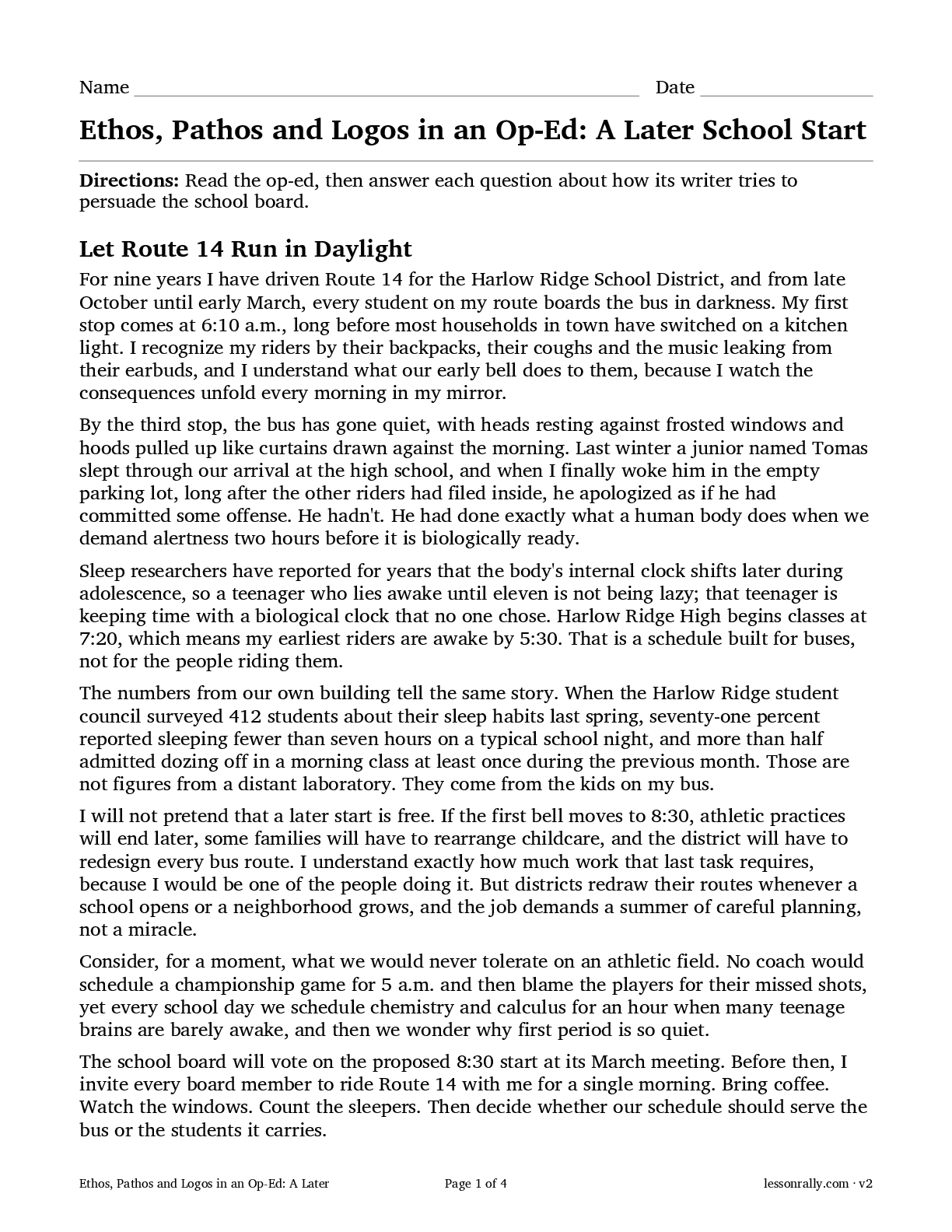
Let Route 14 Run in Daylight

For nine years I have driven Route 14 for the Harlow Ridge School District, and from late October until early March, every student on my route boards the bus in darkness. My first stop comes at 6:10 a.m., long before most households in town have switched on a kitchen light. I recognize my riders by their backpacks, their coughs and the music leaking from their earbuds, and I understand what our early bell does to them, because I watch the consequences unfold every morning in my mirror.

By the third stop, the bus has gone quiet, with heads resting against frosted windows and hoods pulled up like curtains drawn against the morning. Last winter a junior named Tomas slept through our arrival at the high school, and when I finally woke him in the empty parking lot, long after the other riders had filed inside, he apologized as if he had committed some offense. He hadn't. He had done exactly what a human body does when we demand alertness two hours before it is biologically ready.

Sleep researchers have reported for years that the body's internal clock shifts later during adolescence, so a teenager who lies awake until eleven is not being lazy; that teenager is keeping time with a biological clock that no one chose. Harlow Ridge High begins classes at 7:20, which means my earliest riders are awake by 5:30. That is a schedule built for buses, not for the people riding them.

The numbers from our own building tell the same story. When the Harlow Ridge student council surveyed 412 students about their sleep habits last spring, seventy-one percent reported sleeping fewer than seven hours on a typical school night, and more than half admitted dozing off in a morning class at least once during the previous month. Those are not figures from a distant laboratory. They come from the kids on my bus.

I will not pretend that a later start is free. If the first bell moves to 8:30, athletic practices will end later, some families will have to rearrange childcare, and the district will have to redesign every bus route. I understand exactly how much work that last task requires, because I would be one of the people doing it. But districts redraw their routes whenever a school opens or a neighborhood grows, and the job demands a summer of careful planning, not a miracle.

Consider, for a moment, what we would never tolerate on an athletic field. No coach would schedule a championship game for 5 a.m. and then blame the players for their missed shots, yet every school day we schedule chemistry and calculus for an hour when many teenage brains are barely awake, and then we wonder why first period is so quiet.

The school board will vote on the proposed 8:30 start at its March meeting. Before then, I invite every board member to ride Route 14 with me for a single morning. Bring coffee. Watch the windows. Count the sleepers. Then decide whether our schedule should serve the bus or the students it carries.


Question 1

Considering the op-ed as a whole, what is the bus driver's primary purpose in writing it?

Choose one answer.

  • To encourage families to rearrange childcare before the schedule changes
  • To persuade the school board to approve the proposed 8:30 starting time
  • To explain how the district designs and periodically redraws its bus routes
  • To warn students that staying up late will damage their academic performance

Question 2

The op-ed opens with the writer's nine years on Route 14 and the daily view in the bus mirror. How does this opening prepare readers to accept the argument that follows?

Choose one answer.

  • It shows that the writer has watched the problem firsthand, so readers will trust the observations that follow.
  • It presents survey results showing how many students at the school lose sleep on school nights.
  • It admits that the writer doubts whether a later start would solve the problem.
  • It shows that the writer has studied the science of teenage sleep, so readers will trust the research that follows.

Question 3

After Tomas apologizes, the writer adds, "He hadn't. He had done exactly what a human body does when we demand alertness two hours before it is biologically ready." What effect do these two sentences, coming right after the apology, most likely have on readers?

Choose one answer.

  • They prove that most students at the school sleep through the arrival.
  • They shift the blame from the student to the schedule and invite sympathy.
  • They suggest that Tomas should have gone to bed earlier the night before.
  • They show that the writer is strict with riders who fall asleep on the way to school.

Question 4

The writer sums up the 7:20 start as "a schedule built for buses, not for the people riding them." What does this contrast suggest about the priorities behind the district's current schedule?

Choose one answer.

  • It works well for students but creates problems for the district's buses.
  • It was chosen because most families in the district prefer an early dismissal.
  • It puts the convenience of transportation ahead of the needs of students.
  • It was designed by the bus drivers to give themselves shorter workdays.

Question 5

Right after the survey results, the writer adds, "Those are not figures from a distant laboratory. They come from the kids on my bus." What do these two sentences contribute to the writer's use of the survey as evidence?

Choose one answer.

  • They explain how the student council decided which students would take the survey.
  • They suggest that research from sleep laboratories contradicts the survey's findings.
  • They admit that the survey was too small for the school board to trust its results.
  • They tie the statistics to the writer's own riders, so the numbers feel close to home.

Question 6

In the paragraph that begins "I will not pretend that a later start is free," the writer lists the costs of the change, including work the writer would have to do. How does this paragraph affect the writer's credibility?

Choose one answer.

  • It weakens it, because the costs the writer lists show that the plan cannot work.
  • It strengthens it, because admitting real costs shows the writer has weighed the plan honestly.
  • It weakens it, because the writer admits to doubting the student council's survey results.
  • It strengthens it, because the writer shows that the change will cost the district nothing at all.

Question 7

How does the writer's comparison to a championship game scheduled for 5 a.m. strengthen the argument for a later start?

Choose one answer.

  • It applies a standard readers accept in sports to school, making the early start look unreasonable.
  • It shows that the school's own games are already scheduled too early in the morning.
  • It argues that sports should matter more to the school than classes like chemistry and calculus.
  • It suggests that coaches, not teachers, are to blame for students who arrive at school tired.

Question 8

The writer supports the claim that students arrive short on sleep with evidence from more than one source. Which two details come from the writer's own observation rather than from the survey or from sleep research?

Choose 2 answers.

  • "more than half admitted dozing off in a morning class at least once during the previous month"
  • "heads resting against frosted windows and hoods pulled up like curtains drawn against the morning"
  • "Sleep researchers have reported for years that the body's internal clock shifts later during adolescence"
  • "Last winter a junior named Tomas slept through our arrival at the high school"
  • "seventy-one percent reported sleeping fewer than seven hours on a typical school night"

Question 9

In the final paragraph, the writer tells board members, "Bring coffee. Watch the windows. Count the sleepers." What is the most likely effect of these brief, direct instructions to the school board?

Choose one answer.

  • The commands admit that the board has already made up its mind.
  • The commands suggest that coffee is the real answer to students' tiredness in the morning.
  • The brisk commands urge board members to see the problem for themselves.
  • The commands restate the student council's survey in simpler and shorter terms.

Question 10

A skeptical board member says that the student council's survey numbers, on their own, would not convince her to change the schedule. Based on the passage, which limitation of the survey could she most reasonably point out?

Choose one answer.

  • The survey asked about students' grades rather than about how much they sleep.
  • The survey asked students at other schools instead of the students at Harlow Ridge High.
  • The figures rest on what students reported about their own sleep, which may not be accurate.
  • The survey is several years old, so its results may no longer describe current students.

Reviews

No reviews yet.

Reviews come from teachers who assigned this activity to a class.

Sign in to write a review

Have a topic of your own? Make a printable worksheet and online quiz, free.

Create an activity

Answer key

Answer keys come with Premium

Print this worksheet with the correct answers marked. The key includes any explanations, sample answers, and rubrics supplied with the activity.

Answer keys aren't public: only teachers with Premium and the people who can edit an activity can download one, so students can't get a ready-to-print key from this page.

Premium includes:

  • No ads for you, and no ads for your students on the assignments you post.
  • Answer keys for printable worksheets, with the correct answers marked and any explanations, sample answers, and rubrics.
  • Create with AI: up to 100 activities a year (5 during the free trial), with every answer checked before you see the draft.

$29 a year, plus sales tax where it applies.

New Premium teachers can try it free for 7 days. A card or other payment method is needed to start. Unless you cancel before the trial ends, you are charged then and the plan renews every year.

Already have Premium or edit this activity? Sign in