Teachers who sign in can assign LessonRally activities to their Google Classroom classes: students open them in Classroom and answer online, and their grades go to the teacher's Classroom gradebook. Practice lets you try it first, the way students see it.
Students judge made-up websites by asking who made each page, why they made it and when, and by checking what other sources say (lateral reading). They also learn that a .org ending, a padlock or a polished design does not prove a page is reliable, and they practice spotting ads and pages that may leave things out. Media literacy and research skills practice.
Learning goal: Evaluate a website by checking who made it, why and when, and by comparing it with other sources, without relying on a .org ending, a padlock or a polished design.
Estimated reading level7.5
Grade 5Hard
Grade 6Stretch
Grade 7On level
Grade 8Easier
Grade 9Easy
About this estimate
The estimate is the middle score of five readability formulas. Their scores run from 4.9 to 9.3.
Flesch-Kincaid GradeSentence length and syllables per word5.2
Gunning FogSentence length and words of three or more syllables7.8
Coleman-Liau Middle scoreLetters per word and sentences per 100 words7.5
Automated Readability IndexCharacters per word and words per sentence4.9
SMOGWords of three or more syllables, for texts of 30 sentences or more9.3
Grade 181216
Flesch Reading Ease
77.5 on a 0 to 100 scale where higher is easier: fairly easy. Not part of the estimate.
Text measured
760 words, 33 sentences
Adapted from common readability formulas (Flesch-Kincaid, Gunning Fog, Coleman-Liau and ARI, plus SMOG for long texts), which look at sentence length and word length. Answer choices count toward word length only. Grades below the estimate will likely find the text harder, grades above it easier. It does not measure ideas, background knowledge or images.
Common Core
Press Ctrl+C or Command+C to copy.
Closest anchor:CCRA.R.6Assess how point of view or purpose shapes the content and style of a text.Anchor Standards for ReadingShow 1 matched standardHide matched standard
Question types: multiple choice, select all that apply.
Student preview
The questions as students see them, without the answers.
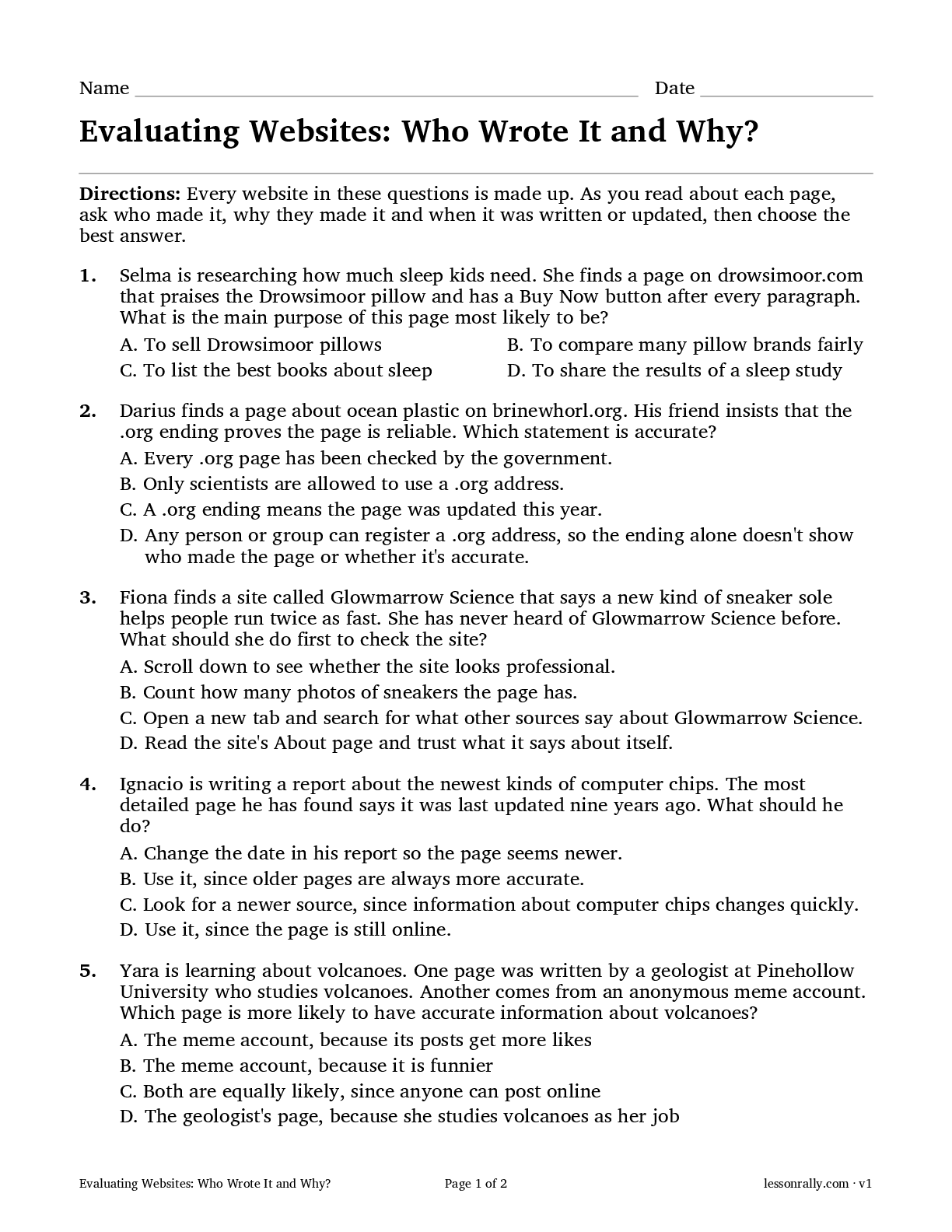
Every website in these questions is made up. As you read about each page, ask who made it, why they made it and when it was written or updated, then choose the best answer.
Question 1
Selma is researching how much sleep kids need. She finds a page on drowsimoor.com that praises the Drowsimoor pillow and has a Buy Now button after every paragraph. What is the main purpose of this page most likely to be?
Choose one answer.
To list the best books about sleep
To compare many pillow brands fairly
To share the results of a sleep study
To sell Drowsimoor pillows
Question 2
Darius finds a page about ocean plastic on brinewhorl.org. His friend insists that the .org ending proves the page is reliable. Which statement is accurate?
Choose one answer.
Any person or group can register a .org address, so the ending alone doesn't show who made the page or whether it's accurate.
A .org ending means the page was updated this year.
Every .org page has been checked by the government.
Only scientists are allowed to use a .org address.
Question 3
Fiona finds a site called Glowmarrow Science that says a new kind of sneaker sole helps people run twice as fast. She has never heard of Glowmarrow Science before. What should she do first to check the site?
Choose one answer.
Read the site's About page and trust what it says about itself.
Count how many photos of sneakers the page has.
Open a new tab and search for what other sources say about Glowmarrow Science.
Scroll down to see whether the site looks professional.
Question 4
Ignacio is writing a report about the newest kinds of computer chips. The most detailed page he has found says it was last updated nine years ago. What should he do?
Choose one answer.
Use it, since older pages are always more accurate.
Look for a newer source, since information about computer chips changes quickly.
Change the date in his report so the page seems newer.
Use it, since the page is still online.
Question 5
Yara is learning about volcanoes. One page was written by a geologist at Pinehollow University who studies volcanoes. Another comes from an anonymous meme account. Which page is more likely to have accurate information about volcanoes?
Choose one answer.
The geologist's page, because she studies volcanoes as her job
The meme account, because its posts get more likes
Both are equally likely, since anyone can post online
The meme account, because it is funnier
Question 6
Celeste finds a page about honeybees with a padlock next to its web address, a sleek design and smooth animations. She thinks those features prove the page is reliable. Which statement is accurate?
Choose one answer.
The padlock proves it, but the design doesn't.
The design proves it, but the padlock doesn't.
Neither the padlock nor the design shows who made the page or whether its facts are right.
The padlock and the design together prove the page is reliable.
Question 7
Mattias wants to know who wrote a page about tornadoes and how up to date it is. Which two parts of the page help answer those questions? Choose 2.
Choose 2 answers.
How many times the page has been shared
A line at the bottom that says "Last updated March 3, 2026"
The page's bright, polished design
The number of photos on the page
A line under the title that says "By Dr. Marta Quillby, weather scientist"
Question 8
Pilar finds two websites that give different heights for Tallowmere Falls. One says 40 meters, and the other says 55 meters. What is the best next step?
Choose one answer.
Check what other reliable sources, such as the park's official website, say about the height.
Average the two numbers and use 47.5 meters.
Use the bigger number, since it sounds more exciting.
Use whichever website loaded faster.
Question 9
Oksana reads a page that compares three video games. It was made by Brindlecrest Games, the company that makes one of the three, and it says that game is the best. Why should she be careful with this page?
Choose one answer.
Comparisons can only be written by teachers.
Companies are never allowed to write about video games.
Pages about video games are always out of date.
The company may want to sell its own game, so the page may leave out that game's weak points.
Question 10
Henry is reading an article on a news website. A small label that says "Paid post" sits at the top of the article. What does that label tell him?
Choose one answer.
Experts checked all the facts in it.
The writer won a prize for it.
Henry has to pay to keep reading it.
It's an ad: someone paid the website to publish it.