Teachers who sign in can assign LessonRally activities to their Google Classroom classes: students open them in Classroom and answer online, and their grades go to the teacher's Classroom gradebook. Practice lets you try it first, the way students see it.
Students read calm, realistic scenarios about cyberbullying and choose the best first or next step: not replying, saving evidence, reporting, getting help from a trusted adult, and supporting the target privately. They tell a bystander from an upstander and practice speaking up without making things worse. Digital citizenship for middle school.
Learning goal: Recognize cyberbullying and choose the best first or next step as a target or a bystander, acting as an upstander who helps.
Estimated reading level4.9
Grade 2Hard
Grade 3Stretch
Grade 4On level
Grade 5Easier
Grade 6Easy
About this estimate
The estimate is halfway between the two middle scores of four readability formulas. Their scores run from 3.7 to 6.4.
Flesch-Kincaid Grade Middle scoreSentence length and syllables per word4.0
Gunning Fog Middle scoreSentence length and words of three or more syllables5.8
Coleman-LiauLetters per word and sentences per 100 words6.4
Automated Readability IndexCharacters per word and words per sentence3.7
Grade 181216
Flesch Reading Ease
83.6 on a 0 to 100 scale where higher is easier: easy. Not part of the estimate.
Text measured
724 words, 29 sentences
Adapted from common readability formulas (Flesch-Kincaid, Gunning Fog, Coleman-Liau and ARI, plus SMOG for long texts), which look at sentence length and word length. Answer choices count toward word length only. Grades below the estimate will likely find the text harder, grades above it easier. It does not measure ideas, background knowledge or images.
Question types: multiple choice, matching, select all that apply.
Student preview
The questions as students see them, without the answers.
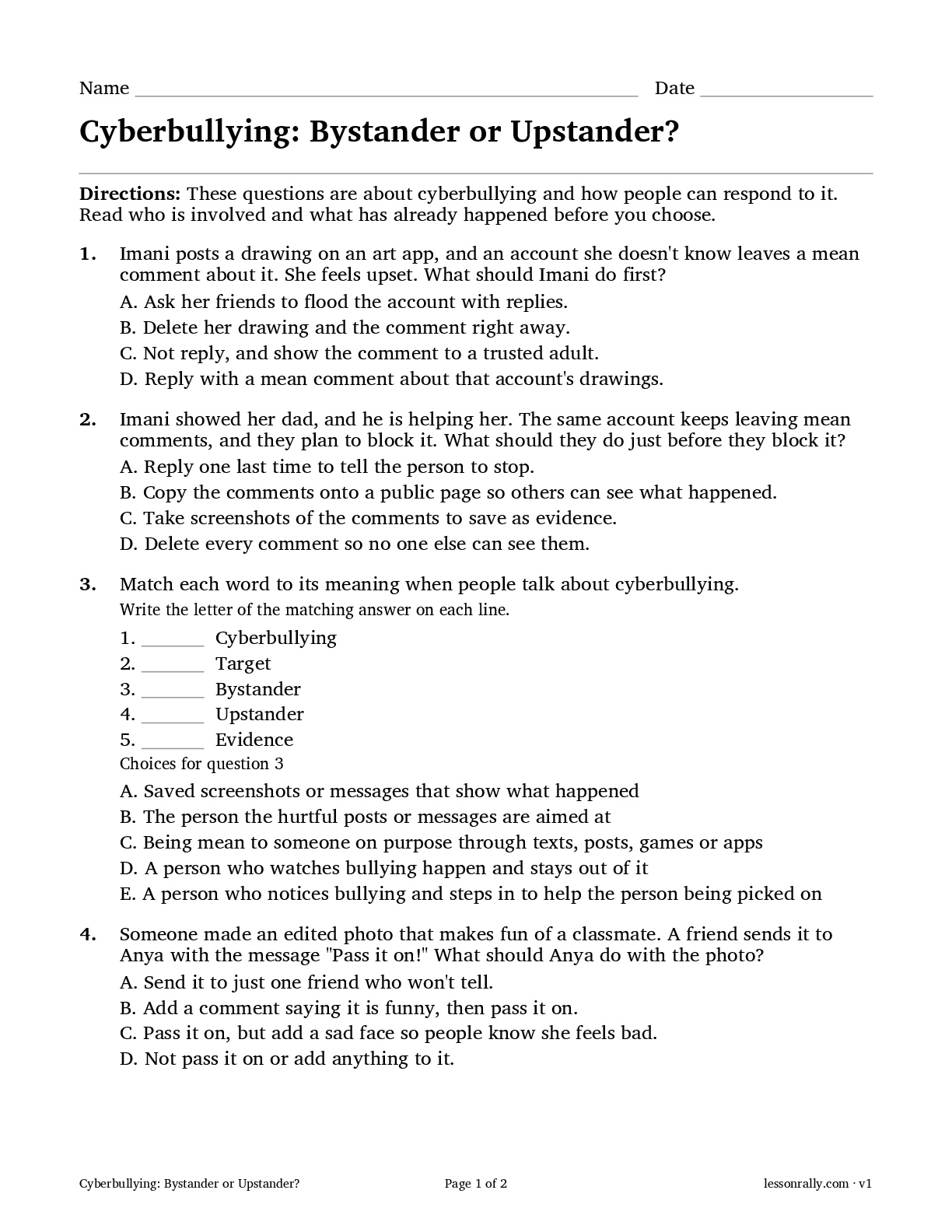
These questions are about cyberbullying and how people can respond to it. Read who is involved and what has already happened before you choose.
Question 1
Imani posts a drawing on an art app, and an account she doesn't know leaves a mean comment about it. She feels upset. What should Imani do first?
Choose one answer.
Not reply, and show the comment to a trusted adult.
Reply with a mean comment about that account's drawings.
Delete her drawing and the comment right away.
Ask her friends to flood the account with replies.
Question 2
Imani showed her dad, and he is helping her. The same account keeps leaving mean comments, and they plan to block it. What should they do just before they block it?
Choose one answer.
Take screenshots of the comments to save as evidence.
Reply one last time to tell the person to stop.
Delete every comment so no one else can see them.
Copy the comments onto a public page so others can see what happened.
Question 3
Match each word to its meaning when people talk about cyberbullying.
Match each item to an option.
Items
Cyberbullying
Target
Bystander
Upstander
Evidence
Options
Being mean to someone on purpose through texts, posts, games or apps
A person who notices bullying and steps in to help the person being picked on
Saved screenshots or messages that show what happened
A person who watches bullying happen and stays out of it
The person the hurtful posts or messages are aimed at
Question 4
Someone made an edited photo that makes fun of a classmate. A friend sends it to Anya with the message "Pass it on!" What should Anya do with the photo?
Choose one answer.
Pass it on, but add a sad face so people know she feels bad.
Add a comment saying it is funny, then pass it on.
Not pass it on or add anything to it.
Send it to just one friend who won't tell.
Question 5
Mr. Ortiz's class is sorting examples. Which two of these are cyberbullying? Choose 2.
Choose 2 answers.
Telling a friend kindly that you liked a different movie better
Making a fake account to post embarrassing things about a classmate
Forgetting to answer a friend's message for a day
Leaving mean comments on a classmate's posts again and again
Losing a game to a classmate and saying "good game"
Question 6
In a group chat, some classmates post laughing replies under a mean comment about Gabe's drawing. Mateo already told his teacher about the chat. What could Mateo do next to support Gabe?
Choose one answer.
Send Gabe a private message saying the comment wasn't fair and asking if he's okay.
Stay out of it and leave Gabe alone for a while.
Forward the chat to more friends so they know what happened.
Post a mean comment about the person who started it.
Question 7
Layla's friend Noor tells her that someone keeps sending her mean messages, but Noor asks Layla to keep it a secret. What should Layla do first?
Choose one answer.
Tell the whole class so everyone knows what is happening.
Send the person mean messages back for Noor.
Keep the secret and not bring it up again.
Encourage Noor to tell a trusted adult, and offer to go with her.
Question 8
Someone posts a false rumor about Asha in a class group chat. Asha told her mom, and they saved screenshots of the messages. What should they do next?
Choose one answer.
Report the messages with the chat app's report tool.
Start a rumor about the person who posted it.
Delete the screenshots and try to forget about it.
Reply in the chat to argue about the rumor.
Question 9
In a class group chat, a few kids keep joking about Rosie's new haircut, and Rosie isn't in the chat. Dmitri wants to speak up without starting a fight. What is the best thing for him to post?
Choose one answer.
"Let's drop this. It isn't fair to Rosie."
Something even meaner about the kid who started it
A screenshot of the chat on a public page, to embarrass them
A laughing reply so he fits in with the group
Question 10
Yesterday, Tobias liked a post that made fun of a classmate's shoes. Today he realizes it was hurtful. What should Tobias do now?
Choose one answer.
Remove his like and tell the classmate privately that he's sorry.
Tell the classmate the post was just a joke.
Do nothing, since a like is not the same as a comment.
Like a few more posts so the first one doesn't stand out.