

Tone and Mood
Tone is the author’s or speaker’s attitude toward a subject, and mood is the feeling a text creates in readers. Students name tones and moods, cite the words that create them and track shifts.
Topics are chosen by LessonRally.
Filter by grade
- English Language ArtsFeatured
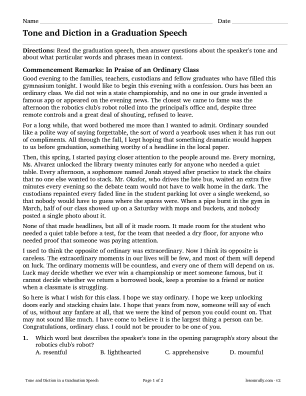
Tone and Diction in a Graduation Speech (opens in a new tab)
- Grades 11–12
- 10 questions
- Estimated reading level 9.5
Made by Julian Corvell · LessonRally (AI-assisted)
- English Language ArtsFeatured
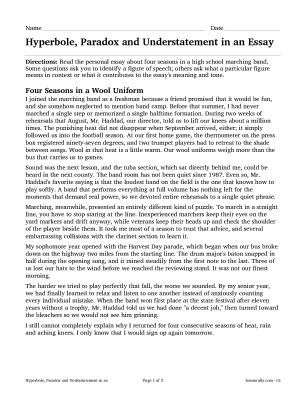
Hyperbole, Paradox and Understatement in an Essay (opens in a new tab)
- Grades 11–12
- 10 questions
- Estimated reading level 10.3
Common Core L.11-12.5a
Made by Julian Corvell · LessonRally (AI-assisted)
- English Language ArtsFeatured
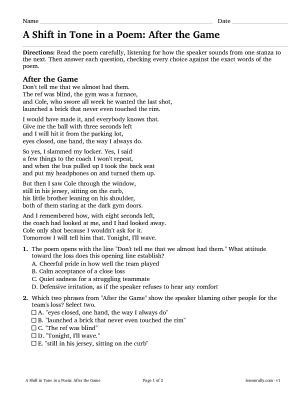
A Shift in Tone in a Poem: After the Game (opens in a new tab)
- Grades 9–10
- 9 questions
- Estimated reading level 7.7
Common Core RL.9-10.4
Made by Eleanor Wrenfield · LessonRally (AI-assisted)
- English Language ArtsFeatured
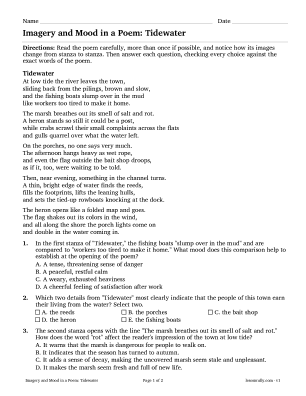
Imagery and Mood in a Poem: Tidewater (opens in a new tab)
- Grades 9–10
- 10 questions
- Estimated reading level 7.7
Common Core RL.9-10.4
Made by Eleanor Wrenfield · LessonRally (AI-assisted)
- English Language ArtsFeatured
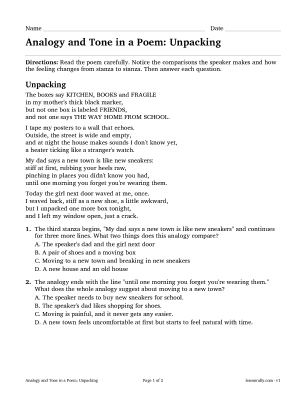
Analogy and Tone in a Poem: Unpacking (opens in a new tab)
- Grade 8
- 8 questions
- Estimated reading level 6.3
Common Core RL.8.4
Made by Claire Fenwood · LessonRally (AI-assisted)
- English Language ArtsFeatured
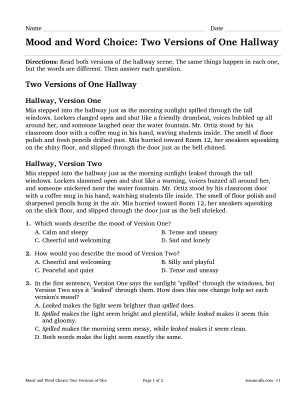
Mood and Word Choice: Two Versions of One Hallway (opens in a new tab)
- Grade 6
- 8 questions
- Estimated reading level 6.1
Common Core RL.6.4
Made by Claire Fenwood · LessonRally (AI-assisted)
About teaching Tone and Mood
- What students practice
- Choosing exact words such as wistful or sarcastic instead of happy or sad, comparing the effect of crumbling and old in the same sentence, highlighting words with strong connotations, finding the line where a shift begins, and telling the writer’s attitude apart from the reader’s feeling.
- Common mistakes
- Students often mix up tone and mood; ask whether a word describes the writer’s attitude or the reader’s feeling. Many name a mood from the events alone, but a story about a storm can still feel cozy, so have them point to the words that create the feeling.
- Ways to use these activities
- Have students rewrite a plain paragraph twice, once cheerful and once ominous, changing only word choice. In pairs, students each name a mood for the same passage, then compare the words that led them there. For an exit ticket, ask for a tone and the words that show it.