A Shift in Tone in a Poem: After the Game

9 questions · 9 points · Grades 9–10 · English · Preview the 9 questions

Made by Eleanor Wrenfield · LessonRally (AI-assisted)

Digital classroom activity

What is a digital classroom activity?

Teachers who sign in can assign LessonRally activities to their Google Classroom classes: students open them in Classroom and answer online, and their grades go to the teacher's Classroom gradebook. Practice lets you try it first, the way students see it.

Free for teachers. Sign in to assign activities to your Google Classroom classes.

Printable worksheet

Students read an original poem in which a young athlete's tone shifts after a loss, from blame and bragging to sympathy and honesty. Questions ask which words set each tone, where the shift happens and what it shows about the speaker's attitude. Practice with tone, tone shifts, word choice and poetry.

Learning goal: Analyze how word choice establishes a speaker's tone in a poem, where the tone shifts, and what the shift reveals about the speaker's attitude.

Estimated reading level 7.7

  1. Grade 5Hard
  2. Grade 6Stretch
  3. Grade 7On level
  4. Grade 8Easier
  5. Grade 9Easy
About this estimate

The estimate is the middle score of five readability formulas. Their scores run from 6.1 to 8.1.

  • Flesch-Kincaid GradeSentence length and syllables per word6.1
  • Gunning FogSentence length and words of three or more syllables8.1
  • Coleman-Liau Middle scoreLetters per word and sentences per 100 words7.7
  • Automated Readability IndexCharacters per word and words per sentence6.4
  • SMOGWords of three or more syllables, for texts of 30 sentences or more7.7
Flesch Reading Ease
77.7 on a 0 to 100 scale where higher is easier: fairly easy. Not part of the estimate.
Text measured
792 words, 31 sentences

Adapted from common readability formulas (Flesch-Kincaid, Gunning Fog, Coleman-Liau and ARI, plus SMOG for long texts), which look at sentence length and word length. Answer choices count toward word length only. Grades below the estimate will likely find the text harder, grades above it easier. It does not measure ideas, background knowledge or images.

Common Core

Closest anchor: CCRA.R.4 Interpret words and phrases as they are used in a text, including determining technical, connotative, and figurative meanings, and analyze how specific word choices shape meaning or tone.Anchor Standards for ReadingShow 1 matched standardHide matched standard

Matched standard

  • RL.9-10.4

    Determine the meaning of words and phrases as they are used in the text, including figurative and connotative meanings; analyze the cumulative impact of specific word choices on meaning and tone (e.g., how the language evokes a sense of time and place; how it sets a formal or informal tone).

    Student preview questions 1, 3, 4, 5, 6, 8, 9

Matched independently by two AI models from this activity's questions.

© Copyright 2010. National Governors Association Center for Best Practices and Council of Chief State School Officers. All rights reserved.

Topic: Tone and Mood Chosen by LessonRally

Question types: multiple choice, select all that apply.

Student preview

The questions as students see them, without the answers.

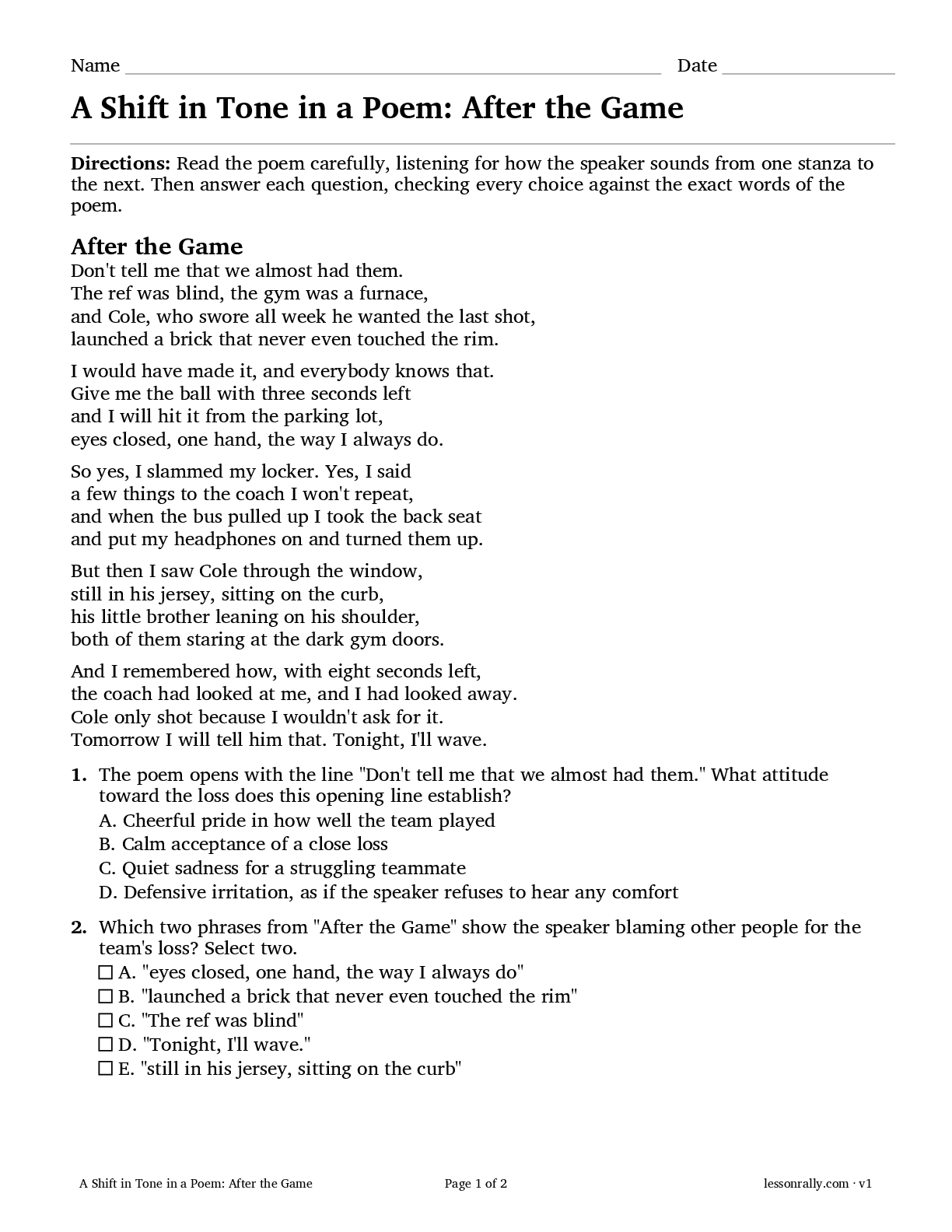
Read the poem carefully, listening for how the speaker sounds from one stanza to the next. Then answer each question, checking every choice against the exact words of the poem.

After the Game

Don't tell me that we almost had them.
The ref was blind, the gym was a furnace,
and Cole, who swore all week he wanted the last shot,
launched a brick that never even touched the rim.

I would have made it, and everybody knows that.
Give me the ball with three seconds left
and I will hit it from the parking lot,
eyes closed, one hand, the way I always do.

So yes, I slammed my locker. Yes, I said
a few things to the coach I won't repeat,
and when the bus pulled up I took the back seat
and put my headphones on and turned them up.

But then I saw Cole through the window,
still in his jersey, sitting on the curb,
his little brother leaning on his shoulder,
both of them staring at the dark gym doors.

And I remembered how, with eight seconds left,
the coach had looked at me, and I had looked away.
Cole only shot because I wouldn't ask for it.
Tomorrow I will tell him that. Tonight, I'll wave.


Question 1

The poem opens with the line "Don't tell me that we almost had them." What attitude toward the loss does this opening line establish?

Choose one answer.

  • Defensive irritation, as if the speaker refuses to hear any comfort
  • Cheerful pride in how well the team played
  • Quiet sadness for a struggling teammate
  • Calm acceptance of a close loss

Question 2

Which two phrases from "After the Game" show the speaker blaming other people for the team's loss? Select two.

Choose 2 answers.

  • "Tonight, I'll wave."
  • "eyes closed, one hand, the way I always do"
  • "The ref was blind"
  • "still in his jersey, sitting on the curb"
  • "launched a brick that never even touched the rim"

Question 3

In the second stanza, the speaker boasts about hitting the shot "from the parking lot" with "eyes closed, one hand, the way I always do." What attitude does this exaggeration reveal?

Choose one answer.

  • Bitter regret
  • Polite modesty
  • Boastful overconfidence
  • Honest self-doubt

Question 4

The third stanza begins, "So yes, I slammed my locker." The following sentence opens with "Yes" again. What does this repeated "yes" suggest about the speaker's attitude toward what happened after the game?

Choose one answer.

  • The speaker has forgotten what was said to the coach.
  • The speaker is calmly agreeing that the coach was right.
  • The speaker is apologizing to everyone on the team.
  • The speaker admits the outburst impatiently, as if answering a complaint, without apologizing.

Question 5

In which line of "After the Game" does the speaker's tone begin to change?

Choose one answer.

  • "Tomorrow I will tell him that. Tonight, I'll wave."
  • "and put my headphones on and turned them up."
  • "But then I saw Cole through the window,"
  • "Give me the ball with three seconds left"

Question 6

Through the bus window, the speaker notices Cole "still in his jersey, sitting on the curb," with "his little brother leaning on his shoulder" beside him. How does this image change the way the speaker sees Cole?

Choose one answer.

  • Cole now looks like someone who is hurting, not someone to blame.
  • Cole now looks like the best player on the team.
  • Cole now looks like someone who does not care about the loss.
  • Cole now looks like someone who is waiting to start an argument.

Question 7

Near the end of the poem, the speaker remembers that "the coach had looked at me, and I had looked away." How does this memory change the meaning of the speaker's boasting in the second stanza?

Choose one answer.

  • It proves that the speaker really could have made the shot.
  • It shows that the coach never trusted the speaker.
  • It shows that the speaker did not see the end of the game.
  • It shows that the speaker avoided the very shot the second stanza brags about wanting.

Question 8

The poem's final words are "Tonight, I'll wave." What does this small, specific plan suggest about the speaker's attitude toward Cole?

Choose one answer.

  • Relief that the basketball season is finally over
  • A plan to avoid Cole by waving instead of ever talking to him
  • A sarcastic way of mocking Cole from the bus
  • A gentle wish to reconnect with Cole before the harder talk tomorrow

Question 9

Early in the poem, the speaker says "Don't tell me"; at the end, the speaker promises "Tomorrow I will tell him that." What does this change in the use of the word "tell" show about the speaker?

Choose one answer.

  • The speaker has decided never to discuss the game again.
  • The speaker has moved from refusing to hear the truth to being ready to say it.
  • The speaker wants someone else to explain the loss to Cole.
  • The speaker still believes that the referee caused the loss.

Reviews

No reviews yet.

Reviews come from teachers who assigned this activity to a class.

Sign in to write a review

Have a topic of your own? Make a printable worksheet and online quiz, free.

Create an activity

Answer key

Answer keys come with Premium

Print this worksheet with the correct answers marked. The key includes any explanations, sample answers, and rubrics supplied with the activity.

Answer keys aren't public: only teachers with Premium and the people who can edit an activity can download one, so students can't get a ready-to-print key from this page.

Premium includes:

  • No ads for you, and no ads for your students on the assignments you post.
  • Answer keys for printable worksheets, with the correct answers marked and any explanations, sample answers, and rubrics.
  • Create with AI: up to 100 activities a year (5 during the free trial), with every answer checked before you see the draft.

$29 a year, plus sales tax where it applies.

New Premium teachers can try it free for 7 days. A card or other payment method is needed to start. Unless you cancel before the trial ends, you are charged then and the plan renews every year.

Already have Premium or edit this activity? Sign in