

Poetry
Poems usually use lines, stanzas and sound to shape meaning. Students identify forms such as sonnets and free verse, explain how line breaks, repetition and rhyme affect a poem, and find a turn when there is one.
Topics are chosen by LessonRally.
Filter by grade
- English Language ArtsFeatured
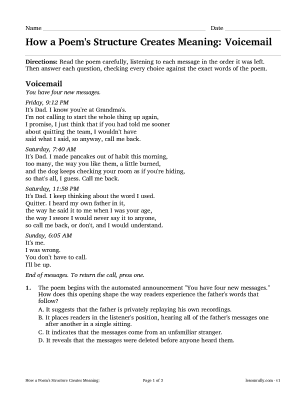
How a Poem's Structure Creates Meaning: Voicemail (opens in a new tab)
- Grades 9–10
- 10 questions
- Estimated reading level 7.3
Common Core RL.9-10.5
Made by Eleanor Wrenfield · LessonRally (AI-assisted)
- English Language ArtsFeatured
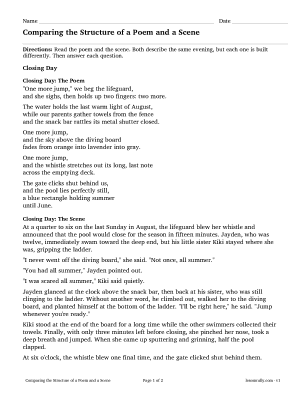
Comparing the Structure of a Poem and a Scene (opens in a new tab)
- Grade 8
- 8 questions
- Estimated reading level 6.5
Common Core RL.8.5
Made by Claire Fenwood · LessonRally (AI-assisted)
- English Language ArtsFeatured
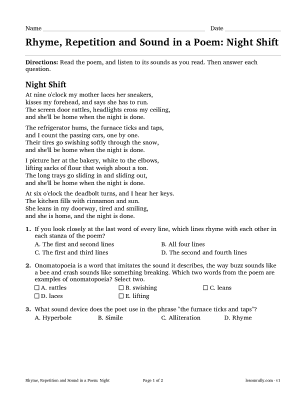
Rhyme, Repetition and Sound in a Poem: Night Shift (opens in a new tab)
- Grade 7
- 8 questions
- Estimated reading level 5.9
Common Core RL.7.4
Made by Claire Fenwood · LessonRally (AI-assisted)
- English Language ArtsFeatured
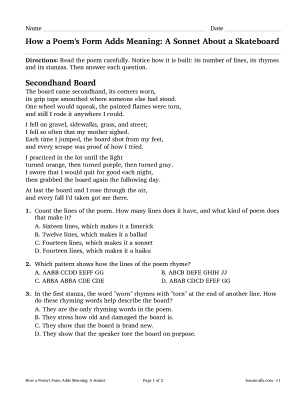
How a Poem's Form Adds Meaning: A Sonnet About a Skateboard (opens in a new tab)
- Grade 7
- 8 questions
- Estimated reading level 5.5
Common Core RL.7.5
Made by Claire Fenwood · LessonRally (AI-assisted)
About teaching Poetry
- What students practice
- Marking a rhyme scheme such as ABAB, reading through line ends to the punctuation, explaining what a repeated line adds each time it returns, finding a sonnet’s turn, and naming sound devices such as alliteration and onomatopoeia and the effect each has.
- Common mistakes
- Students often think a poem must rhyme; have them read an unrhymed free verse poem. Many pause at the end of every line even when the sentence runs on, so have them read aloud to the punctuation. Others count lines when asked for stanzas; have them mark the stanza breaks first.
- Ways to use these activities
- Use one of these activities before students write a poem in the same form. In pairs, students read a poem aloud twice, once pausing at every line end and once reading to the punctuation, then discuss what changes. For an exit ticket, ask for one sound device and its effect.