How a Poem's Structure Creates Meaning: Voicemail

10 questions · 10 points · Grades 9–10 · English · Preview the 10 questions

Made by Eleanor Wrenfield · LessonRally (AI-assisted)

Digital classroom activity

What is a digital classroom activity?

Teachers who sign in can assign LessonRally activities to their Google Classroom classes: students open them in Classroom and answer online, and their grades go to the teacher's Classroom gradebook. Practice lets you try it first, the way students see it.

Free for teachers. Sign in to assign activities to your Google Classroom classes.

Printable worksheet

Students read an original poem written as a series of voicemail messages from a father to his child after an argument. Questions examine how the poem's form, line breaks, repetition and the order of the messages create meaning and effect. Practice with poetry, poetic structure, poetic form and line breaks.

Learning goal: Analyze how a poem's form, line breaks, repetition and the order of its parts create meaning and effects.

Estimated reading level 7.3

  1. Grade 5Hard
  2. Grade 6Stretch
  3. Grade 7On level
  4. Grade 8Easier
  5. Grade 9Easy
About this estimate

The estimate is the middle score of five readability formulas. Their scores run from 5.2 to 8.5.

  • Flesch-Kincaid GradeSentence length and syllables per word5.5
  • Gunning FogSentence length and words of three or more syllables8.2
  • Coleman-Liau Middle scoreLetters per word and sentences per 100 words7.3
  • Automated Readability IndexCharacters per word and words per sentence5.2
  • SMOGWords of three or more syllables, for texts of 30 sentences or more8.5
Flesch Reading Ease
77.1 on a 0 to 100 scale where higher is easier: fairly easy. Not part of the estimate.
Text measured
973 words, 42 sentences

Adapted from common readability formulas (Flesch-Kincaid, Gunning Fog, Coleman-Liau and ARI, plus SMOG for long texts), which look at sentence length and word length. Answer choices count toward word length only. Grades below the estimate will likely find the text harder, grades above it easier. It does not measure ideas, background knowledge or images.

Common Core

Closest anchor: CCRA.R.5 Analyze the structure of texts, including how specific sentences, paragraphs, and larger portions of the text (e.g., a section, chapter, scene, or stanza) relate to each other and the whole.Anchor Standards for ReadingShow 2 matched standardsHide matched standards

Matched standards

  • RL.9-10.5

    Analyze how an author's choices concerning how to structure a text, order events within it (e.g., parallel plots), and manipulate time (e.g., pacing, flashbacks) create such effects as mystery, tension, or surprise.

    Student preview questions 8, 9, 10

  • RL.9-10.4

    Determine the meaning of words and phrases as they are used in the text, including figurative and connotative meanings; analyze the cumulative impact of specific word choices on meaning and tone (e.g., how the language evokes a sense of time and place; how it sets a formal or informal tone).

    Student preview questions 5, 6

Matched independently by two AI models from this activity's questions.

© Copyright 2010. National Governors Association Center for Best Practices and Council of Chief State School Officers. All rights reserved.

Topics: Poetry, Characterization Chosen by LessonRally

Question types: multiple choice, select all that apply.

Student preview

The questions as students see them, without the answers.

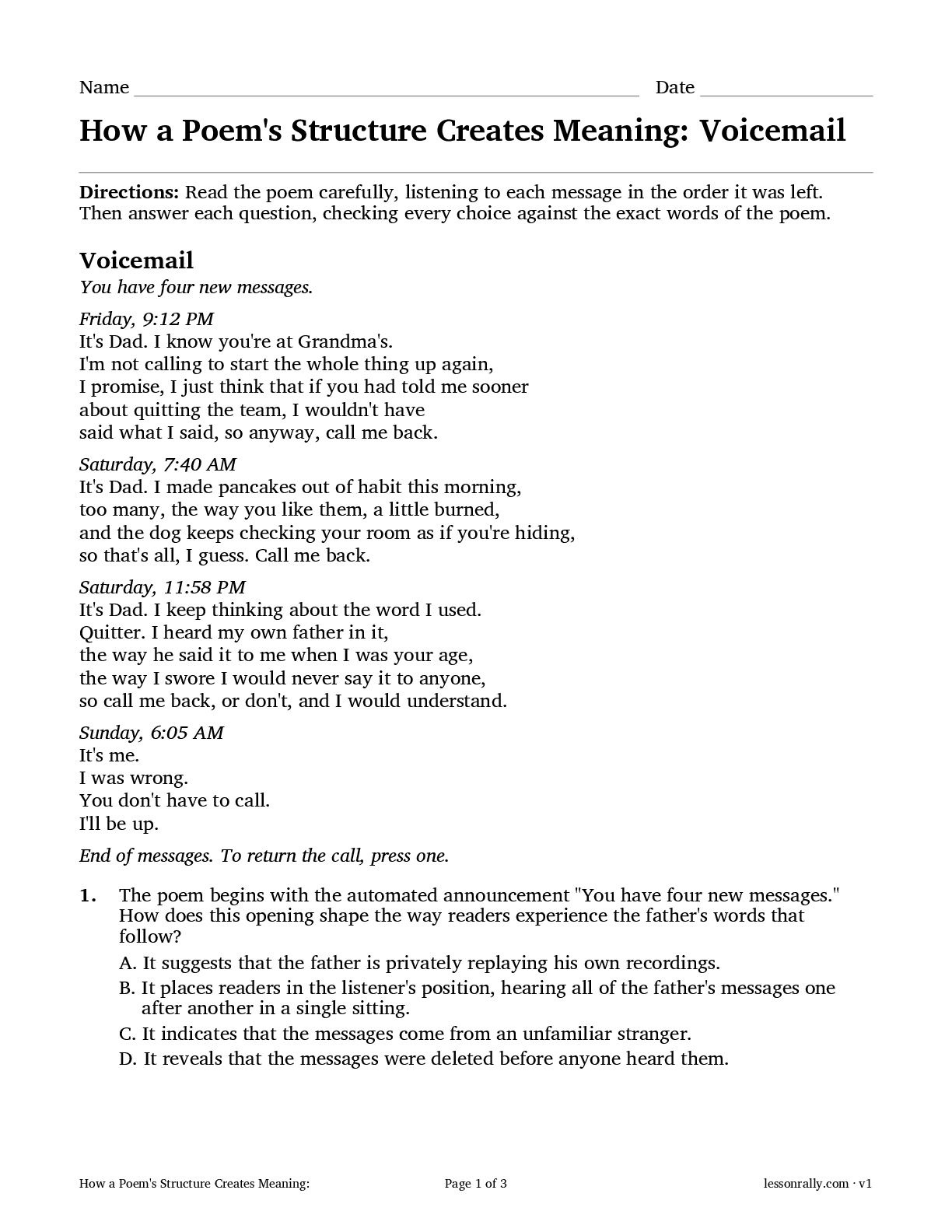
Read the poem carefully, listening to each message in the order it was left. Then answer each question, checking every choice against the exact words of the poem.

Voicemail

You have four new messages.

Friday, 9:12 PM
It's Dad. I know you're at Grandma's.
I'm not calling to start the whole thing up again,
I promise, I just think that if you had told me sooner
about quitting the team, I wouldn't have
said what I said, so anyway, call me back.

Saturday, 7:40 AM
It's Dad. I made pancakes out of habit this morning,
too many, the way you like them, a little burned,
and the dog keeps checking your room as if you're hiding,
so that's all, I guess. Call me back.

Saturday, 11:58 PM
It's Dad. I keep thinking about the word I used.
Quitter. I heard my own father in it,
the way he said it to me when I was your age,
the way I swore I would never say it to anyone,
so call me back, or don't, and I would understand.

Sunday, 6:05 AM
It's me.
I was wrong.
You don't have to call.
I'll be up.

End of messages. To return the call, press one.

Question 1

The poem begins with the automated announcement "You have four new messages." How does this opening shape the way readers experience the father's words that follow?

Choose one answer.

  • It places readers in the listener's position, hearing all of the father's messages one after another in a single sitting.
  • It indicates that the messages come from an unfamiliar stranger.
  • It suggests that the father is privately replaying his own recordings.
  • It reveals that the messages were deleted before anyone heard them.
Question 2

In the first message, the father says that if his child "had told me sooner" about quitting the team, he would not have said what he said. What attitude does this explanation reveal?

Choose one answer.

  • He is furious that his child decided to stay at Grandma's.
  • He regrets the argument but still places part of the blame on his child.
  • He has already forgotten what the argument was about.
  • He accepts complete responsibility for everything he said.

Question 3

The first message breaks a line after "about quitting the team, I wouldn't have" and completes the thought on the following line. What effect does this particular line break create?

Choose one answer.

  • It leaves the thought hanging for a moment, so the father sounds reluctant to face what he said.
  • It indicates that the phone call was accidentally cut off.
  • It speeds the message up so that it sounds cheerful and relaxed.
  • It suggests that the father cannot remember what he said.

Question 4

Which two details suggest that the father misses his child, even though he never says so directly anywhere in the poem? Select two.

Choose 2 answers.

  • "and the dog keeps checking your room as if you're hiding,"
  • "To return the call, press one."
  • "I made pancakes out of habit this morning,"
  • "Quitter. I heard my own father in it,"
  • "I'm not calling to start the whole thing up again,"

Question 5

In the third message, the father isolates one word as its own sentence, "Quitter." He continues, "I heard my own father in it," and remembers how his father once used the word. What does the father realize?

Choose one answer.

  • He feels proud of having been tough on his child.
  • He hurt his child with the same word that his own father once used on him.
  • His child should apologize for quitting the team.
  • His own father is the person who called the child a quitter.

Question 6

The first three messages each begin "It's Dad." The father's final message begins instead with "It's me." What does this change in the repeated opening suggest?

Choose one answer.

  • He is angrier than he was in the earlier messages.
  • He speaks more simply and personally, as himself rather than as the parent in charge.
  • He wants to sound more official and formal than before.
  • He has decided to stop calling his child altogether.

Question 7

The first two messages end with a request to call back. The third message softens that request with "or don't, and I would understand." The final message says, "You don't have to call." How does this repeated request change over the course of the poem?

Choose one answer.

  • It reveals that the father no longer wants to talk at all.
  • It shifts from a request to a release, as the father stops pressing for a call and leaves the choice to his child.
  • It stays exactly the same from beginning to end.
  • It grows more demanding and impatient with each message.

Question 8

Unlike the long, rambling sentences of the earlier messages, the final message is four short lines, each a complete sentence, beginning with "It's me." What is the effect of this contrast in form?

Choose one answer.

  • The bare, separate lines strip the message down to the plain truth, without excuses or small talk.
  • The short lines make the message sound cold, distant and angry.
  • The short lines repeat the exact words of the first message.
  • The short lines show that the father is too exhausted to finish his sentences.

Question 9

Consider the four messages in the order they were left, from Friday night to early Sunday morning. What does this arrangement reveal about the father?

Choose one answer.

  • He grows angrier and more impatient as the weekend continues.
  • His messages become longer and more detailed over time.
  • He gradually forgets why his child left home.
  • He moves step by step from defending himself to apologizing.

Question 10

The poem concludes with the automated instruction "To return the call, press one." What is the effect of ending the poem with this line?

Choose one answer.

  • It leaves the next step to the listener, so readers never learn whether the child calls back.
  • It shows that the child has already returned the call.
  • It proves that the father will never call again.
  • It reveals that the messages were only a dream.

Reviews

No reviews yet.

Reviews come from teachers who assigned this activity to a class.

Sign in to write a review

Have a topic of your own? Make a printable worksheet and online quiz, free.

Create an activity

Answer key

Answer keys come with Premium

Print this worksheet with the correct answers marked. The key includes any explanations, sample answers, and rubrics supplied with the activity.

Answer keys aren't public: only teachers with Premium and the people who can edit an activity can download one, so students can't get a ready-to-print key from this page.

Premium includes:

  • No ads for you, and no ads for your students on the assignments you post.
  • Answer keys for printable worksheets, with the correct answers marked and any explanations, sample answers, and rubrics.
  • Create with AI: up to 100 activities a year (5 during the free trial), with every answer checked before you see the draft.

$29 a year, plus sales tax where it applies.

New Premium teachers can try it free for 7 days. A card or other payment method is needed to start. Unless you cancel before the trial ends, you are charged then and the plan renews every year.

Already have Premium or edit this activity? Sign in