Question 1
If you look closely at the last word of every line, which lines rhyme with each other in each stanza of the poem?
Choose one answer.
- The first and second lines
- All four lines
- The second and fourth lines
- The first and third lines


Teachers who sign in can assign LessonRally activities to their Google Classroom classes: students open them in Classroom and answer online, and their grades go to the teacher's Classroom gradebook. Practice lets you try it first, the way students see it.
Free for teachers. Sign in to assign activities to your Google Classroom classes.
 (opens in a new tab)
2 pages · Student copy, no answers
Print worksheet (opens in a new tab)Answer keyPremiumStudents read an original poem about a child waiting through the night for a parent who works the night shift at a bakery. They find the rhyme pattern, alliteration, onomatopoeia and a repeated refrain, and explain how each sound device shapes the feeling of a stanza.
Learning goal: Analyze how rhyme, repetition and other sound devices affect the meaning and feeling of specific stanzas in a poem.
The estimate is halfway between the two middle scores of four readability formulas. Their scores run from 4.7 to 7.0.
Adapted from common readability formulas (Flesch-Kincaid, Gunning Fog, Coleman-Liau and ARI, plus SMOG for long texts), which look at sentence length and word length. Answer choices count toward word length only. Grades below the estimate will likely find the text harder, grades above it easier. It does not measure ideas, background knowledge or images.
Determine the meaning of words and phrases as they are used in a text, including figurative and connotative meanings; analyze the impact of rhymes and other repetitions of sounds (e.g., alliteration) on a specific verse or stanza of a poem or section of a story or drama.
Matched independently by two AI models from this activity's questions.
© Copyright 2010. National Governors Association Center for Best Practices and Council of Chief State School Officers. All rights reserved.
Topic: Poetry Chosen by LessonRally
Question types: multiple choice, select all that apply.
The questions as students see them, without the answers.
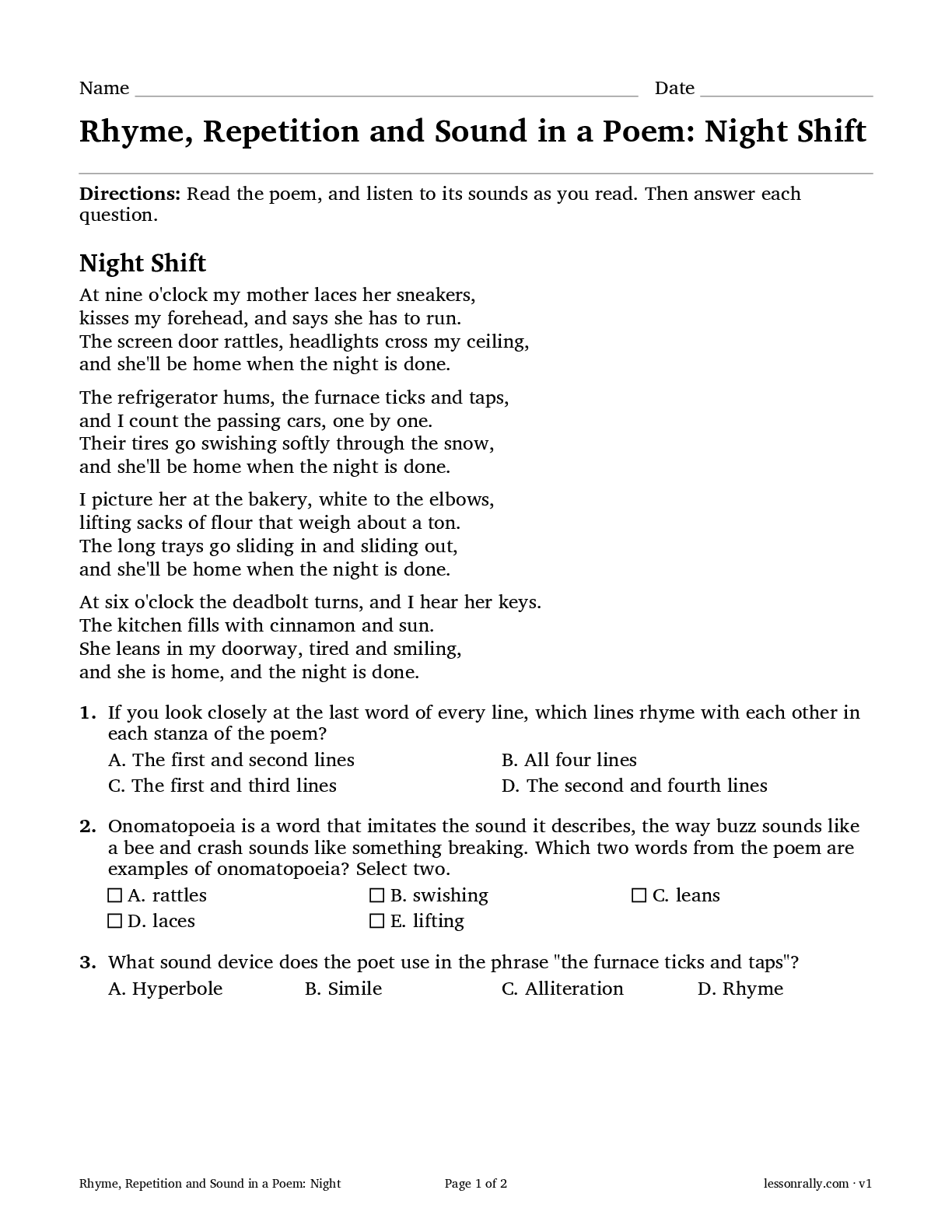
Read the poem, and listen to its sounds as you read. Then answer each question.
At nine o'clock my mother laces her sneakers,
kisses my forehead, and says she has to run.
The screen door rattles, headlights cross my ceiling,
and she'll be home when the night is done.
The refrigerator hums, the furnace ticks and taps,
and I count the passing cars, one by one.
Their tires go swishing softly through the snow,
and she'll be home when the night is done.
I picture her at the bakery, white to the elbows,
lifting sacks of flour that weigh about a ton.
The long trays go sliding in and sliding out,
and she'll be home when the night is done.
At six o'clock the deadbolt turns, and I hear her keys.
The kitchen fills with cinnamon and sun.
She leans in my doorway, tired and smiling,
and she is home, and the night is done.
If you look closely at the last word of every line, which lines rhyme with each other in each stanza of the poem?
Choose one answer.
Onomatopoeia is a word that imitates the sound it describes, the way buzz sounds like a bee and crash sounds like something breaking. Which two words from the poem are examples of onomatopoeia? Select two.
Choose 2 answers.
What sound device does the poet use in the phrase "the furnace ticks and taps"?
Choose one answer.
Think about the phrase "the furnace ticks and taps" in the second stanza of the poem. What do the repeated t sounds add to that stanza?
Choose one answer.
The line "and she'll be home when the night is done." ends each of the first three stanzas. What does this repetition add to the poem?
Choose one answer.
In the third stanza, the trays go "sliding in and sliding out" of the ovens. What does repeating the word sliding suggest?
Choose one answer.
When the mother comes home in the last stanza, the speaker says, "The kitchen fills with cinnamon and sun." How do the soft s sounds in this line fit the feeling of that morning?
Choose one answer.
The last stanza ends with "and she is home, and the night is done." instead of the line repeated earlier. How does this change fit the poem as a whole?
Choose one answer.
No reviews yet.
Reviews come from teachers who assigned this activity to a class.
Have a topic of your own? Make a printable worksheet and online quiz, free.
Create an activityCommon Core L.7.4b
Made by Simone Thornbury · LessonRally (AI-assisted)
Common Core L.7.4b
Made by Simone Thornbury · LessonRally (AI-assisted)
Common Core L.7.4a
Made by Simone Thornbury · LessonRally (AI-assisted)
Common Core L.7.5a
Made by Claire Fenwood · LessonRally (AI-assisted)