Comparing the Structure of a Poem and a Scene

8 questions · 8 points · Grade 8 · English · Preview the 8 questions

Made by Claire Fenwood · LessonRally (AI-assisted)

Digital classroom activity

What is a digital classroom activity?

Teachers who sign in can assign LessonRally activities to their Google Classroom classes: students open them in Classroom and answer online, and their grades go to the teacher's Classroom gradebook. Practice lets you try it first, the way students see it.

Free for teachers. Sign in to assign activities to your Google Classroom classes.

Printable worksheet

Students read an original poem and an original scene about the same evening, the last night before the town pool closes for the season. They compare the structure of each text, from stanzas, repetition and a we speaker to paragraphs, dialogue and clock times, and analyze how each structure shapes its meaning and style.

Learning goal: Compare and contrast the structures of a poem and a scene about the same event, and analyze how each structure contributes to meaning and style.

Estimated reading level 6.5

  1. Grade 4Hard
  2. Grade 5Stretch
  3. Grade 6On level
  4. Grade 7Easier
  5. Grade 8Easy
About this estimate

The estimate is the middle score of five readability formulas. Their scores run from 5.1 to 7.6.

  • Flesch-Kincaid GradeSentence length and syllables per word5.1
  • Gunning Fog Middle scoreSentence length and words of three or more syllables6.5
  • Coleman-LiauLetters per word and sentences per 100 words7.6
  • Automated Readability IndexCharacters per word and words per sentence5.4
  • SMOGWords of three or more syllables, for texts of 30 sentences or more6.9
Flesch Reading Ease
80.9 on a 0 to 100 scale where higher is easier: easy. Not part of the estimate.
Text measured
787 words, 37 sentences

Adapted from common readability formulas (Flesch-Kincaid, Gunning Fog, Coleman-Liau and ARI, plus SMOG for long texts), which look at sentence length and word length. Answer choices count toward word length only. Grades below the estimate will likely find the text harder, grades above it easier. It does not measure ideas, background knowledge or images.

Common Core

Closest anchor: CCRA.R.5 Analyze the structure of texts, including how specific sentences, paragraphs, and larger portions of the text (e.g., a section, chapter, scene, or stanza) relate to each other and the whole.Anchor Standards for ReadingShow 1 matched standardHide matched standard

Matched standard

  • RL.8.5

    Compare and contrast the structure of two or more texts and analyze how the differing structure of each text contributes to its meaning and style.

    Student preview questions 1, 2, 3, 7, 8

Matched independently by two AI models from this activity's questions.

© Copyright 2010. National Governors Association Center for Best Practices and Council of Chief State School Officers. All rights reserved.

Topics: Comparing Texts, Poetry Chosen by LessonRally

Question types: multiple choice, select all that apply.

Student preview

The questions as students see them, without the answers.

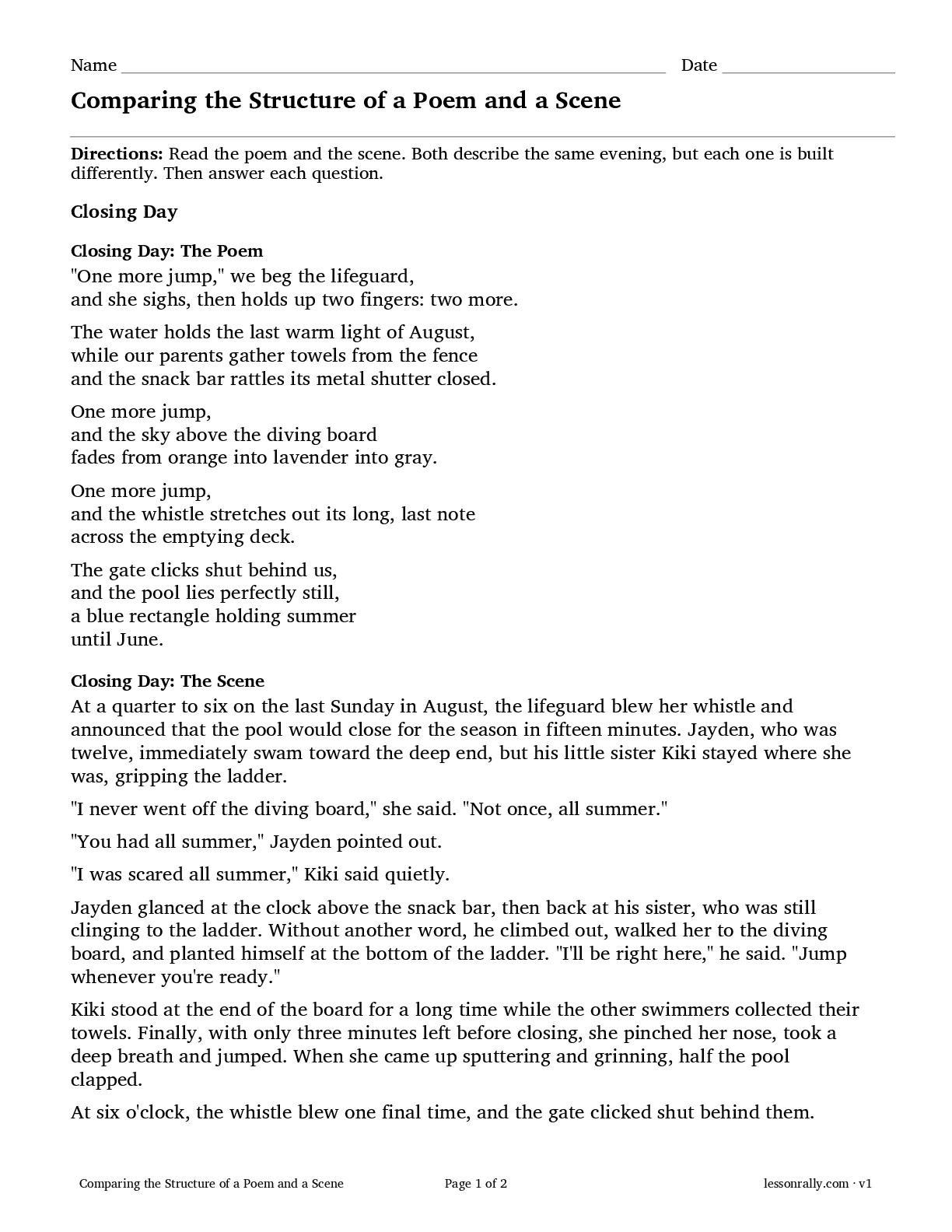
Read the poem and the scene. Both describe the same evening, but each one is built differently. Then answer each question.

Closing Day

Closing Day: The Poem

"One more jump," we beg the lifeguard,
and she sighs, then holds up two fingers: two more.

The water holds the last warm light of August,
while our parents gather towels from the fence
and the snack bar rattles its metal shutter closed.

One more jump,
and the sky above the diving board
fades from orange into lavender into gray.

One more jump,
and the whistle stretches out its long, last note
across the emptying deck.

The gate clicks shut behind us,
and the pool lies perfectly still,
a blue rectangle holding summer
until June.

Closing Day: The Scene

At a quarter to six on the last Sunday in August, the lifeguard blew her whistle and announced that the pool would close for the season in fifteen minutes. Jayden, who was twelve, immediately swam toward the deep end, but his little sister Kiki stayed where she was, gripping the ladder.

"I never went off the diving board," she said. "Not once, all summer."

"You had all summer," Jayden pointed out.

"I was scared all summer," Kiki said quietly.

Jayden glanced at the clock above the snack bar, then back at his sister, who was still clinging to the ladder. Without another word, he climbed out, walked her to the diving board, and planted himself at the bottom of the ladder. "I'll be right here," he said. "Jump whenever you're ready."

Kiki stood at the end of the board for a long time while the other swimmers collected their towels. Finally, with only three minutes left before closing, she pinched her nose, took a deep breath and jumped. When she came up sputtering and grinning, half the pool clapped.

At six o'clock, the whistle blew one final time, and the gate clicked shut behind them.

Question 1

Which feature does the poem use that the scene does not?

Choose one answer.

  • A line, "One more jump," that returns again and again
  • Paragraphs that move from a problem to its solution
  • Exact times, such as six o'clock
  • Dialogue between two named characters

Question 2

The scene marks time with the clock: a quarter to six, three minutes left, six o'clock. How does this structure affect the scene?

Choose one answer.

  • It shows that the events happen out of order.
  • It builds pressure as closing time gets closer and Kiki still has not jumped.
  • It makes the scene feel slow and dreamlike, with no deadline.
  • It shows that the pool stays open all night.

Question 3

The poem never mentions a clock. How does it show the passing of time instead?

Choose one answer.

  • Through a character who keeps checking her watch
  • Through dates written at the start of each stanza
  • Through a lifeguard who announces the time
  • Through the sky fading from orange into lavender into gray

Question 4

In the poem, the words "One more jump" appear three times. What does this repetition add to the poem's meaning?

Choose one answer.

  • It captures the wish to make summer last just a little longer.
  • It shows that the speakers are bored with swimming.
  • It shows that the lifeguard is getting angry.
  • It tells the reader exactly how many jumps are left.

Question 5

In the scene, Kiki quietly admits, "I was scared all summer," after Jayden says that she had all summer to jump. How does the scene's dialogue add to its meaning?

Choose one answer.

  • It shows that the lifeguard is angry at the swimmers.
  • It shows that Kiki doesn't want to swim at all.
  • It reveals Kiki's fear and Jayden's support, so the scene becomes a story about facing a fear.
  • It explains why the pool is closing for the season.

Question 6

Which two details appear in both the poem and the scene? Select two.

Choose 2 answers.

  • The sky fading into gray
  • The whistle blowing near closing time
  • Kiki jumping off the diving board
  • The gate clicking shut behind the swimmers
  • The lifeguard holding up two fingers

Question 7

The poem says "we" and never names anyone, while the scene follows Jayden and Kiki by name. How does this difference affect each text?

Choose one answer.

  • The poem has no speaker at all, while the scene has no characters.
  • The poem is about only one swimmer, while the scene is about a whole crowd.
  • The poem shares a feeling many swimmers have, while the scene tells one family's moment.
  • Both texts are told by Kiki.

Question 8

Both texts end as the gate clicks shut. How are their endings different?

Choose one answer.

  • The poem ends with dialogue, while the scene ends with an image of the pool.
  • Both texts end with Kiki jumping into the water.
  • The scene ends in June, while the poem ends in August.
  • The poem lingers on the still, empty pool, while the scene moves quickly from Kiki's jump to the final whistle.

Reviews

No reviews yet.

Reviews come from teachers who assigned this activity to a class.

Sign in to write a review

Have a topic of your own? Make a printable worksheet and online quiz, free.

Create an activity

Answer key

Answer keys come with Premium

Print this worksheet with the correct answers marked. The key includes any explanations, sample answers, and rubrics supplied with the activity.

Answer keys aren't public: only teachers with Premium and the people who can edit an activity can download one, so students can't get a ready-to-print key from this page.

Premium includes:

  • No ads for you, and no ads for your students on the assignments you post.
  • Answer keys for printable worksheets, with the correct answers marked and any explanations, sample answers, and rubrics.
  • Create with AI: up to 100 activities a year (5 during the free trial), with every answer checked before you see the draft.

$29 a year, plus sales tax where it applies.

New Premium teachers can try it free for 7 days. A card or other payment method is needed to start. Unless you cancel before the trial ends, you are charged then and the plan renews every year.

Already have Premium or edit this activity? Sign in