How a Poem's Form Adds Meaning: A Sonnet About a Skateboard

8 questions · 11 points · Grade 7 · English · Preview the 8 questions

Made by Claire Fenwood · LessonRally (AI-assisted)

Digital classroom activity

What is a digital classroom activity?

Teachers who sign in can assign LessonRally activities to their Google Classroom classes: students open them in Classroom and answer online, and their grades go to the teacher's Classroom gradebook. Practice lets you try it first, the way students see it.

Free for teachers. Sign in to assign activities to your Google Classroom classes.

Printable worksheet

Students read an original Shakespearean sonnet about learning to ride a secondhand skateboard. They count its lines, find its rhyme pattern, quatrains, couplet and turn, and explain how the sonnet form adds to the poem's meaning.

Learning goal: Analyze how the form and structure of a sonnet, including its quatrains, couplet and turn, contribute to the poem's meaning.

Estimated reading level 5.5

  1. Grade 3Hard
  2. Grade 4Stretch
  3. Grade 5On level
  4. Grade 6Easier
  5. Grade 7Easy
About this estimate

The estimate is halfway between the two middle scores of four readability formulas. Their scores run from 4.2 to 6.9.

  • Flesch-Kincaid GradeSentence length and syllables per word4.2
  • Gunning Fog Middle scoreSentence length and words of three or more syllables6.0
  • Coleman-LiauLetters per word and sentences per 100 words6.9
  • Automated Readability Index Middle scoreCharacters per word and words per sentence5.0
Flesch Reading Ease
87.8 on a 0 to 100 scale where higher is easier: easy. Not part of the estimate.
Text measured
572 words, 24 sentences

Adapted from common readability formulas (Flesch-Kincaid, Gunning Fog, Coleman-Liau and ARI, plus SMOG for long texts), which look at sentence length and word length. Answer choices count toward word length only. Grades below the estimate will likely find the text harder, grades above it easier. It does not measure ideas, background knowledge or images.

Common Core

Closest anchor: CCRA.R.5 Analyze the structure of texts, including how specific sentences, paragraphs, and larger portions of the text (e.g., a section, chapter, scene, or stanza) relate to each other and the whole.Anchor Standards for ReadingShow 2 matched standardsHide matched standards

Matched standards

  • RL.7.5

    Analyze how a drama's or poem's form or structure (e.g., soliloquy, sonnet) contributes to its meaning

    Student preview questions 1, 2, 4, 5, 6, 7, 8

  • RL.7.4

    Determine the meaning of words and phrases as they are used in a text, including figurative and connotative meanings; analyze the impact of rhymes and other repetitions of sounds (e.g., alliteration) on a specific verse or stanza of a poem or section of a story or drama.

    Student preview question 3

Matched independently by two AI models from this activity's questions.

© Copyright 2010. National Governors Association Center for Best Practices and Council of Chief State School Officers. All rights reserved.

Topic: Poetry Chosen by LessonRally

Question types: multiple choice, matching.

Student preview

The questions as students see them, without the answers.

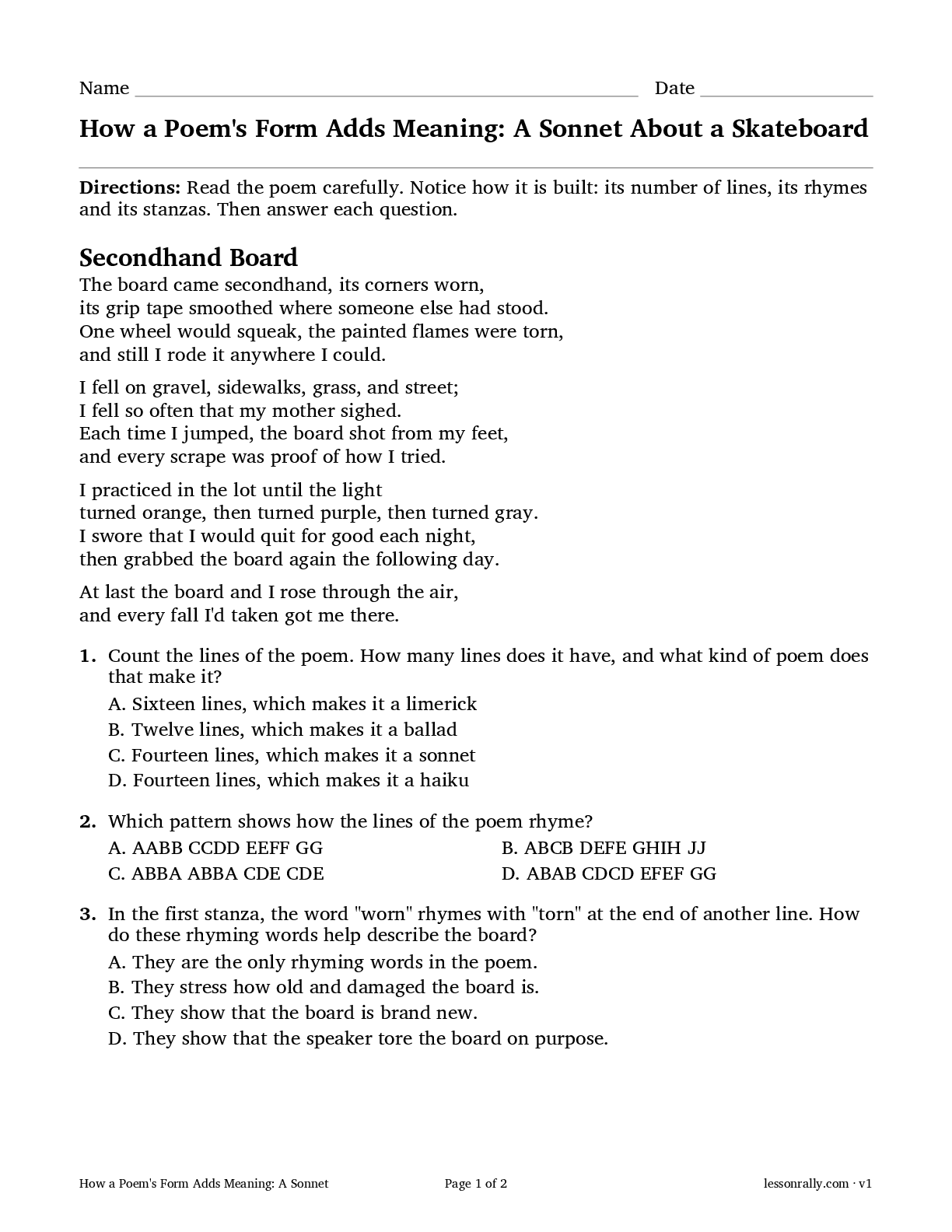
Read the poem carefully. Notice how it is built: its number of lines, its rhymes and its stanzas. Then answer each question.

Secondhand Board

The board came secondhand, its corners worn,
its grip tape smoothed where someone else had stood.
One wheel would squeak, the painted flames were torn,
and still I rode it anywhere I could.

I fell on gravel, sidewalks, grass, and street;
I fell so often that my mother sighed.
Each time I jumped, the board shot from my feet,
and every scrape was proof of how I tried.

I practiced in the lot until the light
turned orange, then turned purple, then turned gray.
I swore that I would quit for good each night,
then grabbed the board again the following day.

At last the board and I rose through the air,
and every fall I'd taken got me there.

Question 1

Count the lines of the poem. How many lines does it have, and what kind of poem does that make it?

Choose one answer.

  • Fourteen lines, which makes it a sonnet
  • Twelve lines, which makes it a ballad
  • Sixteen lines, which makes it a limerick
  • Fourteen lines, which makes it a haiku

Question 2

Which pattern shows how the lines of the poem rhyme?

Choose one answer.

  • ABAB CDCD EFEF GG
  • ABCB DEFE GHIH JJ
  • ABBA ABBA CDE CDE
  • AABB CCDD EEFF GG

Question 3

In the first stanza, the word "worn" rhymes with "torn" at the end of another line. How do these rhyming words help describe the board?

Choose one answer.

  • They are the only rhyming words in the poem.
  • They show that the speaker tore the board on purpose.
  • They show that the board is brand new.
  • They stress how old and damaged the board is.

Question 4

A quatrain is a group of four lines, and a couplet is a pair of rhyming lines. Match each part of the poem to what happens in it.

Match each item to an option.

Items

  1. First quatrain
  2. Second quatrain
  3. Third quatrain
  4. Final couplet

Options

  1. The speaker finally rises into the air.
  2. The speaker falls again and again.
  3. The speaker describes the worn, secondhand board.
  4. The speaker practices until dark and keeps coming back.

Question 5

In a sonnet, the turn is the place where the poem's thinking shifts. Which words signal the turn in this poem?

Choose one answer.

  • "then grabbed the board again"
  • "I practiced in the lot"
  • "At last the board and I"
  • "Each time I jumped"

Question 6

How does the third quatrain set up the turn in the couplet?

Choose one answer.

  • It describes the old board in detail.
  • It shows the speaker nearly quitting but coming back each day, so the success feels earned.
  • It shows the speaker landing the jump for the first time.
  • It shows the speaker giving up skateboarding for good.

Question 7

The last line says that "every fall I'd taken got me there." How does this line change the way the reader sees the falls in the earlier quatrains?

Choose one answer.

  • The falls happened only once or twice.
  • The falls were steps toward success, not just failures.
  • The falls hurt so badly that the speaker quit.
  • The falls were the fault of the old, broken board.

Question 8

The poem ends with a two-line couplet after twelve lines of struggle. How does this short ending fit what happens?

Choose one answer.

  • It breaks the rhyme pattern to show the speaker failed again.
  • Its quick, rhyming finish feels sudden and satisfying, like the speaker's rise into the air at last.
  • It repeats the first quatrain to show that nothing changed.
  • Its shortness shows that the speaker ran out of things to say.

Reviews

No reviews yet.

Reviews come from teachers who assigned this activity to a class.

Sign in to write a review

Have a topic of your own? Make a printable worksheet and online quiz, free.

Create an activity

Answer key

Answer keys come with Premium

Print this worksheet with the correct answers marked. The key includes any explanations, sample answers, and rubrics supplied with the activity.

Answer keys aren't public: only teachers with Premium and the people who can edit an activity can download one, so students can't get a ready-to-print key from this page.

Premium includes:

  • No ads for you, and no ads for your students on the assignments you post.
  • Answer keys for printable worksheets, with the correct answers marked and any explanations, sample answers, and rubrics.
  • Create with AI: up to 100 activities a year (5 during the free trial), with every answer checked before you see the draft.

$29 a year, plus sales tax where it applies.

New Premium teachers can try it free for 7 days. A card or other payment method is needed to start. Unless you cancel before the trial ends, you are charged then and the plan renews every year.

Already have Premium or edit this activity? Sign in