Hyperbole, Paradox and Understatement in an Essay

10 questions · 10 points · Grades 11–12 · English · Preview the 10 questions

Made by Julian Corvell · LessonRally (AI-assisted)

Digital classroom activity

What is a digital classroom activity?

Teachers who sign in can assign LessonRally activities to their Google Classroom classes: students open them in Classroom and answer online, and their grades go to the teacher's Classroom gradebook. Practice lets you try it first, the way students see it.

Free for teachers. Sign in to assign activities to your Google Classroom classes.

Printable worksheet

Students read an original personal essay about four seasons in a high school marching band and interpret its figurative language in context. They identify hyperbole, paradox and understatement, explain what each example means and analyze how the devices shape the essay's tone and its picture of the band's director.

Learning goal: Interpret hyperbole, paradox and understatement in context and analyze the role each figure of speech plays in an essay's meaning and tone.

Estimated reading level 10.3

  1. Grade 8Hard
  2. Grade 9Stretch
  3. Grade 10On level
  4. Grade 11Easier
  5. Grade 12Easy
About this estimate

The estimate is the middle score of five readability formulas. Their scores run from 9.0 to 11.8.

  • Flesch-Kincaid GradeSentence length and syllables per word9.0
  • Gunning FogSentence length and words of three or more syllables11.8
  • Coleman-Liau Middle scoreLetters per word and sentences per 100 words10.3
  • Automated Readability IndexCharacters per word and words per sentence9.7
  • SMOGWords of three or more syllables, for texts of 30 sentences or more10.6
Flesch Reading Ease
62.1 on a 0 to 100 scale where higher is easier: standard. Not part of the estimate.
Text measured
1,248 words, 43 sentences

Adapted from common readability formulas (Flesch-Kincaid, Gunning Fog, Coleman-Liau and ARI, plus SMOG for long texts), which look at sentence length and word length. Answer choices count toward word length only. Grades below the estimate will likely find the text harder, grades above it easier. It does not measure ideas, background knowledge or images.

Common Core

Closest anchor: CCRA.L.5 Demonstrate understanding of figurative language, word relationships, and nuances in word meanings.Anchor Standards for LanguageShow 1 matched standardHide matched standard

Matched standard

  • L.11-12.5a

    Interpret figures of speech (e.g., hyperbole, paradox) in context and analyze their role in the text.

    Student preview questions 1, 2, 3, 4, 5, 6, 7, 8, 9, 10

Matched independently by two AI models from this activity's questions.

© Copyright 2010. National Governors Association Center for Best Practices and Council of Chief State School Officers. All rights reserved.

Topics: Figurative Language, Tone and Mood Chosen by LessonRally

Question types: multiple choice, select all that apply.

Student preview

The questions as students see them, without the answers.

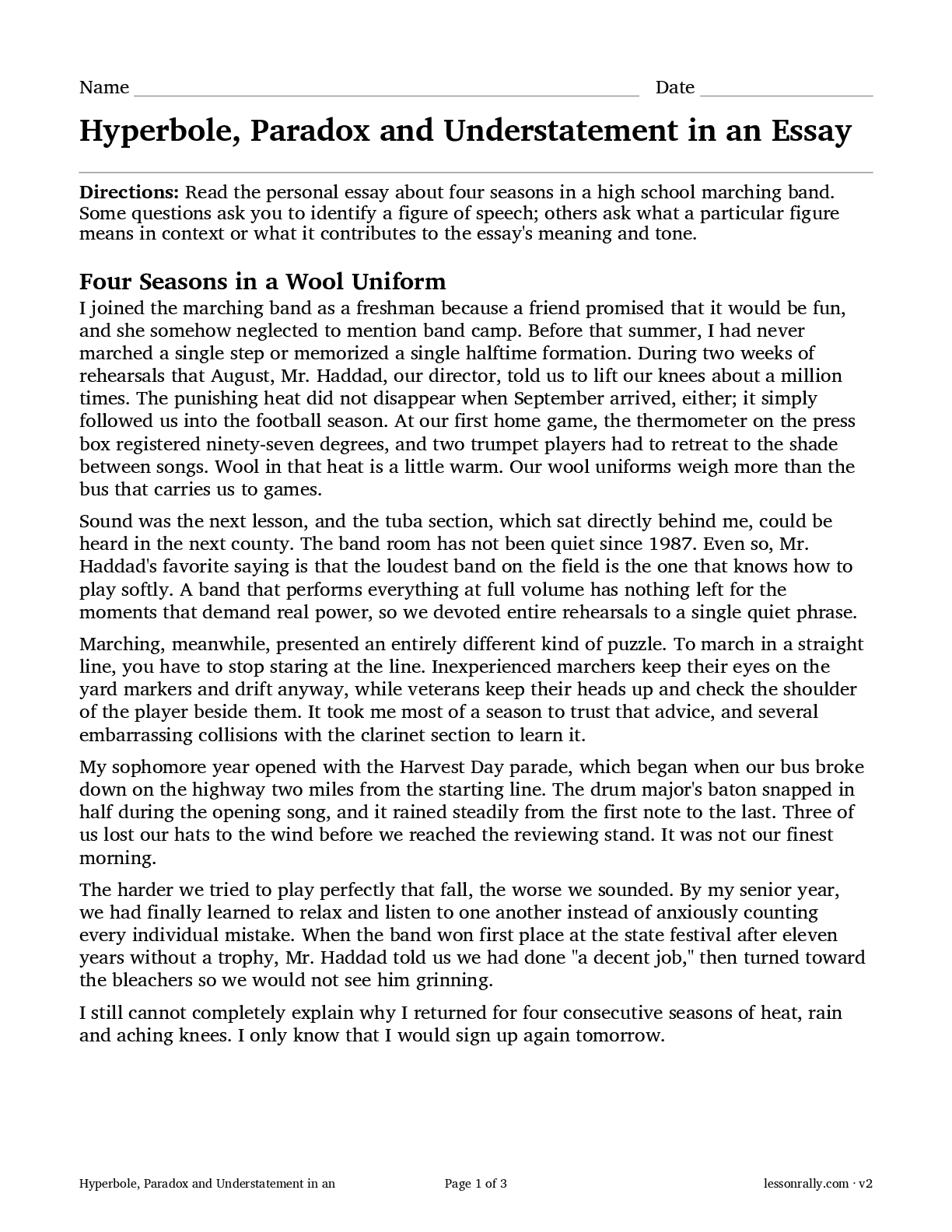
Read the personal essay about four seasons in a high school marching band. Some questions ask you to identify a figure of speech; others ask what a particular figure means in context or what it contributes to the essay's meaning and tone.

Four Seasons in a Wool Uniform

I joined the marching band as a freshman because a friend promised that it would be fun, and she somehow neglected to mention band camp. Before that summer, I had never marched a single step or memorized a single halftime formation. During two weeks of rehearsals that August, Mr. Haddad, our director, told us to lift our knees about a million times. The punishing heat did not disappear when September arrived, either; it simply followed us into the football season. At our first home game, the thermometer on the press box registered ninety-seven degrees, and two trumpet players had to retreat to the shade between songs. Wool in that heat is a little warm. Our wool uniforms weigh more than the bus that carries us to games.

Sound was the next lesson, and the tuba section, which sat directly behind me, could be heard in the next county. The band room has not been quiet since 1987. Even so, Mr. Haddad's favorite saying is that the loudest band on the field is the one that knows how to play softly. A band that performs everything at full volume has nothing left for the moments that demand real power, so we devoted entire rehearsals to a single quiet phrase.

Marching, meanwhile, presented an entirely different kind of puzzle. To march in a straight line, you have to stop staring at the line. Inexperienced marchers keep their eyes on the yard markers and drift anyway, while veterans keep their heads up and check the shoulder of the player beside them. It took me most of a season to trust that advice, and several embarrassing collisions with the clarinet section to learn it.

My sophomore year opened with the Harvest Day parade, which began when our bus broke down on the highway two miles from the starting line. The drum major's baton snapped in half during the opening song, and it rained steadily from the first note to the last. Three of us lost our hats to the wind before we reached the reviewing stand. It was not our finest morning.

The harder we tried to play perfectly that fall, the worse we sounded. By my senior year, we had finally learned to relax and listen to one another instead of anxiously counting every individual mistake. When the band won first place at the state festival after eleven years without a trophy, Mr. Haddad told us we had done "a decent job," then turned toward the bleachers so we would not see him grinning.

I still cannot completely explain why I returned for four consecutive seasons of heat, rain and aching knees. I only know that I would sign up again tomorrow.


Question 1

According to the writer, during two weeks of August rehearsals the director told the band to lift their knees "about a million times." Which figure of speech does this phrase illustrate?

Choose one answer.

  • Hyperbole: deliberate exaggeration too extreme for anyone to believe it literally
  • Paradox: a statement that seems contradictory or against common sense yet holds a truth
  • Simile: a comparison between two unlike things that uses the word like or as
  • Understatement: describing something as far less serious or impressive than it really is

Question 2

In the second paragraph, what does the writer mean by claiming that the tuba section "could be heard in the next county"?

Choose one answer.

  • The tuba section played extraordinarily loudly.
  • The tubas were too quiet to hear from the writer's seat.
  • Residents of nearby towns complained to the school.
  • The band performed in a neighboring county that season.

Question 3

Describing the band's struggles, the writer reports, "The harder we tried to play perfectly that fall, the worse we sounded." Which figure of speech is this sentence built on?

Choose one answer.

  • Understatement: describing something as far less serious or impressive than it really is
  • Hyperbole: deliberate exaggeration too extreme for anyone to believe it literally
  • Paradox: a statement that seems contradictory or against common sense yet holds a truth
  • Simile: a comparison between two unlike things that uses the word like or as

Question 4

The director's favorite saying is that "the loudest band on the field is the one that knows how to play softly." What truth does this apparently contradictory saying express?

Choose one answer.

  • Volume matters more than playing the correct notes accurately.
  • A band should play quietly for most of every performance.
  • The quietest band on the field usually wins the competition.
  • Loud passages sound strongest when set against quiet ones.

Question 5

After a broken-down bus, a snapped baton and a parade in steady rain, the writer concludes, "It was not our finest morning." Which figure of speech is at work in this sentence?

Choose one answer.

  • Paradox: a statement that seems contradictory or against common sense yet holds a truth
  • Understatement: describing something as far less serious or impressive than it really is
  • Simile: a comparison between two unlike things that uses the word like or as
  • Hyperbole: deliberate exaggeration too extreme for anyone to believe it literally

Question 6

After eleven years without a trophy, the band wins first place at the state festival, and the director tells them they did "a decent job." What does this understatement suggest about him?

Choose one answer.

  • He is proud but keeps his praise dry and restrained.
  • He is too exhausted after the festival to celebrate.
  • He is surprised that the judges noticed the band at all.
  • He believes the band could have performed considerably better.

Question 7

Which two sentences from the band essay use exaggeration so extreme that no reader could possibly take it literally?

Choose 2 answers.

  • "Three of us lost our hats to the wind before we reached the reviewing stand."
  • "Wool in that heat is a little warm."
  • "Our wool uniforms weigh more than the bus that carries us to games."
  • "The band room has not been quiet since 1987."
  • "My sophomore year opened with the Harvest Day parade, which began when our bus broke down on the highway two miles from the starting line."

Question 8

The writer observes, "To march in a straight line, you have to stop staring at the line." What does this paradox actually mean in the context of the essay?

Choose one answer.

  • The yard markers on the field were painted noticeably crooked.
  • Speed matters more than straight lines during a parade performance.
  • Marchers keep a line straight by watching the players beside them.
  • Marchers should look down at the field in order to stay straight.

Question 9

The writer says, "Wool in that heat is a little warm." What in the essay shows that this is an understatement and not a plain description?

Choose one answer.

  • The essay explains that wool keeps marchers cool, so they rarely notice the temperature.
  • The sentence before it describes ninety-seven degrees and players retreating to the shade.
  • The writer admits to missing that first game and hearing about the weather from friends.
  • The writer later says that the wool uniforms felt surprisingly comfortable even on the hottest days.

Question 10

Taken together, how do the essay's hyperboles about knees, tubas and uniforms shape its overall tone?

Choose one answer.

  • They turn hard work into comedy, so the writer sounds amused, not bitter.
  • They make the season sound effortless, so the band's eventual trophy seems unearned.
  • They make the director seem cruel, so the writer sounds resentful and disappointed.
  • They make the practices sound dangerous, so the essay reads as a warning to newcomers.

Reviews

No reviews yet.

Reviews come from teachers who assigned this activity to a class.

Sign in to write a review

Have a topic of your own? Make a printable worksheet and online quiz, free.

Create an activity

Answer key

Answer keys come with Premium

Print this worksheet with the correct answers marked. The key includes any explanations, sample answers, and rubrics supplied with the activity.

Answer keys aren't public: only teachers with Premium and the people who can edit an activity can download one, so students can't get a ready-to-print key from this page.

Premium includes:

  • No ads for you, and no ads for your students on the assignments you post.
  • Answer keys for printable worksheets, with the correct answers marked and any explanations, sample answers, and rubrics.
  • Create with AI: up to 100 activities a year (5 during the free trial), with every answer checked before you see the draft.

$29 a year, plus sales tax where it applies.

New Premium teachers can try it free for 7 days. A card or other payment method is needed to start. Unless you cancel before the trial ends, you are charged then and the plan renews every year.

Already have Premium or edit this activity? Sign in