Analogy and Tone in a Poem: Unpacking

8 questions · 8 points · Grade 8 · English · Preview the 8 questions

Made by Claire Fenwood · LessonRally (AI-assisted)

Digital classroom activity

What is a digital classroom activity?

Teachers who sign in can assign LessonRally activities to their Google Classroom classes: students open them in Classroom and answer online, and their grades go to the teacher's Classroom gradebook. Practice lets you try it first, the way students see it.

Free for teachers. Sign in to assign activities to your Google Classroom classes.

Printable worksheet

Students read an original poem about unpacking after a move to a new town. They explain the poem's extended analogy, which compares a new town to new sneakers, and analyze how that analogy and other word choices shape the tone as it shifts from lonely to hopeful.

Learning goal: Analyze how an analogy and other specific word choices shape the meaning and tone of a poem.

Estimated reading level 6.3

  1. Grade 4Hard
  2. Grade 5Stretch
  3. Grade 6On level
  4. Grade 7Easier
  5. Grade 8Easy
About this estimate

The estimate is halfway between the two middle scores of four readability formulas. Their scores run from 5.5 to 7.2.

  • Flesch-Kincaid GradeSentence length and syllables per word5.5
  • Gunning FogSentence length and words of three or more syllables7.2
  • Coleman-Liau Middle scoreLetters per word and sentences per 100 words6.9
  • Automated Readability Index Middle scoreCharacters per word and words per sentence5.6
Flesch Reading Ease
81.0 on a 0 to 100 scale where higher is easier: easy. Not part of the estimate.
Text measured
654 words, 24 sentences

Adapted from common readability formulas (Flesch-Kincaid, Gunning Fog, Coleman-Liau and ARI, plus SMOG for long texts), which look at sentence length and word length. Answer choices count toward word length only. Grades below the estimate will likely find the text harder, grades above it easier. It does not measure ideas, background knowledge or images.

Common Core

Closest anchor: CCRA.R.4 Interpret words and phrases as they are used in a text, including determining technical, connotative, and figurative meanings, and analyze how specific word choices shape meaning or tone.Anchor Standards for ReadingShow 1 matched standardHide matched standard

Matched standard

  • RL.8.4

    Determine the meaning of words and phrases as they are used in a text, including figurative and connotative meanings; analyze the impact of specific word choices on meaning and tone, including analogies or allusions to other texts.

    Student preview questions 1, 2, 5, 6

Matched independently by two AI models from this activity's questions.

© Copyright 2010. National Governors Association Center for Best Practices and Council of Chief State School Officers. All rights reserved.

Topics: Figurative Language, Tone and Mood Chosen by LessonRally

Question types: multiple choice, select all that apply.

Student preview

The questions as students see them, without the answers.

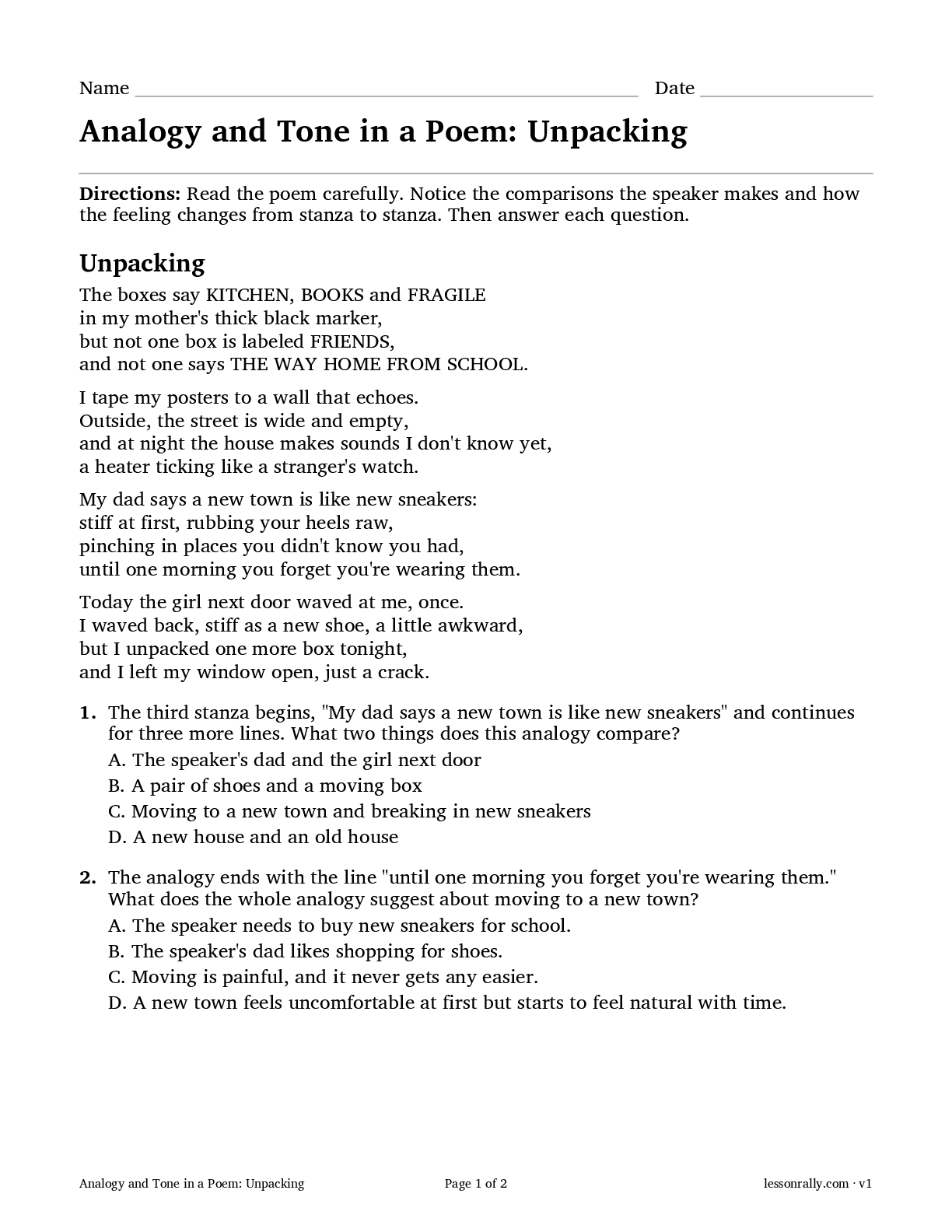
Read the poem carefully. Notice the comparisons the speaker makes and how the feeling changes from stanza to stanza. Then answer each question.

Unpacking

The boxes say KITCHEN, BOOKS and FRAGILE
in my mother's thick black marker,
but not one box is labeled FRIENDS,
and not one says THE WAY HOME FROM SCHOOL.

I tape my posters to a wall that echoes.
Outside, the street is wide and empty,
and at night the house makes sounds I don't know yet,
a heater ticking like a stranger's watch.

My dad says a new town is like new sneakers:
stiff at first, rubbing your heels raw,
pinching in places you didn't know you had,
until one morning you forget you're wearing them.

Today the girl next door waved at me, once.
I waved back, stiff as a new shoe, a little awkward,
but I unpacked one more box tonight,
and I left my window open, just a crack.


Question 1

The third stanza begins, "My dad says a new town is like new sneakers" and continues for three more lines. What two things does this analogy compare?

Choose one answer.

  • A new house and an old house
  • A pair of shoes and a moving box
  • The speaker's dad and the girl next door
  • Moving to a new town and breaking in new sneakers

Question 2

The analogy ends with the line "until one morning you forget you're wearing them." What does the whole analogy suggest about moving to a new town?

Choose one answer.

  • Moving is painful, and it never gets any easier.
  • A new town feels uncomfortable at first but starts to feel natural with time.
  • The speaker's dad likes shopping for shoes.
  • The speaker needs to buy new sneakers for school.

Question 3

In the first stanza, the speaker notices that "not one box is labeled FRIENDS" among all the labels on the moving boxes. What does this detail suggest?

Choose one answer.

  • The things the speaker misses most cannot be packed in a box.
  • The speaker's mother ran out of marker.
  • The speaker forgot to pack some of the boxes.
  • The speaker wants to move back right away.

Question 4

Which two details from the poem make the speaker's new house and neighborhood feel empty and unfamiliar? Select two.

Choose 2 answers.

  • "a wall that echoes"
  • "in my mother's thick black marker"
  • "Today the girl next door waved at me"
  • "I unpacked one more box tonight"
  • "the street is wide and empty"

Question 5

At night, the speaker hears "a heater ticking like a stranger's watch." How does this comparison add to the tone of the second stanza?

Choose one answer.

  • It shows that a stranger left a watch in the house.
  • It shows that the heater is broken and needs to be repaired.
  • It makes the house sound cozy and familiar.
  • It shows that even the small sounds of the house feel unfamiliar, as if they belong to someone else.

Question 6

In the last stanza, the speaker waves back to the girl next door "stiff as a new shoe" and a little awkward. How does this phrase connect to Dad's analogy?

Choose one answer.

  • It shows that the speaker is in the early, stiff stage of getting used to the new town.
  • It shows that the speaker's shoes hurt after walking outside.
  • It shows that the speaker refuses to make new friends.
  • It shows that Dad's analogy turned out to be wrong.

Question 7

How does the tone of the poem change in the last stanza, compared with the stanzas that come before it?

Choose one answer.

  • It shifts from hopeful to hopeless.
  • It stays lonely and gloomy from start to finish.
  • It shifts from lonely to cautiously hopeful.
  • It becomes wildly excited and joyful.

Question 8

The poem ends, "and I left my window open, just a crack." What does this final image suggest?

Choose one answer.

  • The speaker is trying to hear the old neighborhood.
  • The speaker is starting to let the new place in, a little at a time.
  • The speaker plans to sneak out of the house at night.
  • The speaker forgot to close the window before bed.

Reviews

No reviews yet.

Reviews come from teachers who assigned this activity to a class.

Sign in to write a review

Have a topic of your own? Make a printable worksheet and online quiz, free.

Create an activity

Answer key

Answer keys come with Premium

Print this worksheet with the correct answers marked. The key includes any explanations, sample answers, and rubrics supplied with the activity.

Answer keys aren't public: only teachers with Premium and the people who can edit an activity can download one, so students can't get a ready-to-print key from this page.

Premium includes:

  • No ads for you, and no ads for your students on the assignments you post.
  • Answer keys for printable worksheets, with the correct answers marked and any explanations, sample answers, and rubrics.
  • Create with AI: up to 100 activities a year (5 during the free trial), with every answer checked before you see the draft.

$29 a year, plus sales tax where it applies.

New Premium teachers can try it free for 7 days. A card or other payment method is needed to start. Unless you cancel before the trial ends, you are charged then and the plan renews every year.

Already have Premium or edit this activity? Sign in