Imagery and Mood in a Poem: Tidewater

10 questions · 10 points · Grades 9–10 · English · Preview the 10 questions

Made by Eleanor Wrenfield · LessonRally (AI-assisted)

Digital classroom activity

What is a digital classroom activity?

Teachers who sign in can assign LessonRally activities to their Google Classroom classes: students open them in Classroom and answer online, and their grades go to the teacher's Classroom gradebook. Practice lets you try it first, the way students see it.

Free for teachers. Sign in to assign activities to your Google Classroom classes.

Printable worksheet

Students read an original poem about a river town at low tide and analyze how its images, similes and word choices build mood and a sense of place. Questions include how a shift in imagery changes the mood of the poem. Poetry practice with figurative language, simile, personification and word choice.

Learning goal: Analyze how imagery, figurative language and word choice in a poem create mood and a sense of place, and how a shift in imagery shifts the mood.

Estimated reading level 7.7

  1. Grade 5Hard
  2. Grade 6Stretch
  3. Grade 7On level
  4. Grade 8Easier
  5. Grade 9Easy
About this estimate

The estimate is the middle score of five readability formulas. Their scores run from 6.6 to 8.8.

  • Flesch-Kincaid GradeSentence length and syllables per word6.6
  • Gunning FogSentence length and words of three or more syllables8.8
  • Coleman-Liau Middle scoreLetters per word and sentences per 100 words7.7
  • Automated Readability IndexCharacters per word and words per sentence7.0
  • SMOGWords of three or more syllables, for texts of 30 sentences or more8.2
Flesch Reading Ease
77.0 on a 0 to 100 scale where higher is easier: fairly easy. Not part of the estimate.
Text measured
854 words, 30 sentences

Adapted from common readability formulas (Flesch-Kincaid, Gunning Fog, Coleman-Liau and ARI, plus SMOG for long texts), which look at sentence length and word length. Answer choices count toward word length only. Grades below the estimate will likely find the text harder, grades above it easier. It does not measure ideas, background knowledge or images.

Common Core

Closest anchor: CCRA.R.4 Interpret words and phrases as they are used in a text, including determining technical, connotative, and figurative meanings, and analyze how specific word choices shape meaning or tone.Anchor Standards for ReadingShow 1 matched standardHide matched standard

Matched standard

  • RL.9-10.4

    Determine the meaning of words and phrases as they are used in the text, including figurative and connotative meanings; analyze the cumulative impact of specific word choices on meaning and tone (e.g., how the language evokes a sense of time and place; how it sets a formal or informal tone).

    Student preview questions 1, 3, 4, 5, 6, 8, 10

Matched independently by two AI models from this activity's questions.

© Copyright 2010. National Governors Association Center for Best Practices and Council of Chief State School Officers. All rights reserved.

Topics: Figurative Language, Tone and Mood Chosen by LessonRally

Question types: multiple choice, select all that apply.

Student preview

The questions as students see them, without the answers.

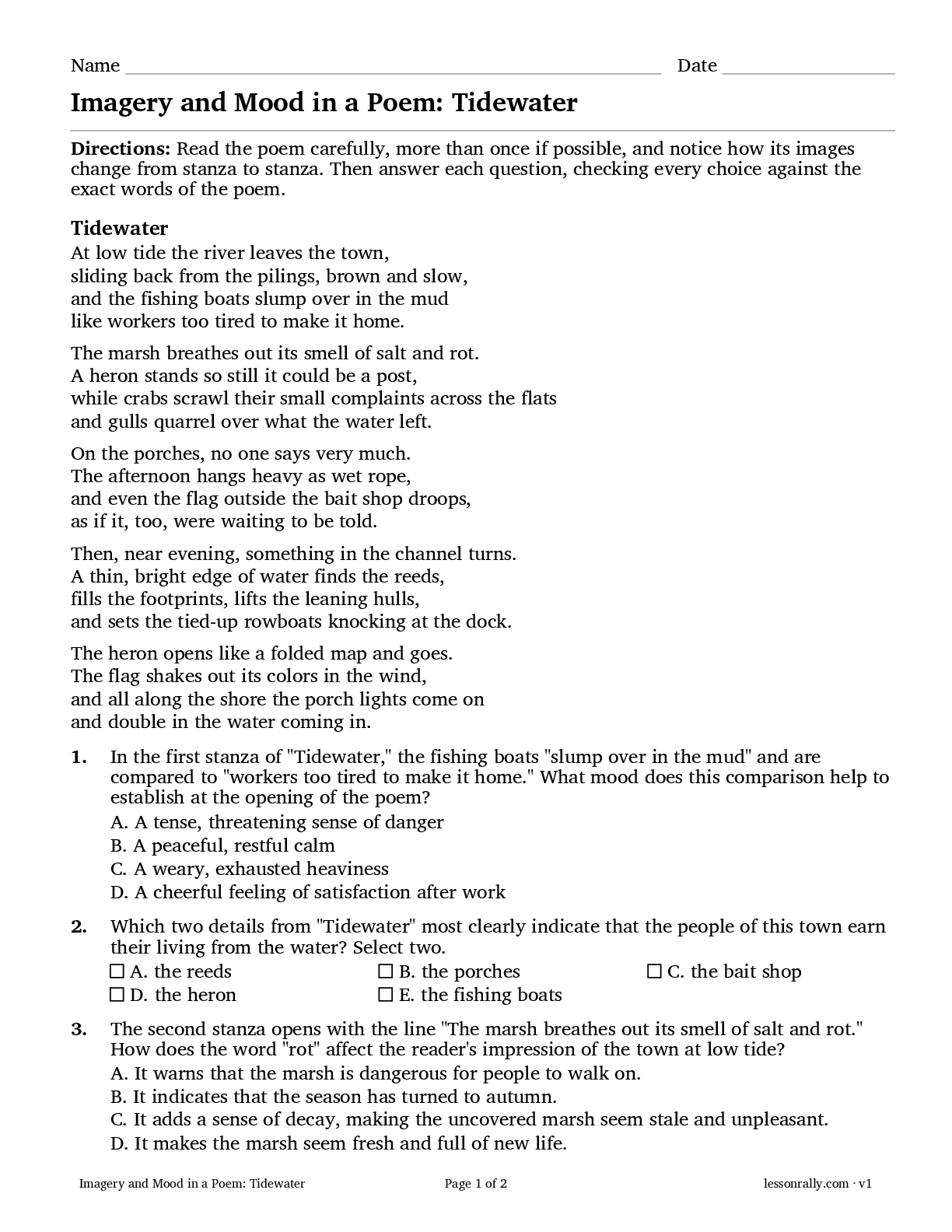
Read the poem carefully, more than once if possible, and notice how its images change from stanza to stanza. Then answer each question, checking every choice against the exact words of the poem.

Tidewater

At low tide the river leaves the town,
sliding back from the pilings, brown and slow,
and the fishing boats slump over in the mud
like workers too tired to make it home.

The marsh breathes out its smell of salt and rot.
A heron stands so still it could be a post,
while crabs scrawl their small complaints across the flats
and gulls quarrel over what the water left.

On the porches, no one says very much.
The afternoon hangs heavy as wet rope,
and even the flag outside the bait shop droops,
as if it, too, were waiting to be told.

Then, near evening, something in the channel turns.
A thin, bright edge of water finds the reeds,
fills the footprints, lifts the leaning hulls,
and sets the tied-up rowboats knocking at the dock.

The heron opens like a folded map and goes.
The flag shakes out its colors in the wind,
and all along the shore the porch lights come on
and double in the water coming in.


Question 1

In the first stanza of "Tidewater," the fishing boats "slump over in the mud" and are compared to "workers too tired to make it home." What mood does this comparison help to establish at the opening of the poem?

Choose one answer.

  • A tense, threatening sense of danger
  • A peaceful, restful calm
  • A weary, exhausted heaviness
  • A cheerful feeling of satisfaction after work

Question 2

Which two details from "Tidewater" most clearly indicate that the people of this town earn their living from the water? Select two.

Choose 2 answers.

  • the reeds
  • the bait shop
  • the heron
  • the fishing boats
  • the porches

Question 3

The second stanza opens with the line "The marsh breathes out its smell of salt and rot." How does the word "rot" affect the reader's impression of the town at low tide?

Choose one answer.

  • It indicates that the season has turned to autumn.
  • It makes the marsh seem fresh and full of new life.
  • It warns that the marsh is dangerous for people to walk on.
  • It adds a sense of decay, making the uncovered marsh seem stale and unpleasant.

Question 4

In the second stanza, the crabs scrawl "small complaints" across the flats while the gulls "quarrel over what the water left." What do these particular word choices contribute to the mood?

Choose one answer.

  • A deep and frightening violence
  • A peaceful, orderly calm
  • A petty, grumbling irritation
  • A playful, cheerful energy

Question 5

In the third stanza, what does the simile "The afternoon hangs heavy as wet rope" suggest about the way time feels to the people of the town?

Choose one answer.

  • It is busy with ropes to tie and chores to finish.
  • It passes quickly, like rope sliding through a hand.
  • It brings a rainstorm that soaks the entire town.
  • It drags, feeling slow and burdensome.

Question 6

The flag outside the bait shop droops "as if it, too, were waiting to be told." What does the word "too" suggest in this line?

Choose one answer.

  • The flag is about to be lifted by a rising wind.
  • The flag is not the only thing waiting, so the whole town seems to be holding still.
  • The flag is about to be taken down for the night.
  • The flag is the only thing in town that is waiting.

Question 7

The fourth stanza begins with the line "Then, near evening, something in the channel turns." How does the shift in imagery in this stanza change the poem's mood?

Choose one answer.

  • Images of the town give way to the open sea, and the mood turns lonely.
  • Images of light give way to darkness, and the mood turns frightening.
  • The images remain much the same, and so does the mood.
  • Images of stillness give way to moving water and light, and the heavy mood begins to lift.

Question 8

Read this line from the final stanza: "The heron opens like a folded map and goes." What does the simile help the reader to visualize?

Choose one answer.

  • The heron standing perfectly still among the reeds
  • The heron folding itself up to sleep
  • The heron studying the marsh to find its way home
  • The heron's folded wings spreading wide as it takes off

Question 9

The boats, the heron and the flag each appear before the tide turns and again after it returns. What is the effect of bringing these images back near the end of the poem?

Choose one answer.

  • It suggests that the speaker is dreaming the same scene twice.
  • It lets readers see the same things transformed, which sharpens the change in mood.
  • It introduces new characters for the end of the poem.
  • It shows that nothing in the town has really changed.

Question 10

The poem ends as the porch lights "double in the water coming in." What is the effect of concluding "Tidewater" with this particular image?

Choose one answer.

  • It closes with a warning that the water will flood the town.
  • It closes with the speaker leaving the town for good.
  • It closes on warmth and fullness, as the returning water shines with the town's lights.
  • It closes by showing that the town has gone to sleep.

Reviews

No reviews yet.

Reviews come from teachers who assigned this activity to a class.

Sign in to write a review

Have a topic of your own? Make a printable worksheet and online quiz, free.

Create an activity

Answer key

Answer keys come with Premium

Print this worksheet with the correct answers marked. The key includes any explanations, sample answers, and rubrics supplied with the activity.

Answer keys aren't public: only teachers with Premium and the people who can edit an activity can download one, so students can't get a ready-to-print key from this page.

Premium includes:

  • No ads for you, and no ads for your students on the assignments you post.
  • Answer keys for printable worksheets, with the correct answers marked and any explanations, sample answers, and rubrics.
  • Create with AI: up to 100 activities a year (5 during the free trial), with every answer checked before you see the draft.

$29 a year, plus sales tax where it applies.

New Premium teachers can try it free for 7 days. A card or other payment method is needed to start. Unless you cancel before the trial ends, you are charged then and the plan renews every year.

Already have Premium or edit this activity? Sign in