

English Language Arts and Literacy
Grade 8 ELA
Open a standard to see the worksheets and online quizzes matched to it.
Grade 8 ELA activities
- ScienceFeatured
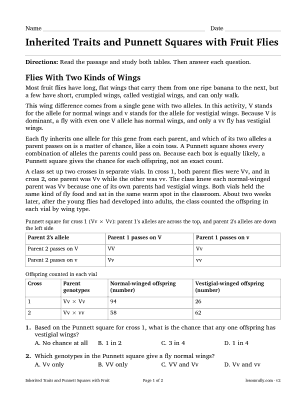
Inherited Traits and Punnett Squares with Fruit Flies (opens in a new tab)
- Grade 8
- 9 questions
- Estimated reading level 7.2
Common Core RST.6-8.7
Made by Myra Jefferson · LessonRally (AI-assisted)
- English Language ArtsFeatured
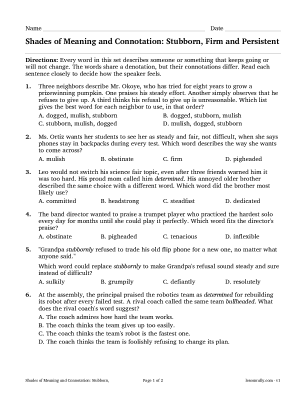
Shades of Meaning and Connotation: Stubborn, Firm and Persistent (opens in a new tab)
- Grade 8
- 10 questions
- Estimated reading level 8.4
Common Core L.8.5c
Made by Simone Thornbury · LessonRally (AI-assisted)
- Social StudiesFeatured
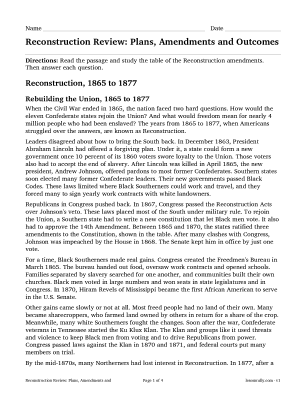
Reconstruction Review: Plans, Amendments and Outcomes (opens in a new tab)
- Grade 8
- 12 questions
- Estimated reading level 9.4
Common Core RH.6-8.1
Made by Monica Ellison · LessonRally (AI-assisted)
Counts updated 14 minutes ago.
Reading: Literature
Cite the textual evidence that most strongly supports an analysis of what the text says explicitly as well as inferences drawn from the text.
Determine a theme or central idea of a text and analyze its development over the course of the text, including its relationship to the characters, setting, and plot; provide an objective summary of the text.
RL.8.3 1 activity
Analyze how particular lines of dialogue or incidents in a story or drama propel the action, reveal aspects of a character, or provoke a decision.
RL.8.4 1 activity
Determine the meaning of words and phrases as they are used in a text, including figurative and connotative meanings; analyze the impact of specific word choices on meaning and tone, including analogies or allusions to other texts.
RL.8.5 1 activity
Compare and contrast the structure of two or more texts and analyze how the differing structure of each text contributes to its meaning and style.
RL.8.6 1 activity
Analyze how differences in the points of view of the characters and the audience or reader (e.g., created through the use of dramatic irony) create such effects as suspense or humor.
Analyze the extent to which a filmed or live production of a story or drama stays faithful to or departs from the text or script, evaluating the choices made by the director or actors.
Analyze how a modern work of fiction draws on themes, patterns of events, or character types from myths, traditional stories, or religious works such as the Bible, including describing how the material is rendered new.
By the end of the year, read and comprehend literature, including stories, dramas, and poems, at the high end of grades 6-8 text complexity band independently and proficiently.
Reading: Informational Text
Show 10 standards in Reading: Informational Text
Cite the textual evidence that most strongly supports an analysis of what the text says explicitly as well as inferences drawn from the text.
Determine a central idea of a text and analyze its development over the course of the text, including its relationship to supporting ideas; provide an objective summary of the text.
Analyze how a text makes connections among and distinctions between individuals, ideas, or events (e.g., through comparisons, analogies, or categories).
Determine the meaning of words and phrases as they are used in a text, including figurative, connotative, and technical meanings; analyze the impact of specific word choices on meaning and tone, including analogies or allusions to other texts.
Analyze in detail the structure of a specific paragraph in a text, including the role of particular sentences in developing and refining a key concept.
Determine an author's point of view or purpose in a text and analyze how the author acknowledges and responds to conflicting evidence or viewpoints.
Evaluate the advantages and disadvantages of using different mediums (e.g., print or digital text, video, multimedia) to present a particular topic or idea.
Delineate and evaluate the argument and specific claims in a text, assessing whether the reasoning is sound and the evidence is relevant and sufficient; recognize when irrelevant evidence is introduced.
Analyze a case in which two or more texts provide conflicting information on the same topic and identify where the texts disagree on matters of fact or interpretation.
By the end of the year, read and comprehend literary nonfiction at the high end of the grades 6-8 text complexity band independently and proficiently.
Writing
Show 10 standards in Writing
Write arguments to support claims with clear reasons and relevant evidence
Parts of W.8.1 (5)
- W.8.1a Introduce claim(s), acknowledge and distinguish the claim(s) from alternate or opposing claims, and organize the reasons and evidence logically.
- W.8.1b Support claim(s) with logical reasoning and relevant evidence, using accurate, credible sources and demonstrating an understanding of the topic or text.
- W.8.1c Use words, phrases, and clauses to create cohesion and clarify the relationships among claim(s), counterclaims, reasons, and evidence.
- W.8.1d Establish and maintain a formal style.
- W.8.1e Provide a concluding statement or section that follows from and supports the argument presented.
Write informative/explanatory texts to examine a topic and convey ideas, concepts, and information through the selection, organization, and analysis of relevant content.
Parts of W.8.2 (6)
- W.8.2a Introduce a topic clearly, previewing what is to follow; organize ideas, concepts, and information into broader categories; include formatting (e.g., headings), graphics (e.g., charts, tables), and multimedia when useful to aiding comprehension.
- W.8.2b Develop the topic with relevant, well-chosen facts, definitions, concrete details, quotations, or other information and examples.
- W.8.2c Use appropriate and varied transitions to create cohesion and clarify the relationships among ideas and concepts.
- W.8.2d Use precise language and domain-specific vocabulary to inform about or explain the topic.
- W.8.2e Establish and maintain a formal style.
- W.8.2f Provide a concluding statement or section that follows from and supports the information or explanation presented.
Write narratives to develop real or imagined experiences or events using effective technique, relevant descriptive details, and well-structured event sequences.
Parts of W.8.3 (5)
- W.8.3a Engage and orient the reader by establishing a context and point of view and introducing a narrator and/or characters; organize an event sequence that unfolds naturally and logically.
- W.8.3b Use narrative techniques, such as dialogue, pacing, description, and reflection, to develop experiences, events, and/or characters.
- W.8.3c Use a variety of transition words, phrases, and clauses to convey sequence, signal shifts from one time frame or setting to another, and show the relationships among experiences and events.
- W.8.3d Use precise words and phrases, relevant descriptive details, and sensory language to capture the action and convey experiences and events.
- W.8.3e Provide a conclusion that follows from and reflects on the narrated experiences or events.
Produce clear and coherent writing in which the development, organization, and style are appropriate to task, purpose, and audience. (Grade-specific expectations for writing types are defined in standards 1-3 above.)
With some guidance and support from peers and adults, develop and strengthen writing as needed by planning, revising, editing, rewriting, or trying a new approach, focusing on how well purpose and audience have been addressed. (Editing for conventions should demonstrate command of Language standards 1-3 up to and including grade 8 here.)
Use technology, including the Internet, to produce and publish writing and present the relationships between information and ideas efficiently as well as to interact and collaborate with others.
Conduct short research projects to answer a question (including a self-generated question), drawing on several sources and generating additional related, focused questions that allow for multiple avenues of exploration.
Gather relevant information from multiple print and digital sources, using search terms effectively; assess the credibility and accuracy of each source; and quote or paraphrase the data and conclusions of others while avoiding plagiarism and following a standard format for citation.
Draw evidence from literary or informational texts to support analysis, reflection, and research.
Parts of W.8.9 (2)
- W.8.9a Apply grade 8 Reading standards to literature (e.g., "Analyze how a modern work of fiction draws on themes, patterns of events, or character types from myths, traditional stories, or religious works such as the Bible, including describing how the material is rendered new").
- W.8.9b Apply grade 8 Reading standards to literary nonfiction (e.g., "Delineate and evaluate the argument and specific claims in a text, assessing whether the reasoning is sound and the evidence is relevant and sufficient; recognize when irrelevant evidence is introduced").
Write routinely over extended time frames (time for research, reflection, and revision) and shorter time frames (a single sitting or a day or two) for a range of discipline-specific tasks, purposes, and audiences.
Speaking and Listening
Show 6 standards in Speaking and Listening
Engage effectively in a range of collaborative discussions (one-on-one, in groups, and teacher-led) with diverse partners on grade 8 topics, texts, and issues, building on others' ideas and expressing their own clearly.
Parts of SL.8.1 (4)
- SL.8.1a Come to discussions prepared, having read or researched material under study; explicitly draw on that preparation by referring to evidence on the topic, text, or issue to probe and reflect on ideas under discussion.
- SL.8.1b Follow rules for collegial discussions and decision-making, track progress toward specific goals and deadlines, and define individual roles as needed.
- SL.8.1c Pose questions that connect the ideas of several speakers and respond to others' questions and comments with relevant evidence, observations, and ideas.
- SL.8.1d Acknowledge new information expressed by others, and, when warranted, qualify or justify their own views in light of the evidence presented.
Analyze the purpose of information presented in diverse media and formats (e.g., visually, quantitatively, orally) and evaluate the motives (e.g., social, commercial, political) behind its presentation.
Delineate a speaker's argument and specific claims, evaluating the soundness of the reasoning and relevance and sufficiency of the evidence and identifying when irrelevant evidence is introduced.
Present claims and findings, emphasizing salient points in a focused, coherent manner with relevant evidence, sound valid reasoning, and well-chosen details; use appropriate eye contact, adequate volume, and clear pronunciation.
Integrate multimedia and visual displays into presentations to clarify information, strengthen claims and evidence, and add interest.
Adapt speech to a variety of contexts and tasks, demonstrating command of formal English when indicated or appropriate. (See grade 8 Language standards 1 and 3 here for specific expectations.)
Language
Demonstrate command of the conventions of standard English grammar and usage when writing or speaking.
Parts of L.8.1 (4)
- L.8.1a Explain the function of verbals (gerunds, participles, infinitives) in general and their function in particular sentences.
- L.8.1b Form and use verbs in the active and passive voice.
- L.8.1c Form and use verbs in the indicative, imperative, interrogative, conditional, and subjunctive mood.
- L.8.1d Recognize and correct inappropriate shifts in verb voice and mood.
Demonstrate command of the conventions of standard English capitalization, punctuation, and spelling when writing.
Use knowledge of language and its conventions when writing, speaking, reading, or listening.
Parts of L.8.3 (1)
- L.8.3a Use verbs in the active and passive voice and in the conditional and subjunctive mood to achieve particular effects (e.g., emphasizing the actor or the action; expressing uncertainty or describing a state contrary to fact).
L.8.4 3 activities
Determine or clarify the meaning of unknown and multiple-meaning words or phrases based on grade 8 reading and content, choosing flexibly from a range of strategies.
L.8.4a, 3 activities L.8.4b, 2 activities
Parts of L.8.4 (4)
- L.8.4a Use context (e.g., the overall meaning of a sentence or paragraph; a word's position or function in a sentence) as a clue to the meaning of a word or phrase.
- L.8.4b Use common, grade-appropriate Greek or Latin affixes and roots as clues to the meaning of a word (e.g., precede, recede, secede).
- L.8.4c Consult general and specialized reference materials (e.g., dictionaries, glossaries, thesauruses), both print and digital, to find the pronunciation of a word or determine or clarify its precise meaning or its part of speech.
- L.8.4d Verify the preliminary determination of the meaning of a word or phrase (e.g., by checking the inferred meaning in context or in a dictionary).
L.8.5 2 activities
Demonstrate understanding of figurative language, word relationships, and nuances in word meanings.
L.8.5a, 1 activity L.8.5c, 1 activity
Parts of L.8.5 (3)
- L.8.5a Interpret figures of speech (e.g. verbal irony, puns) in context.
- L.8.5b Use the relationship between particular words to better understand each of the words.
- L.8.5c Distinguish among the connotations (associations) of words with similar denotations (definitions) (e.g., bullheaded, willful, firm, persistent, resolute).
Acquire and use accurately grade-appropriate general academic and domain-specific words and phrases; gather vocabulary knowledge when considering a word or phrase important to comprehension or expression.
Reading: History/Social Studies
RH.6-8.1 8 activities in grades 6 to 8
Cite specific textual evidence to support analysis of primary and secondary sources.
RH.6-8.2 5 activities in grades 6 to 8
Determine the central ideas or information of a primary or secondary source; provide an accurate summary of the source distinct from prior knowledge or opinions.
Identify key steps in a text's description of a process related to history/social studies (e.g., how a bill becomes law, how interest rates are raised or lowered).
RH.6-8.4 6 activities in grades 6 to 8
Determine the meaning of words and phrases as they are used in a text, including vocabulary specific to domains related to history/social studies.
RH.6-8.5 4 activities in grades 6 to 8
Describe how a text presents information (e.g., sequentially, comparatively, causally).
Identify aspects of a text that reveal an author's point of view or purpose (e.g., loaded language, inclusion or avoidance of particular facts).
RH.6-8.7 4 activities in grades 6 to 8
Integrate visual information (e.g., in charts, graphs, photographs, videos, or maps) with other information in print and digital texts.
RH.6-8.8 1 activity in grades 6 to 8
Distinguish among fact, opinion, and reasoned judgment in a text.
Analyze the relationship between a primary and secondary source on the same topic.
By the end of grade 8, read and comprehend history/social studies texts in the grades 6-8 text complexity band independently and proficiently.
Reading: Science and Technical Subjects
RST.6-8.1 1 activity in grades 6 to 8
Cite specific textual evidence to support analysis of science and technical texts.
Determine the central ideas or conclusions of a text; provide an accurate summary of the text distinct from prior knowledge or opinions.
RST.6-8.3 1 activity in grades 6 to 8
Follow precisely a multistep procedure when carrying out experiments, taking measurements, or performing technical tasks.
RST.6-8.4 7 activities in grades 6 to 8
Determine the meaning of symbols, key terms, and other domain-specific words and phrases as they are used in a specific scientific or technical context relevant to grades 6-8 texts and topics.
Analyze the structure an author uses to organize a text, including how the major sections contribute to the whole and to an understanding of the topic.
Analyze the author's purpose in providing an explanation, describing a procedure, or discussing an experiment in a text.
RST.6-8.7 12 activities in grades 6 to 8
Integrate quantitative or technical information expressed in words in a text with a version of that information expressed visually (e.g., in a flowchart, diagram, model, graph, or table).
RST.6-8.8 1 activity in grades 6 to 8
Distinguish among facts, reasoned judgment based on research findings, and speculation in a text.
Compare and contrast the information gained from experiments, simulations, video, or multimedia sources with that gained from reading a text on the same topic.
By the end of grade 8, read and comprehend science/technical texts in the grades 6-8 text complexity band independently and proficiently.
Writing: History/Social Studies, Science, and Technical Subjects
Show 9 standards in Writing: History/Social Studies, Science, and Technical Subjects
Write arguments focused on discipline-specific content.
Parts of WHST.6-8.1 (5)
- WHST.6-8.1a Introduce claim(s) about a topic or issue, acknowledge and distinguish the claim(s) from alternate or opposing claims, and organize the reasons and evidence logically.
- WHST.6-8.1b Support claim(s) with logical reasoning and relevant, accurate data and evidence that demonstrate an understanding of the topic or text, using credible sources.
- WHST.6-8.1c Use words, phrases, and clauses to create cohesion and clarify the relationships among claim(s), counterclaims, reasons, and evidence.
- WHST.6-8.1d Establish and maintain a formal style.
- WHST.6-8.1e Provide a concluding statement or section that follows from and supports the argument presented.
Write informative/explanatory texts, including the narration of historical events, scientific procedures/ experiments, or technical processes.
Parts of WHST.6-8.2 (6)
- WHST.6-8.2a Introduce a topic clearly, previewing what is to follow; organize ideas, concepts, and information into broader categories as appropriate to achieving purpose; include formatting (e.g., headings), graphics (e.g., charts, tables), and multimedia when useful to aiding comprehension.
- WHST.6-8.2b Develop the topic with relevant, well-chosen facts, definitions, concrete details, quotations, or other information and examples.
- WHST.6-8.2c Use appropriate and varied transitions to create cohesion and clarify the relationships among ideas and concepts.
- WHST.6-8.2d Use precise language and domain-specific vocabulary to inform about or explain the topic.
- WHST.6-8.2e Establish and maintain a formal style and objective tone.
- WHST.6-8.2f Provide a concluding statement or section that follows from and supports the information or explanation presented.
Produce clear and coherent writing in which the development, organization, and style are appropriate to task, purpose, and audience.
With some guidance and support from peers and adults, develop and strengthen writing as needed by planning, revising, editing, rewriting, or trying a new approach, focusing on how well purpose and audience have been addressed.
Use technology, including the Internet, to produce and publish writing and present the relationships between information and ideas clearly and efficiently.
Conduct short research projects to answer a question (including a self-generated question), drawing on several sources and generating additional related, focused questions that allow for multiple avenues of exploration.
Gather relevant information from multiple print and digital sources, using search terms effectively; assess the credibility and accuracy of each source; and quote or paraphrase the data and conclusions of others while avoiding plagiarism and following a standard format for citation.
Draw evidence from informational texts to support analysis, reflection, and research.
Write routinely over extended time frames (time for reflection and revision) and shorter time frames (a single sitting or a day or two) for a range of discipline-specific tasks, purposes, and audiences.
How matching works
LessonRally matches each shared activity to the Common Core standards its questions require, using AI after the activity passes review. Every standard shown in Browse was chosen independently by two AI models, or by LessonRally.
© Copyright 2010. National Governors Association Center for Best Practices and Council of Chief State School Officers. All rights reserved.
Don't see the standard you need?
Build it yourself or start from your AI chat. Your draft stays private until you publish it.