Reconstruction Review: Plans, Amendments and Outcomes

12 questions · 15 points · Grade 8 · English · Preview the 12 questions

Made by Monica Ellison · LessonRally (AI-assisted)

Digital classroom activity

What is a digital classroom activity?

Teachers who sign in can assign LessonRally activities to their Google Classroom classes: students open them in Classroom and answer online, and their grades go to the teacher's Classroom gradebook. Practice lets you try it first, the way students see it.

Free for teachers. Sign in to assign activities to your Google Classroom classes.

Printable worksheet

Students review the Reconstruction era, 1865 to 1877, with a passage and a table of the 13th, 14th and 15th Amendments. They find the central idea, summarize the plans for rebuilding the Union, match each amendment to what it did, and explain how Black Southerners gained rights and how Southern state laws and groups such as the Ku Klux Klan worked to undo those gains.

Learning goal: Determine the central ideas of a passage about Reconstruction, and summarize how the 13th, 14th and 15th Amendments expanded rights and how many of those gains were later undone.

Estimated reading level 9.4

  1. Grade 7Hard
  2. Grade 8Stretch
  3. Grade 9On level
  4. Grade 10Easier
  5. Grade 11Easy
About this estimate

The estimate is the middle score of five readability formulas. Their scores run from 6.7 to 10.0.

  • Flesch-Kincaid GradeSentence length and syllables per word6.7
  • Gunning Fog Middle scoreSentence length and words of three or more syllables9.4
  • Coleman-LiauLetters per word and sentences per 100 words9.5
  • Automated Readability IndexCharacters per word and words per sentence7.5
  • SMOGWords of three or more syllables, for texts of 30 sentences or more10.0
Flesch Reading Ease
69.2 on a 0 to 100 scale where higher is easier: standard. Not part of the estimate.
Text measured
1,286 words, 58 sentences

Adapted from common readability formulas (Flesch-Kincaid, Gunning Fog, Coleman-Liau and ARI, plus SMOG for long texts), which look at sentence length and word length. Answer choices count toward word length only. Grades below the estimate will likely find the text harder, grades above it easier. It does not measure ideas, background knowledge or images.

Common Core

Closest anchor: CCRA.R.1 Read closely to determine what the text says explicitly and to make logical inferences from it; cite specific textual evidence when writing or speaking to support conclusions drawn from the text.Anchor Standards for ReadingShow 2 matched standardsHide matched standards

Matched standards

  • RH.6-8.1

    Cite specific textual evidence to support analysis of primary and secondary sources.

    Student preview question 12

  • RH.6-8.2

    Determine the central ideas or information of a primary or secondary source; provide an accurate summary of the source distinct from prior knowledge or opinions.

    Student preview question 1

Matched independently by two AI models from this activity's questions.

© Copyright 2010. National Governors Association Center for Best Practices and Council of Chief State School Officers. All rights reserved.

Topic: Reconstruction Chosen by LessonRally

Question types: multiple choice, matching, fill in the blank, select all that apply.

Student preview

The questions as students see them, without the answers.

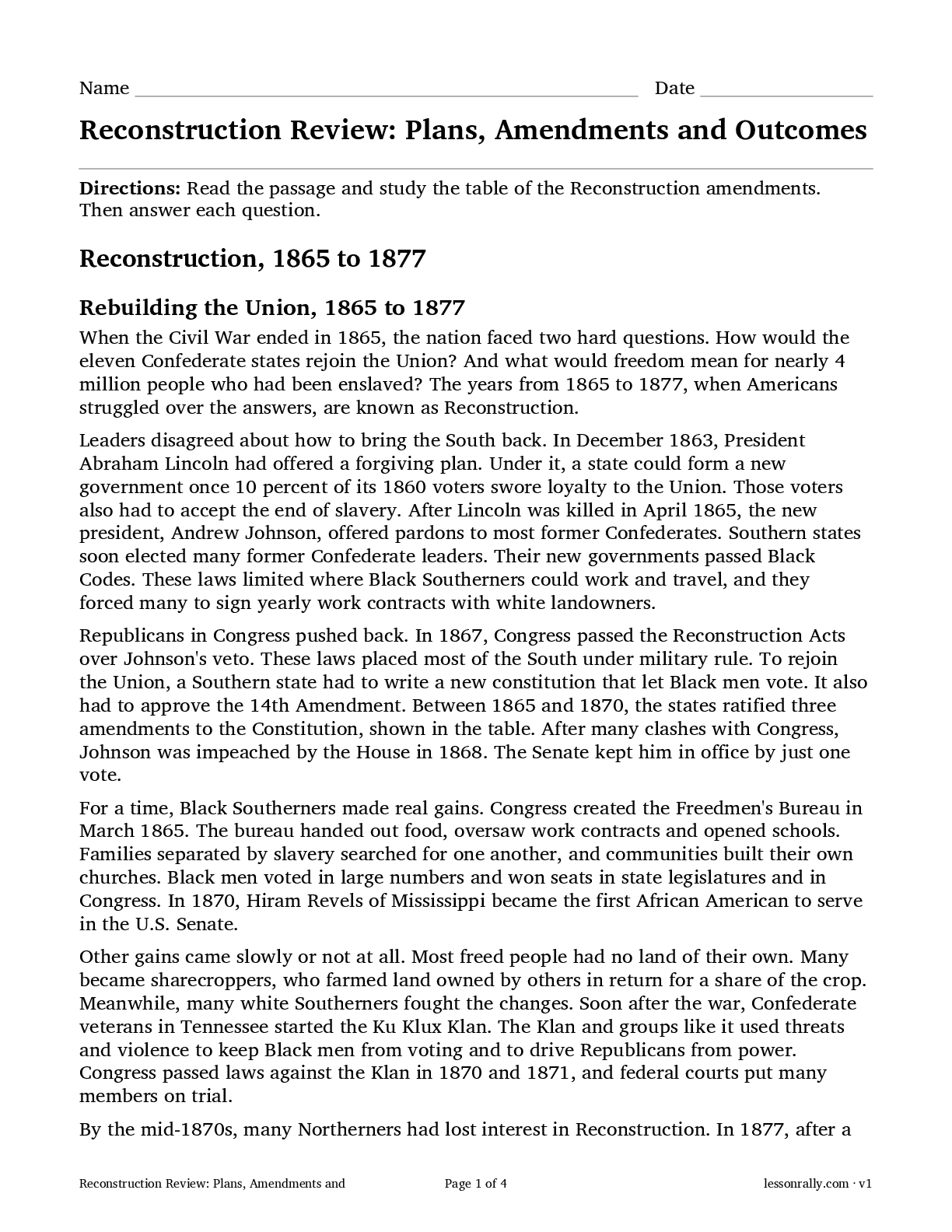
Read the passage and study the table of the Reconstruction amendments. Then answer each question.

Reconstruction, 1865 to 1877

Rebuilding the Union, 1865 to 1877

When the Civil War ended in 1865, the nation faced two hard questions. How would the eleven Confederate states rejoin the Union? And what would freedom mean for nearly 4 million people who had been enslaved? The years from 1865 to 1877, when Americans struggled over the answers, are known as Reconstruction.

Leaders disagreed about how to bring the South back. In December 1863, President Abraham Lincoln had offered a forgiving plan. Under it, a state could form a new government once 10 percent of its 1860 voters swore loyalty to the Union. Those voters also had to accept the end of slavery. After Lincoln was killed in April 1865, the new president, Andrew Johnson, offered pardons to most former Confederates. Southern states soon elected many former Confederate leaders. Their new governments passed Black Codes. These laws limited where Black Southerners could work and travel, and they forced many to sign yearly work contracts with white landowners.

Republicans in Congress pushed back. In 1867, Congress passed the Reconstruction Acts over Johnson's veto. These laws placed most of the South under military rule. To rejoin the Union, a Southern state had to write a new constitution that let Black men vote. It also had to approve the 14th Amendment. Between 1865 and 1870, the states ratified three amendments to the Constitution, shown in the table. After many clashes with Congress, Johnson was impeached by the House in 1868. The Senate kept him in office by just one vote.

For a time, Black Southerners made real gains. Congress created the Freedmen's Bureau in March 1865. The bureau handed out food, oversaw work contracts and opened schools. Families separated by slavery searched for one another, and communities built their own churches. Black men voted in large numbers and won seats in state legislatures and in Congress. In 1870, Hiram Revels of Mississippi became the first African American to serve in the U.S. Senate.

Other gains came slowly or not at all. Most freed people had no land of their own. Many became sharecroppers, who farmed land owned by others in return for a share of the crop. Meanwhile, many white Southerners fought the changes. Soon after the war, Confederate veterans in Tennessee started the Ku Klux Klan. The Klan and groups like it used threats and violence to keep Black men from voting and to drive Republicans from power. Congress passed laws against the Klan in 1870 and 1871, and federal courts put many members on trial.

By the mid-1870s, many Northerners had lost interest in Reconstruction. In 1877, after a disputed election for president, Rutherford B. Hayes took office. He pulled federal troops away from the statehouses of South Carolina and Louisiana. Soon the last Republican-led governments in Southern states fell, and Reconstruction was over. By 1910, Southern states had used poll taxes, literacy tests and violence to keep most Black men from voting. They also passed laws that separated Black and white people in public places.


The Reconstruction amendments to the Constitution, 1865 to 1870
AmendmentPassed by CongressRatified by the statesWhat it did
13thJanuary 1865December 1865Ended slavery in the United States, except as punishment for a crime
14thJune 1866July 1868Made citizens of people born in the United States, including those who had been enslaved, and required states to treat all people equally under the law
15thFebruary 1869February 1870Barred the national and state governments from denying a citizen the vote because of race or color, or because the person had once been enslaved

Question 1

Which choice best captures the central idea of the passage about Reconstruction?

Choose one answer.

  • Northern leaders left the South alone for a few years so it could rebuild in its own way.
  • Johnson and Congress agreed on one plan to rebuild the South and to protect freedom.
  • Every freed family got a farm of its own, and the old cotton trade quickly came to an end.
  • Black Southerners won new rights after the war, but many of those gains were later lost.

Question 2

What did Lincoln's 1863 plan require before a Southern state could form a new government?

Choose one answer.

  • The state had to pay back the full cost of the war to the United States government.
  • The state had to let Black men vote and write a brand-new state constitution.
  • Half of its voters had to approve the 15th Amendment in a special election.
  • Ten percent of its 1860 voters had to swear loyalty and accept the end of slavery.

Question 3

Match each Reconstruction amendment in the table to the change it made.

Match each item to an option.

Items

  1. 15th Amendment
  2. 13th Amendment
  3. 14th Amendment

Options

  1. Barred denying a citizen the vote because of race
  2. Ended slavery, except as punishment for a crime
  3. Made people born in the United States citizens and required equal treatment under state law
  4. Gave women the right to vote

Question 4

According to the table, which amendment took the longest to be ratified after Congress passed it?

Choose one answer.

  • Each one took exactly one year.
  • The 15th Amendment
  • The 13th Amendment
  • The 14th Amendment

Question 5

According to the passage, what led Republicans in Congress to push back against Johnson's plan?

Choose one answer.

  • Southern states under his plan had already given Black men the right to vote.
  • The 15th Amendment had just been ratified, so Congress wanted to enforce it.
  • Southern states under his plan elected former Confederates and passed Black Codes.
  • Lincoln had asked Congress to take charge of Reconstruction in the months before he died.

Question 6

Fill in each blank about Johnson and the freed people with the right word bank term.

Fill in each blank.

In 1868, the House blank 1 President Johnson, but the Senate kept him in office by one vote. Many freed people became blank 2, farming land owned by others in return for a share of the crop.

Word bank

  • pardoned
  • planters
  • sharecroppers
  • impeached
  • delegates

Question 7

The Freedmen's Bureau did several kinds of work. Which choice describes one result of that work?

Choose one answer.

  • The Ku Klux Klan broke up for good.
  • Schools opened for freed people.
  • Every freed family received a farm of its own.
  • Southern states passed the Black Codes.

Question 8

Which choice best sums up how many white Southerners responded to the changes, according to the passage?

Choose one answer.

  • Most welcomed Black voters, and many white Southerners joined the Republican Party in the 1870s.
  • Many fought the changes, and groups like the Klan used threats and violence against Black voters.
  • They wrote and ratified the 15th Amendment to protect Black voters.
  • They asked Congress to send even more federal troops so the South could be kept safe.

Question 9

Which two details from the passage describe things Black Southerners did with their new freedom?

Choose 2 answers.

  • They started the Ku Klux Klan in Tennessee.
  • Black men voted in large numbers and won seats in state legislatures and in Congress.
  • Most of them bought large plantations.
  • Families separated by slavery searched for one another.
  • They passed Black Codes in the Southern states.

Question 10

How did Congress respond to the Klan's violence, according to the passage?

Choose one answer.

  • It repealed the 15th Amendment so that the Klan would stop its attacks.
  • It ended Reconstruction at once and pulled every federal soldier out of the South in 1870.
  • It passed laws against the Klan, and federal courts put many members on trial.
  • It gave the Klan control of the Freedmen's Bureau and its schools.

Question 11

In 1877, President Hayes pulled federal troops away from the statehouses of South Carolina and Louisiana. What happened next, according to the passage?

Choose one answer.

  • Congress passed the Reconstruction Acts and placed most of the South under military rule.
  • The 13th Amendment was ratified by the states, ending slavery.
  • The last Republican-led governments in Southern states fell, and Reconstruction was over.
  • Black men won the right to vote in every Southern state for the first time.

Question 12

Many gains of Reconstruction were later undone. Which sentence from the passage gives the clearest evidence of this?

Choose one answer.

  • "The bureau handed out food, oversaw work contracts and opened schools."
  • "In 1867, Congress passed the Reconstruction Acts over Johnson's veto."
  • "By 1910, Southern states had used poll taxes, literacy tests and violence to keep most Black men from voting."
  • "In 1870, Hiram Revels of Mississippi became the first African American to serve in the U.S. Senate."

Reviews

No reviews yet.

Reviews come from teachers who assigned this activity to a class.

Sign in to write a review

Have a topic of your own? Make a printable worksheet and online quiz, free.

Create an activity

Answer key

Answer keys come with Premium

Print this worksheet with the correct answers marked. The key includes any explanations, sample answers, and rubrics supplied with the activity.

Answer keys aren't public: only teachers with Premium and the people who can edit an activity can download one, so students can't get a ready-to-print key from this page.

Premium includes:

  • No ads for you, and no ads for your students on the assignments you post.
  • Answer keys for printable worksheets, with the correct answers marked and any explanations, sample answers, and rubrics.
  • Create with AI: up to 100 activities a year (5 during the free trial), with every answer checked before you see the draft.

$29 a year, plus sales tax where it applies.

New Premium teachers can try it free for 7 days. A card or other payment method is needed to start. Unless you cancel before the trial ends, you are charged then and the plan renews every year.

Already have Premium or edit this activity? Sign in