Road to the Civil War: Timeline from the Missouri Compromise to Fort Sumter

8 questions · 11 points · Grade 8 · English · Preview the 8 questions

Made by Monica Ellison · LessonRally (AI-assisted)

Digital classroom activity

What is a digital classroom activity?

Teachers who sign in can assign LessonRally activities to their Google Classroom classes: students open them in Classroom and answer online, and their grades go to the teacher's Classroom gradebook. Practice lets you try it first, the way students see it.

Free for teachers. Sign in to assign activities to your Google Classroom classes.

Printable worksheet

Students read a short passage and a timeline of events from 1820 to 1861, then connect the two to explain the causes of the Civil War. They put events in order and trace how the fight over slavery and its spread into the West grew, from the Missouri Compromise and the Kansas-Nebraska Act to the Dred Scott decision, John Brown's raid, secession and the attack on Fort Sumter.

Learning goal: Use a timeline and a passage together to explain how the fight over slavery and its spread into the West led to secession and the Civil War.

Estimated reading level 9.4

  1. Grade 7Hard
  2. Grade 8Stretch
  3. Grade 9On level
  4. Grade 10Easier
  5. Grade 11Easy
About this estimate

The estimate is the middle score of five readability formulas. Their scores run from 7.4 to 10.8.

  • Flesch-Kincaid GradeSentence length and syllables per word7.4
  • Gunning FogSentence length and words of three or more syllables10.8
  • Coleman-Liau Middle scoreLetters per word and sentences per 100 words9.4
  • Automated Readability IndexCharacters per word and words per sentence7.5
  • SMOGWords of three or more syllables, for texts of 30 sentences or more10.7
Flesch Reading Ease
64.2 on a 0 to 100 scale where higher is easier: standard. Not part of the estimate.
Text measured
633 words, 33 sentences

Adapted from common readability formulas (Flesch-Kincaid, Gunning Fog, Coleman-Liau and ARI, plus SMOG for long texts), which look at sentence length and word length. Answer choices count toward word length only. Grades below the estimate will likely find the text harder, grades above it easier. It does not measure ideas, background knowledge or images.

Topic: Civil War Chosen by LessonRally

Question types: multiple choice, matching, fill in the blank, select all that apply.

Student preview

The questions as students see them, without the answers.

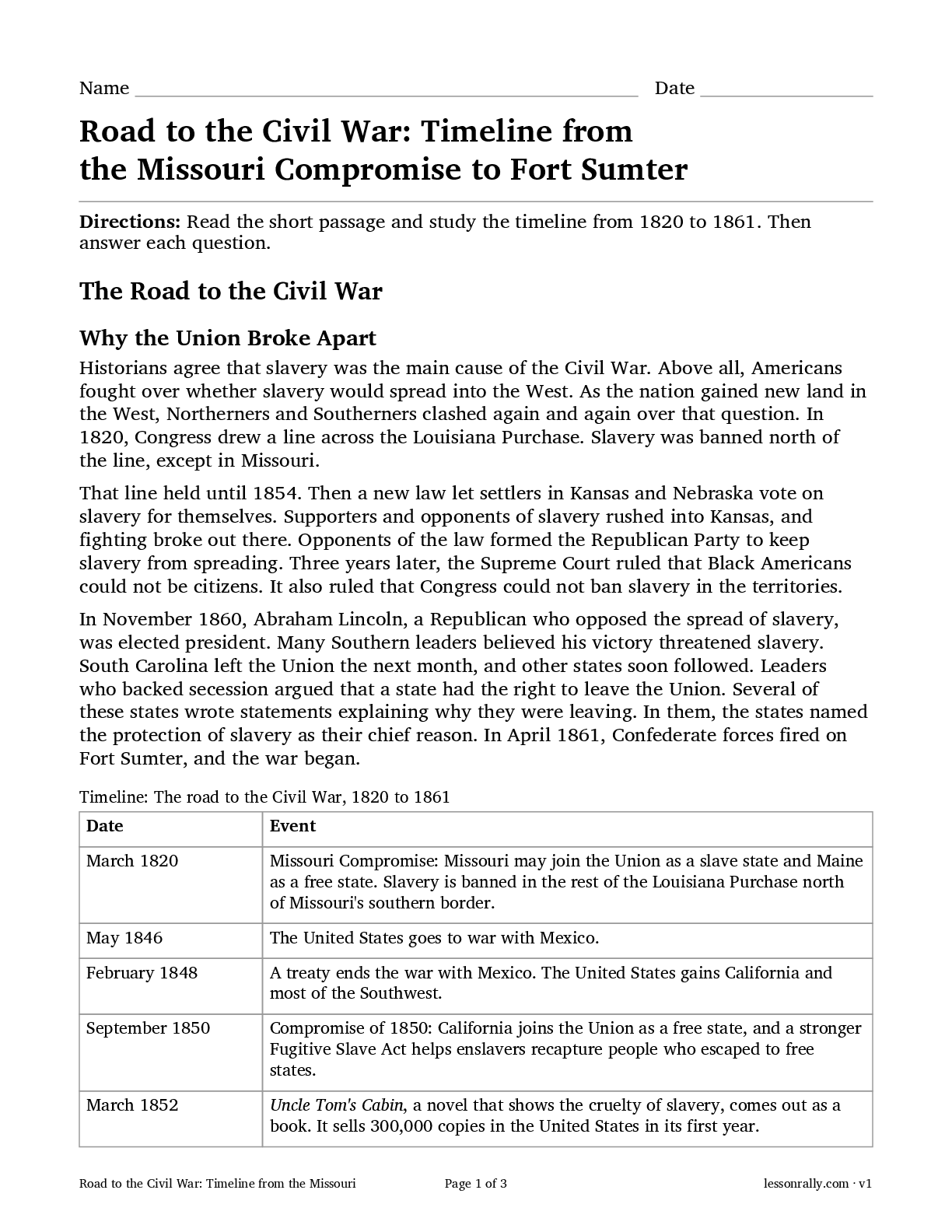
Read the short passage and study the timeline from 1820 to 1861. Then answer each question.

The Road to the Civil War

Why the Union Broke Apart

Historians agree that slavery was the main cause of the Civil War. Above all, Americans fought over whether slavery would spread into the West. As the nation gained new land in the West, Northerners and Southerners clashed again and again over that question. In 1820, Congress drew a line across the Louisiana Purchase. Slavery was banned north of the line, except in Missouri.

That line held until 1854. Then a new law let settlers in Kansas and Nebraska vote on slavery for themselves. Supporters and opponents of slavery rushed into Kansas, and fighting broke out there. Opponents of the law formed the Republican Party to keep slavery from spreading. Three years later, the Supreme Court ruled that Black Americans could not be citizens. It also ruled that Congress could not ban slavery in the territories.

In November 1860, Abraham Lincoln, a Republican who opposed the spread of slavery, was elected president. Many Southern leaders believed his victory threatened slavery. South Carolina left the Union the next month, and other states soon followed. Leaders who backed secession argued that a state had the right to leave the Union. Several of these states wrote statements explaining why they were leaving. In them, the states named the protection of slavery as their chief reason. In April 1861, Confederate forces fired on Fort Sumter, and the war began.


Timeline: The road to the Civil War, 1820 to 1861
DateEvent
March 1820Missouri Compromise: Missouri may join the Union as a slave state and Maine as a free state. Slavery is banned in the rest of the Louisiana Purchase north of Missouri's southern border.
May 1846The United States goes to war with Mexico.
February 1848A treaty ends the war with Mexico. The United States gains California and most of the Southwest.
September 1850Compromise of 1850: California joins the Union as a free state, and a stronger Fugitive Slave Act helps enslavers recapture people who escaped to free states.
March 1852Uncle Tom's Cabin, a novel that shows the cruelty of slavery, comes out as a book. It sells 300,000 copies in the United States in its first year.
May 1854The Kansas-Nebraska Act lets settlers in Kansas and Nebraska vote on slavery, ending the Missouri Compromise line.
July 1854Opponents of the Kansas-Nebraska Act form the Republican Party to stop the spread of slavery.
May 1856A proslavery mob attacks the antislavery town of Lawrence, Kansas, burning a hotel and wrecking newspaper offices.
March 1857In the Dred Scott decision, the Supreme Court rules that Black Americans cannot be citizens and that Congress cannot ban slavery in the territories.
August to October 1858Abraham Lincoln and Stephen Douglas hold seven debates about slavery during their race for a U.S. Senate seat from Illinois.
October 1859John Brown leads a raid on the federal armory at Harpers Ferry, Virginia, hoping to start an uprising of enslaved people. He is captured and later executed.
November 1860Abraham Lincoln, a Republican, is elected president.
December 1860South Carolina secedes, or leaves the Union.
January to February 1861Six more Southern states secede. In February, seceded states form the Confederate States of America.
April 1861Confederate forces fire on Fort Sumter in Charleston Harbor, South Carolina. The Civil War begins.

Question 1

What does the passage say historians agree was the main cause of the Civil War?

Choose one answer.

  • Slavery, and above all whether it would spread into the West
  • Taxes that Parliament placed on tea and paper
  • A quarrel with Britain over sailors taken from American ships
  • A fight over whether to keep a national bank

Question 2

According to the passage, what happened soon after the 1854 law let settlers in Kansas and Nebraska vote on slavery?

Choose one answer.

  • Maine joined the Union as a free state.
  • Congress drew a line across the Louisiana Purchase to limit slavery.
  • California joined the Union as a free state.
  • Supporters and opponents of slavery rushed into Kansas.

Question 3

Three events from the 1850s are listed below. Using the timeline, label each one First, Second or Third in the order it happened.

Match each item to an option.

Items

  1. Lincoln and Douglas hold seven debates in Illinois
  2. Uncle Tom's Cabin comes out as a book
  3. The Supreme Court decides the Dred Scott case

Options

  1. Second
  2. First
  3. Third

Question 4

Use the timeline to fill in the state name each sentence needs.

Fill in each blank.

In 1850, blank 1 joined the Union as a free state. In December 1860, blank 2 became the first state to secede.

Word bank

  • South Carolina
  • Kansas
  • California
  • Missouri
  • Virginia

Question 5

Why did opponents of the Kansas-Nebraska Act form the Republican Party, according to the passage and the timeline?

Choose one answer.

  • To help Southern states leave the Union
  • To bring back the war with Mexico and win more land
  • To keep slavery from spreading into the territories
  • To support the Supreme Court's Dred Scott decision

Question 6

Which two timeline events show the fight over slavery turning violent before the war began?

Choose 2 answers.

  • May 1856: A proslavery mob attacks Lawrence, Kansas.
  • October 1859: John Brown leads a raid on the armory at Harpers Ferry.
  • March 1852: Uncle Tom's Cabin comes out as a book.
  • November 1860: Lincoln is elected president.
  • August to October 1858: Lincoln and Douglas hold seven debates.

Question 7

The passage says that after South Carolina left the Union, "other states soon followed." When does the timeline show those states leaving?

Choose one answer.

  • October 1859
  • January to February 1861
  • November 1860
  • March 1857

Question 8

Leaders who backed secession argued that a state had the right to leave the Union. According to the passage, what did several seceding states name as their chief reason for leaving?

Choose one answer.

  • To end the Fugitive Slave Act
  • To stop the spread of factories
  • To protect slavery
  • To protest the war with Mexico

Reviews

No reviews yet.

Reviews come from teachers who assigned this activity to a class.

Sign in to write a review

Have a topic of your own? Make a printable worksheet and online quiz, free.

Create an activity

Answer key

Answer keys come with Premium

Print this worksheet with the correct answers marked. The key includes any explanations, sample answers, and rubrics supplied with the activity.

Answer keys aren't public: only teachers with Premium and the people who can edit an activity can download one, so students can't get a ready-to-print key from this page.

Premium includes:

  • No ads for you, and no ads for your students on the assignments you post.
  • Answer keys for printable worksheets, with the correct answers marked and any explanations, sample answers, and rubrics.
  • Create with AI: up to 100 activities a year (5 during the free trial), with every answer checked before you see the draft.

$29 a year, plus sales tax where it applies.

New Premium teachers can try it free for 7 days. A card or other payment method is needed to start. Unless you cancel before the trial ends, you are charged then and the plan renews every year.

Already have Premium or edit this activity? Sign in