Question 1
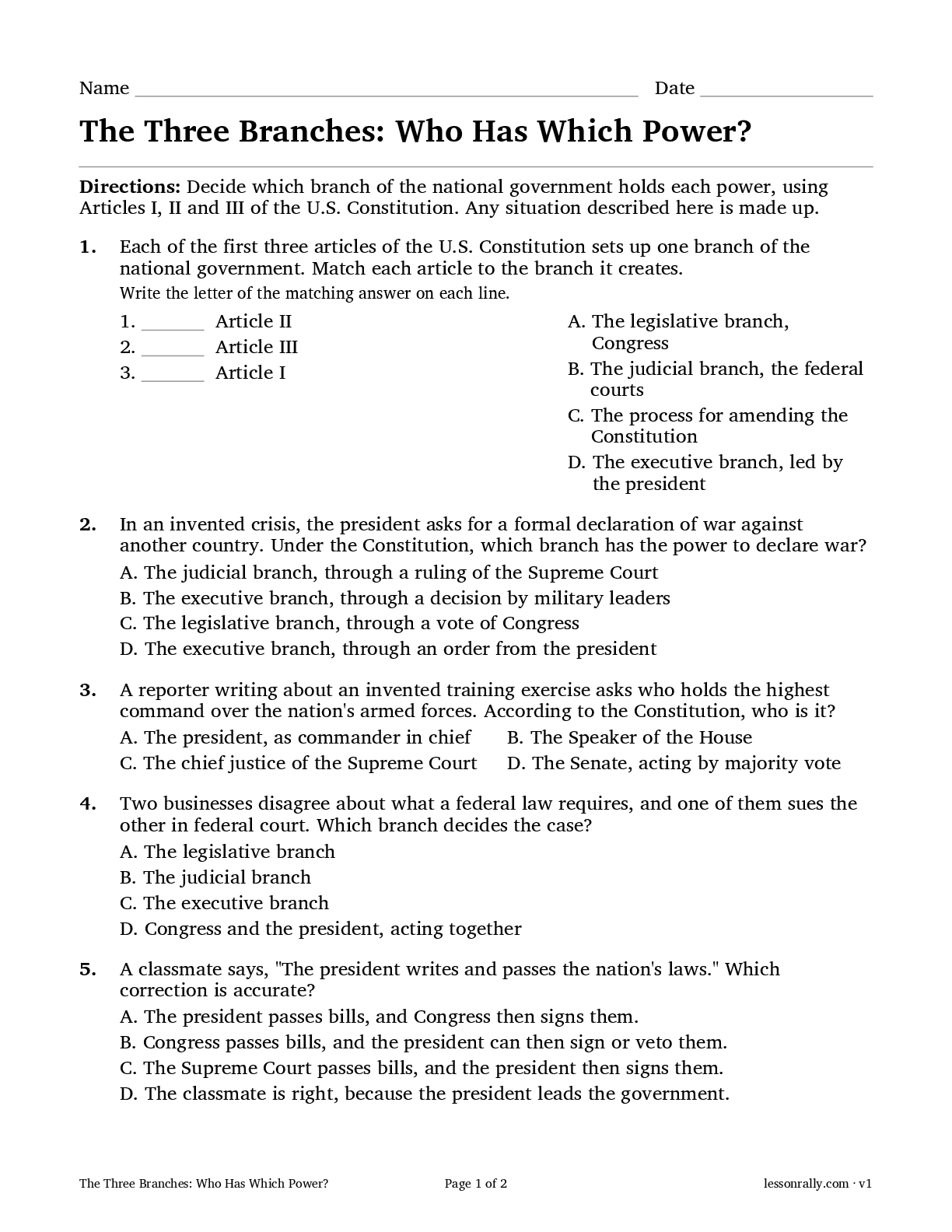
Each of the first three articles of the U.S. Constitution sets up one branch of the national government. Match each article to the branch it creates.
Match each item to an option.
Items
- Article II
- Article III
- Article I
Options


Teachers who sign in can assign LessonRally activities to their Google Classroom classes: students open them in Classroom and answer online, and their grades go to the teacher's Classroom gradebook. Practice lets you try it first, the way students see it.
Free for teachers. Sign in to assign activities to your Google Classroom classes.
 (opens in a new tab)
2 pages · Student copy, no answers
Print worksheet (opens in a new tab)Answer keyPremiumStudents match Articles I, II and III to the branch each one creates, then decide whether the legislative, executive or judicial branch holds a power in short invented situations: declaring war, commanding the armed forces, deciding cases, passing bills, carrying out laws, receiving ambassadors, reporting to Congress, building an army and a navy, and granting a pardon.
Learning goal: Identify which branch of the U.S. government holds a given power, using the powers that Articles I, II and III assign to Congress, the president and the federal courts.
The estimate is halfway between the two middle scores of four readability formulas. Their scores run from 8.0 to 11.9.
Adapted from common readability formulas (Flesch-Kincaid, Gunning Fog, Coleman-Liau and ARI, plus SMOG for long texts), which look at sentence length and word length. Answer choices count toward word length only. Grades below the estimate will likely find the text harder, grades above it easier. It does not measure ideas, background knowledge or images.
Topic: Government and Citizenship Chosen by LessonRally
Question types: matching, multiple choice, select all that apply.
The questions as students see them, without the answers.
Decide which branch of the national government holds each power, using Articles I, II and III of the U.S. Constitution. Any situation described here is made up.
Each of the first three articles of the U.S. Constitution sets up one branch of the national government. Match each article to the branch it creates.
Match each item to an option.
Items
Options
In an invented crisis, the president asks for a formal declaration of war against another country. Under the Constitution, which branch has the power to declare war?
Choose one answer.
A reporter writing about an invented training exercise asks who holds the highest command over the nation's armed forces. According to the Constitution, who is it?
Choose one answer.
Two businesses disagree about what a federal law requires, and one of them sues the other in federal court. Which branch decides the case?
Choose one answer.
A classmate says, "The president writes and passes the nation's laws." Which correction is accurate?
Choose one answer.
Congress passes an invented law requiring safety labels on new ladders, and the president signs it. Which branch is responsible for carrying out and enforcing the law?
Choose one answer.
A new ambassador from an invented country arrives in Washington, D.C., to begin her post. Which official does the Constitution make responsible for receiving foreign ambassadors?
Choose one answer.
The Constitution directs one official to keep Congress informed, every so often, about how the country is doing and to suggest measures for Congress to consider. Who is it?
Choose one answer.
Congress and the president both play parts in national defense. Which TWO of these powers does the Constitution give to Congress? Select 2.
Choose 2 answers.
Years after being convicted of a federal tax crime in an invented case, a man asks to be forgiven for the offense. Which official has the power to grant him a pardon?
Choose one answer.
No reviews yet.
Reviews come from teachers who assigned this activity to a class.
Have a topic of your own? Make a printable worksheet and online quiz, free.
Create an activityMade by Nathan Kessler · LessonRally (AI-assisted)
Made by Nathan Kessler · LessonRally (AI-assisted)
Made by Monica Ellison · LessonRally (AI-assisted)
Common Core RH.6-8.1
Made by Monica Ellison · LessonRally (AI-assisted)