Voting Rights Amendments: The 15th, 19th, 24th and 26th

8 questions · 11 points · Grade 8 · English · Preview the 8 questions

Made by Nathan Kessler · LessonRally (AI-assisted)

Digital classroom activity

What is a digital classroom activity?

Teachers who sign in can assign LessonRally activities to their Google Classroom classes: students open them in Classroom and answer online, and their grades go to the teacher's Classroom gradebook. Practice lets you try it first, the way students see it.

Free for teachers. Sign in to assign activities to your Google Classroom classes.

Printable worksheet

Students match the Fifteenth, Nineteenth, Twenty-fourth and Twenty-sixth Amendments to what each one bars, then apply these voting rights amendments: which were ratified after 1950, whether a state may set a voting age of 21, how poll taxes ended in federal and in state elections, primary elections, women's voting before 1920, how each amendment was added, and what the Twenty-sixth Amendment does not require.

Learning goal: Identify what the Fifteenth, Nineteenth, Twenty-fourth and Twenty-sixth Amendments each bar, and apply them to invented situations, including the elections each one covers.

Estimated reading level 10.3

  1. Grade 8Hard
  2. Grade 9Stretch
  3. Grade 10On level
  4. Grade 11Easier
  5. Grade 12Easy
About this estimate

The estimate is halfway between the two middle scores of four readability formulas. Their scores run from 8.8 to 13.5.

  • Flesch-Kincaid GradeSentence length and syllables per word8.8
  • Gunning FogSentence length and words of three or more syllables13.5
  • Coleman-Liau Middle scoreLetters per word and sentences per 100 words11.8
  • Automated Readability Index Middle scoreCharacters per word and words per sentence8.8
Flesch Reading Ease
52.8 on a 0 to 100 scale where higher is easier: fairly difficult. Not part of the estimate.
Text measured
584 words, 16 sentences

Adapted from common readability formulas (Flesch-Kincaid, Gunning Fog, Coleman-Liau and ARI, plus SMOG for long texts), which look at sentence length and word length. Answer choices count toward word length only. Grades below the estimate will likely find the text harder, grades above it easier. It does not measure ideas, background knowledge or images.

Topic: U.S. Constitution Chosen by LessonRally

Question types: matching, select all that apply, multiple choice.

Student preview

The questions as students see them, without the answers.

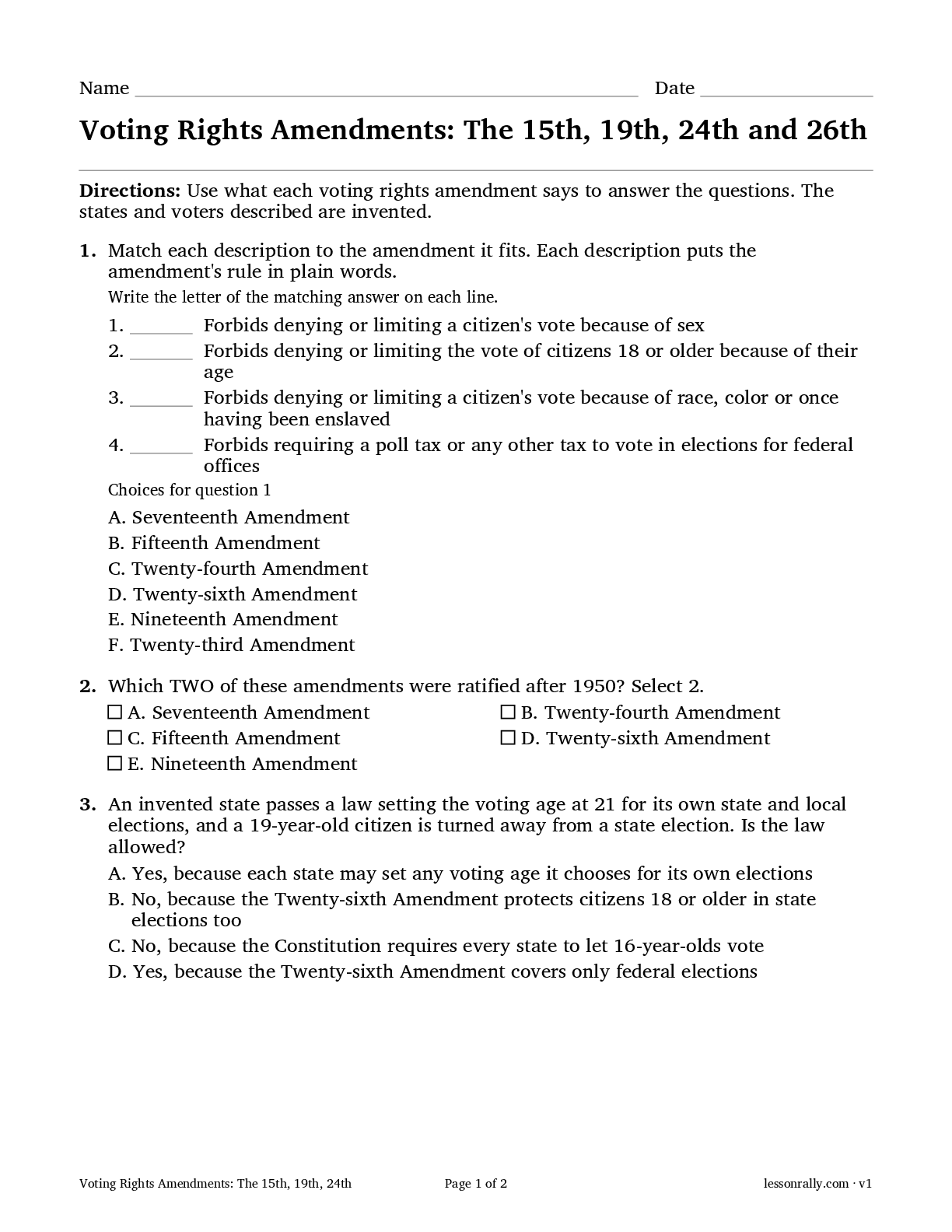
Use what each voting rights amendment says to answer the questions. The states and voters described are invented.

Question 1

Match each description to the amendment it fits. Each description puts the amendment's rule in plain words.

Match each item to an option.

Items

  1. Forbids denying or limiting a citizen's vote because of sex
  2. Forbids denying or limiting the vote of citizens 18 or older because of their age
  3. Forbids denying or limiting a citizen's vote because of race, color or once having been enslaved
  4. Forbids requiring a poll tax or any other tax to vote in elections for federal offices

Options
  1. Twenty-third Amendment
  2. Twenty-fourth Amendment
  3. Nineteenth Amendment
  4. Fifteenth Amendment
  5. Twenty-sixth Amendment
  6. Seventeenth Amendment

Question 2

Which TWO of these amendments were ratified after 1950? Select 2.

Choose 2 answers.

  • Twenty-sixth Amendment
  • Fifteenth Amendment
  • Seventeenth Amendment
  • Nineteenth Amendment
  • Twenty-fourth Amendment

Question 3

An invented state passes a law setting the voting age at 21 for its own state and local elections, and a 19-year-old citizen is turned away from a state election. Is the law allowed?

Choose one answer.

  • No, because the Constitution requires every state to let 16-year-olds vote
  • Yes, because the Twenty-sixth Amendment covers only federal elections
  • No, because the Twenty-sixth Amendment protects citizens 18 or older in state elections too
  • Yes, because each state may set any voting age it chooses for its own elections

Question 4

An invented state charges a $2 poll tax to vote for governor and other state offices, but not to vote for federal offices. Which statement about the tax is accurate?

Choose one answer.

  • It is unconstitutional under Harper v. Virginia Board of Elections (1966), not the Twenty-fourth Amendment.
  • It is allowed, because none of the voting rights amendments mentions state taxes.
  • It is allowed, because the Twenty-fourth Amendment reaches only elections for federal offices.
  • It is unconstitutional, because the Twenty-fourth Amendment reaches every election in the country.

Question 5

An invented state charges a poll tax to vote in a primary election that picks candidates for the U.S. House. Does the Twenty-fourth Amendment cover this tax?

Choose one answer.

  • Yes, because the amendment covers primaries for federal offices as well as general elections
  • No, because primaries choose candidates rather than the officeholders themselves
  • Yes, but only if the state also charges a tax to vote in general elections
  • No, because the amendment covers only general elections held in November

Question 6

Which statement accurately describes women's voting in the United States before the Nineteenth Amendment was ratified in 1920?

Choose one answer.

  • Some states already let women vote, but the Constitution did not protect that right nationwide.
  • No woman anywhere in the country could vote in any election.
  • Every state already let women vote, so the amendment changed nothing.
  • Women could vote in federal elections everywhere but in no state elections.

Question 7

How did each of these four voting rights changes become part of the Constitution?

Choose one answer.

  • Congress proposed each one by a two-thirds vote in both chambers, and three-fourths of the states ratified it.
  • Each state voted on its own version, and Congress then combined the different versions.
  • The Supreme Court added each one to the Constitution when it decided an important voting case.
  • The president added each one by signing it, the same way the president signs a bill.

Question 8

A classmate says, "The Twenty-sixth Amendment requires every citizen who turns 18 to vote." Which correction is accurate?

Choose one answer.

  • It protects the right of citizens 18 or older to vote, but it does not make anyone vote.
  • The classmate is right, because voting is required starting at age 18.
  • The amendment requires voting only in elections for president.
  • The amendment lowered the voting age to 16 for state elections.

Reviews

No reviews yet.

Reviews come from teachers who assigned this activity to a class.

Sign in to write a review

Have a topic of your own? Make a printable worksheet and online quiz, free.

Create an activity

Answer key

Answer keys come with Premium

Print this worksheet with the correct answers marked. The key includes any explanations, sample answers, and rubrics supplied with the activity.

Answer keys aren't public: only teachers with Premium and the people who can edit an activity can download one, so students can't get a ready-to-print key from this page.

Premium includes:

  • No ads for you, and no ads for your students on the assignments you post.
  • Answer keys for printable worksheets, with the correct answers marked and any explanations, sample answers, and rubrics.
  • Create with AI: up to 100 activities a year (5 during the free trial), with every answer checked before you see the draft.

$29 a year, plus sales tax where it applies.

New Premium teachers can try it free for 7 days. A card or other payment method is needed to start. Unless you cancel before the trial ends, you are charged then and the plan renews every year.

Already have Premium or edit this activity? Sign in