Made by Nathan Kessler · LessonRally (AI-assisted)
Digital classroom activity
What is a digital classroom activity?
Teachers who sign in can assign LessonRally activities to their Google Classroom classes: students open them in Classroom and answer online, and their grades go to the teacher's Classroom gradebook. Practice lets you try it first, the way students see it.
Students separate legal duties from civic responsibilities, sort examples into duties, responsibilities, rights held only by citizens and rights that protect everyone, and apply these ideas to invented people: a citizen summoned for jury service, a new voter who skips an election, a visitor with a traffic ticket, a permanent resident, a naturalized citizen planning to run for office and a park cleanup volunteer.
Learning goal: Distinguish legal duties from civic responsibilities, and rights held only by citizens from rights that protect everyone in the country, and apply these categories to invented situations.
Estimated reading level7.6
Grade 5Hard
Grade 6Stretch
Grade 7On level
Grade 8Easier
Grade 9Easy
About this estimate
The estimate is halfway between the two middle scores of four readability formulas. Their scores run from 5.4 to 10.0.
Flesch-Kincaid Grade Middle scoreSentence length and syllables per word7.4
Gunning FogSentence length and words of three or more syllables10.0
Coleman-Liau Middle scoreLetters per word and sentences per 100 words7.7
Automated Readability IndexCharacters per word and words per sentence5.4
Grade 181216
Flesch Reading Ease
63.1 on a 0 to 100 scale where higher is easier: standard. Not part of the estimate.
Text measured
641 words, 19 sentences
Adapted from common readability formulas (Flesch-Kincaid, Gunning Fog, Coleman-Liau and ARI, plus SMOG for long texts), which look at sentence length and word length. Answer choices count toward word length only. Grades below the estimate will likely find the text harder, grades above it easier. It does not measure ideas, background knowledge or images.
Question types: multiple choice, matching, select all that apply.
Student preview
The questions as students see them, without the answers.
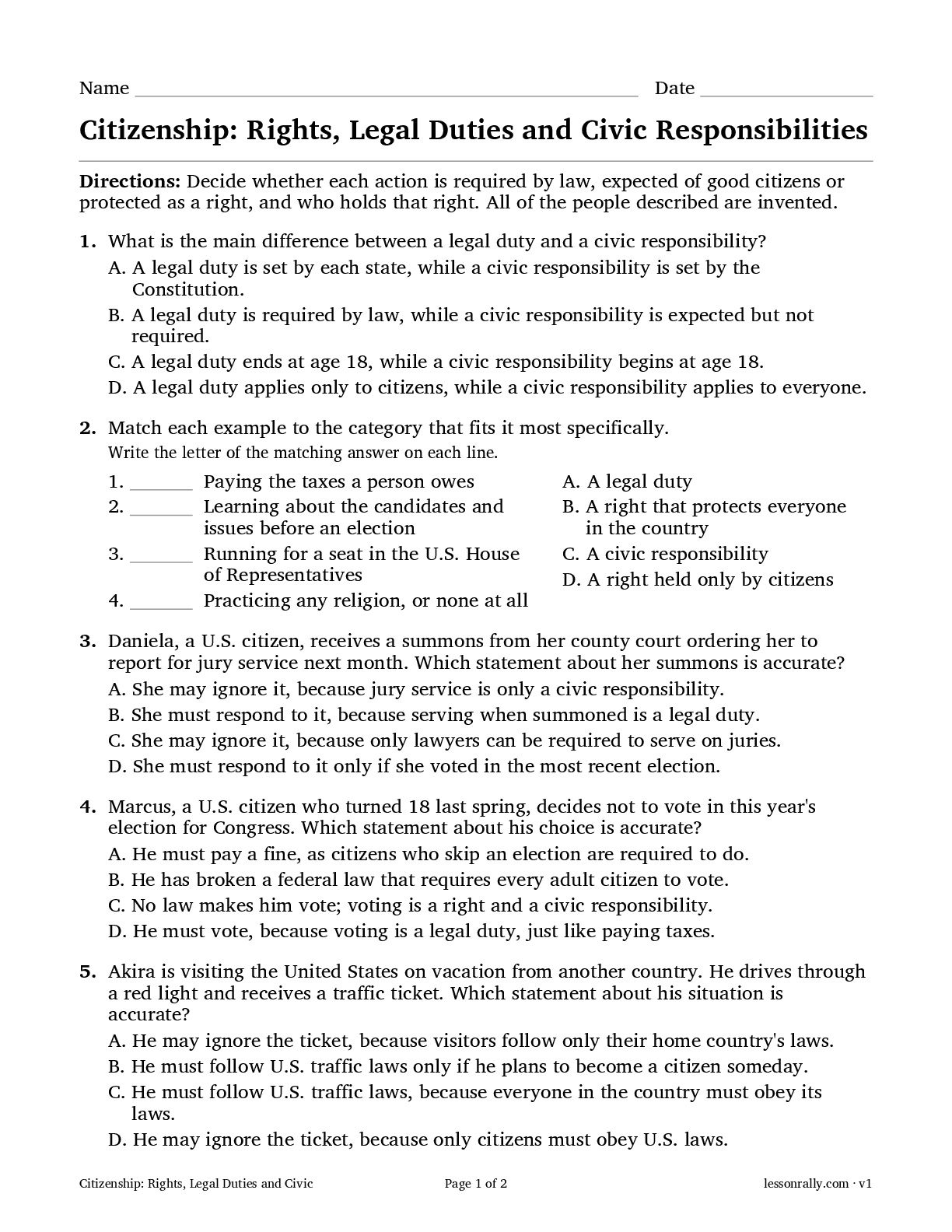
Decide whether each action is required by law, expected of good citizens or protected as a right, and who holds that right. All of the people described are invented.
Question 1
What is the main difference between a legal duty and a civic responsibility?
Choose one answer.
A legal duty is set by each state, while a civic responsibility is set by the Constitution.
A legal duty applies only to citizens, while a civic responsibility applies to everyone.
A legal duty is required by law, while a civic responsibility is expected but not required.
A legal duty ends at age 18, while a civic responsibility begins at age 18.
Question 2
Match each example to the category that fits it most specifically.
Match each item to an option.
Items
Paying the taxes a person owes
Learning about the candidates and issues before an election
Running for a seat in the U.S. House of Representatives
Practicing any religion, or none at all
Options
A right held only by citizens
A right that protects everyone in the country
A civic responsibility
A legal duty
Question 3
Daniela, a U.S. citizen, receives a summons from her county court ordering her to report for jury service next month. Which statement about her summons is accurate?
Choose one answer.
She may ignore it, because jury service is only a civic responsibility.
She must respond to it only if she voted in the most recent election.
She may ignore it, because only lawyers can be required to serve on juries.
She must respond to it, because serving when summoned is a legal duty.
Question 4
Marcus, a U.S. citizen who turned 18 last spring, decides not to vote in this year's election for Congress. Which statement about his choice is accurate?
Choose one answer.
No law makes him vote; voting is a right and a civic responsibility.
He has broken a federal law that requires every adult citizen to vote.
He must pay a fine, as citizens who skip an election are required to do.
He must vote, because voting is a legal duty, just like paying taxes.
Question 5
Akira is visiting the United States on vacation from another country. He drives through a red light and receives a traffic ticket. Which statement about his situation is accurate?
Choose one answer.
He may ignore the ticket, because only citizens must obey U.S. laws.
He may ignore the ticket, because visitors follow only their home country's laws.
He must follow U.S. traffic laws only if he plans to become a citizen someday.
He must follow U.S. traffic laws, because everyone in the country must obey its laws.
Question 6
Priya has been a lawful permanent resident of the United States for six years and is not a citizen. Which TWO of these may she do? Select 2.
Choose 2 answers.
Run for a seat in the U.S. Senate
Vote in the next election for president
Receive a fair trial if she is ever charged with a crime
Serve on a jury in a federal court
Write a letter to the newspaper criticizing a city plan
Question 7
Yusuf came to the United States as a child and became a citizen through naturalization ten years ago. He is now 40 and has lived in his state for 20 years. He hopes to run for the U.S. Senate and, someday, for president. Which statement about his plans is accurate?
Choose one answer.
He may serve in neither office, because both require being born in the United States.
He may serve in both offices, because every citizen may run for any office.
He may serve in the Senate, but the Constitution bars him from being president.
He may serve as president, but senators must have been born in the United States.
Question 8
Which of these is a civic responsibility rather than a legal duty?
Choose one answer.
Paying a fine that a judge has ordered
Appearing in court after receiving a subpoena to testify
Volunteering to help clean up a public park
Registering a car with the state before driving it on public roads