

English Language Arts and Literacy
Grade 1 ELA
Open a standard to see the worksheets and online quizzes matched to it.
Grade 1 ELA activities
- English Language Arts
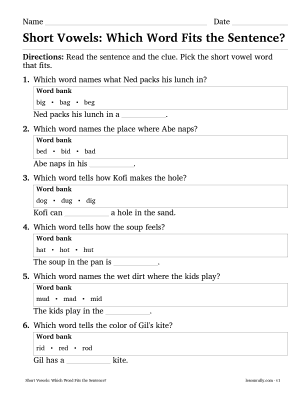
Short Vowels: Which Word Fits the Sentence? (opens in a new tab)
- Grade 1
- 6 questions
- Estimated reading level 1.0 (short text, rough estimate)
Common Core RF.1.3b
Made by Nell Hargrove · LessonRally (AI-assisted)
- English Language Arts
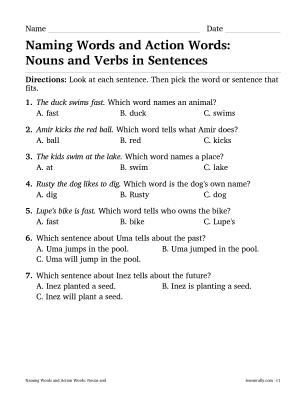
Naming Words and Action Words: Nouns and Verbs in Sentences (opens in a new tab)
- Grade 1
- 7 questions
- Estimated reading level 1.7 (short text, rough estimate)
Common Core L.1.1b
Made by Nell Hargrove · LessonRally (AI-assisted)
- English Language Arts
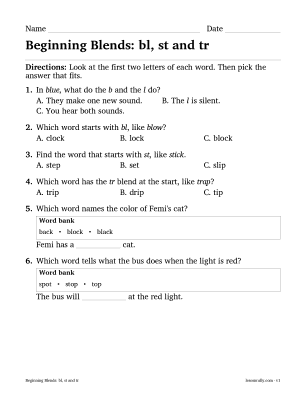
Beginning Blends: bl, st and tr (opens in a new tab)
- Grade 1
- 6 questions
- Estimated reading level 1.2 (short text, rough estimate)
Common Core RF.1.3b
Made by Nell Hargrove · LessonRally (AI-assisted)
Counts updated 14 minutes ago.
Reading: Literature
Show 9 standards in Reading: Literature
Ask and answer questions about key details in a text.
Retell stories, including key details, and demonstrate understanding of their central message or lesson.
Describe characters, settings, and major events in a story, using key details.
Identify words and phrases in stories or poems that suggest feelings or appeal to the senses.
Explain major differences between books that tell stories and books that give information, drawing on a wide reading of a range of text types.
Identify who is telling the story at various points in a text.
Use illustrations and details in a story to describe its characters, setting, or events.
Compare and contrast the adventures and experiences of characters in stories.
With prompting and support, read prose and poetry of appropriate complexity for grade 1.
Reading: Informational Text
Show 10 standards in Reading: Informational Text
Ask and answer questions about key details in a text.
Identify the main topic and retell key details of a text.
Describe the connection between two individuals, events, ideas, or pieces of information in a text.
Ask and answer questions to help determine or clarify the meaning of words and phrases in a text.
Know and use various text features (e.g., headings, tables of contents, glossaries, electronic menus, icons) to locate key facts or information in a text.
Distinguish between information provided by pictures or other illustrations and information provided by the words in a text.
Use the illustrations and details in a text to describe its key ideas.
Identify the reasons an author gives to support points in a text.
Identify basic similarities in and differences between two texts on the same topic (e.g., in illustrations, descriptions, or procedures).
With prompting and support, read informational texts appropriately complex for grade 1.
Reading: Foundational Skills
Demonstrate understanding of the organization and basic features of print.
Parts of RF.1.1 (1)
- RF.1.1a Recognize the distinguishing features of a sentence (e.g., first word, capitalization, ending punctuation).
Demonstrate understanding of spoken words, syllables, and sounds (phonemes).
Parts of RF.1.2 (4)
- RF.1.2a Distinguish long from short vowel sounds in spoken single-syllable words.
- RF.1.2b Orally produce single-syllable words by blending sounds (phonemes), including consonant blends.
- RF.1.2c Isolate and pronounce initial, medial vowel, and final sounds (phonemes) in spoken single-syllable words.
- RF.1.2d Segment spoken single-syllable words into their complete sequence of individual sounds (phonemes).
RF.1.3 6 activities
Know and apply grade-level phonics and word analysis skills in decoding words.
RF.1.3a, 1 activity RF.1.3b, 3 activities RF.1.3c, 1 activity RF.1.3g, 1 activity
Parts of RF.1.3 (7)
- RF.1.3a Know the spelling-sound correspondences for common consonant digraphs.
- RF.1.3b Decode regularly spelled one-syllable words.
- RF.1.3c Know final -e and common vowel team conventions for representing long vowel sounds.
- RF.1.3d Use knowledge that every syllable must have a vowel sound to determine the number of syllables in a printed word.
- RF.1.3e Decode two-syllable words following basic patterns by breaking the words into syllables.
- RF.1.3f Read words with inflectional endings.
- RF.1.3g Recognize and read grade-appropriate irregularly spelled words.
Read with sufficient accuracy and fluency to support comprehension.
Writing
Show 7 standards in Writing
Write opinion pieces in which they introduce the topic or name the book they are writing about, state an opinion, supply a reason for the opinion, and provide some sense of closure.
Write informative/explanatory texts in which they name a topic, supply some facts about the topic, and provide some sense of closure.
Write narratives in which they recount two or more appropriately sequenced events, include some details regarding what happened, use temporal words to signal event order, and provide some sense of closure.
With guidance and support from adults, focus on a topic, respond to questions and suggestions from peers, and add details to strengthen writing as needed.
With guidance and support from adults, use a variety of digital tools to produce and publish writing, including in collaboration with peers.
Participate in shared research and writing projects (e.g., explore a number of "how-to" books on a given topic and use them to write a sequence of instructions).
With guidance and support from adults, recall information from experiences or gather information from provided sources to answer a question.
Speaking and Listening
Show 6 standards in Speaking and Listening
Participate in collaborative conversations with diverse partners about grade 1 topics and texts with peers and adults in small and larger groups.
Parts of SL.1.1 (3)
- SL.1.1a Follow agreed-upon rules for discussions (e.g., listening to others with care, speaking one at a time about the topics and texts under discussion).
- SL.1.1b Build on others' talk in conversations by responding to the comments of others through multiple exchanges.
- SL.1.1c Ask questions to clear up any confusion about the topics and texts under discussion.
Ask and answer questions about key details in a text read aloud or information presented orally or through other media.
Ask and answer questions about what a speaker says in order to gather additional information or clarify something that is not understood.
Describe people, places, things, and events with relevant details, expressing ideas and feelings clearly.
Add drawings or other visual displays to descriptions when appropriate to clarify ideas, thoughts, and feelings.
Produce complete sentences when appropriate to task and situation. (See grade 1 Language standards 1 and 3 here for specific expectations.)
Language
L.1.1 1 activity
Demonstrate command of the conventions of standard English grammar and usage when writing or speaking.
L.1.1b, 1 activity L.1.1e, 1 activity
Parts of L.1.1 (10)
- L.1.1a Print all upper- and lowercase letters.
- L.1.1b Use common, proper, and possessive nouns.
- L.1.1c Use singular and plural nouns with matching verbs in basic sentences (e.g., He hops; We hop).
- L.1.1d Use personal, possessive, and indefinite pronouns (e.g., I, me, my; they, them, their, anyone, everything).
- L.1.1e Use verbs to convey a sense of past, present, and future (e.g., Yesterday I walked home; Today I walk home; Tomorrow I will walk home).
- L.1.1f Use frequently occurring adjectives.
- L.1.1g Use frequently occurring conjunctions (e.g., and, but, or, so, because).
- L.1.1h Use determiners (e.g., articles, demonstratives).
- L.1.1i Use frequently occurring prepositions (e.g., during, beyond, toward).
- L.1.1j Produce and expand complete simple and compound declarative, interrogative, imperative, and exclamatory sentences in response to prompts.
L.1.2 1 activity
Demonstrate command of the conventions of standard English capitalization, punctuation, and spelling when writing.
L.1.2a, 1 activity L.1.2b, 1 activity
Parts of L.1.2 (5)
- L.1.2a Capitalize dates and names of people.
- L.1.2b Use end punctuation for sentences.
- L.1.2c Use commas in dates and to separate single words in a series.
- L.1.2d Use conventional spelling for words with common spelling patterns and for frequently occurring irregular words.
- L.1.2e Spell untaught words phonetically, drawing on phonemic awareness and spelling conventions.
Determine or clarify the meaning of unknown and multiple-meaning words and phrases based on grade 1 reading and content, choosing flexibly from an array of strategies.
With guidance and support from adults, demonstrate understanding of word relationships and nuances in word meanings.
Parts of L.1.5 (4)
- L.1.5a Sort words into categories (e.g., colors, clothing) to gain a sense of the concepts the categories represent.
- L.1.5b Define words by category and by one or more key attributes (e.g., a duck is a bird that swims; a tiger is a large cat with stripes).
- L.1.5c Identify real-life connections between words and their use (e.g., note places at home that are cozy).
- L.1.5d Distinguish shades of meaning among verbs differing in manner (e.g., look, peek, glance, stare, glare, scowl) and adjectives differing in intensity (e.g., large, gigantic) by defining or choosing them or by acting out the meanings.
Use words and phrases acquired through conversations, reading and being read to, and responding to texts, including using frequently occurring conjunctions to signal simple relationships (e.g., because).
How matching works
LessonRally matches each shared activity to the Common Core standards its questions require, using AI after the activity passes review. Every standard shown in Browse was chosen independently by two AI models, or by LessonRally.
© Copyright 2010. National Governors Association Center for Best Practices and Council of Chief State School Officers. All rights reserved.
Don't see the standard you need?
Build it yourself or start from your AI chat. Your draft stays private until you publish it.