Civil War Turning Points and Vocabulary: From Fort Sumter to Appomattox

10 questions · 13 points · Grade 8 · English · Preview the 10 questions

Made by Monica Ellison · LessonRally (AI-assisted)

Digital classroom activity

What is a digital classroom activity?

Teachers who sign in can assign LessonRally activities to their Google Classroom classes: students open them in Classroom and answer online, and their grades go to the teacher's Classroom gradebook. Practice lets you try it first, the way students see it.

Free for teachers. Sign in to assign activities to your Google Classroom classes.

Printable worksheet

Students read a passage about the turning points of the Civil War, then use context clues to work out what history words such as secede, blockade, casualties, siege and emancipation mean as the passage uses them. Questions also cover the Union's strategy, Antietam, Gettysburg and Vicksburg, what the Emancipation Proclamation did and did not do, and how the war ended at Appomattox in 1865.

Learning goal: Determine the meaning of history words and phrases as a passage about the Civil War uses them, and explain how key turning points changed the course of the war.

Estimated reading level 9.7

  1. Grade 7Hard
  2. Grade 8Stretch
  3. Grade 9On level
  4. Grade 10Easier
  5. Grade 11Easy
About this estimate

The estimate is the middle score of five readability formulas. Their scores run from 7.9 to 11.0.

  • Flesch-Kincaid GradeSentence length and syllables per word8.0
  • Gunning FogSentence length and words of three or more syllables10.5
  • Coleman-Liau Middle scoreLetters per word and sentences per 100 words9.7
  • Automated Readability IndexCharacters per word and words per sentence7.9
  • SMOGWords of three or more syllables, for texts of 30 sentences or more11.0
Flesch Reading Ease
61.6 on a 0 to 100 scale where higher is easier: standard. Not part of the estimate.
Text measured
1,002 words, 48 sentences

Adapted from common readability formulas (Flesch-Kincaid, Gunning Fog, Coleman-Liau and ARI, plus SMOG for long texts), which look at sentence length and word length. Answer choices count toward word length only. Grades below the estimate will likely find the text harder, grades above it easier. It does not measure ideas, background knowledge or images.

Common Core

Closest anchor: CCRA.R.4 Interpret words and phrases as they are used in a text, including determining technical, connotative, and figurative meanings, and analyze how specific word choices shape meaning or tone.Anchor Standards for ReadingShow 1 matched standardHide matched standard

Matched standard

  • RH.6-8.4

    Determine the meaning of words and phrases as they are used in a text, including vocabulary specific to domains related to history/social studies.

    Student preview questions 1, 4, 5

Matched independently by two AI models from this activity's questions.

© Copyright 2010. National Governors Association Center for Best Practices and Council of Chief State School Officers. All rights reserved.

Topic: Civil War Chosen by LessonRally

Question types: multiple choice, matching, select all that apply.

Student preview

The questions as students see them, without the answers.

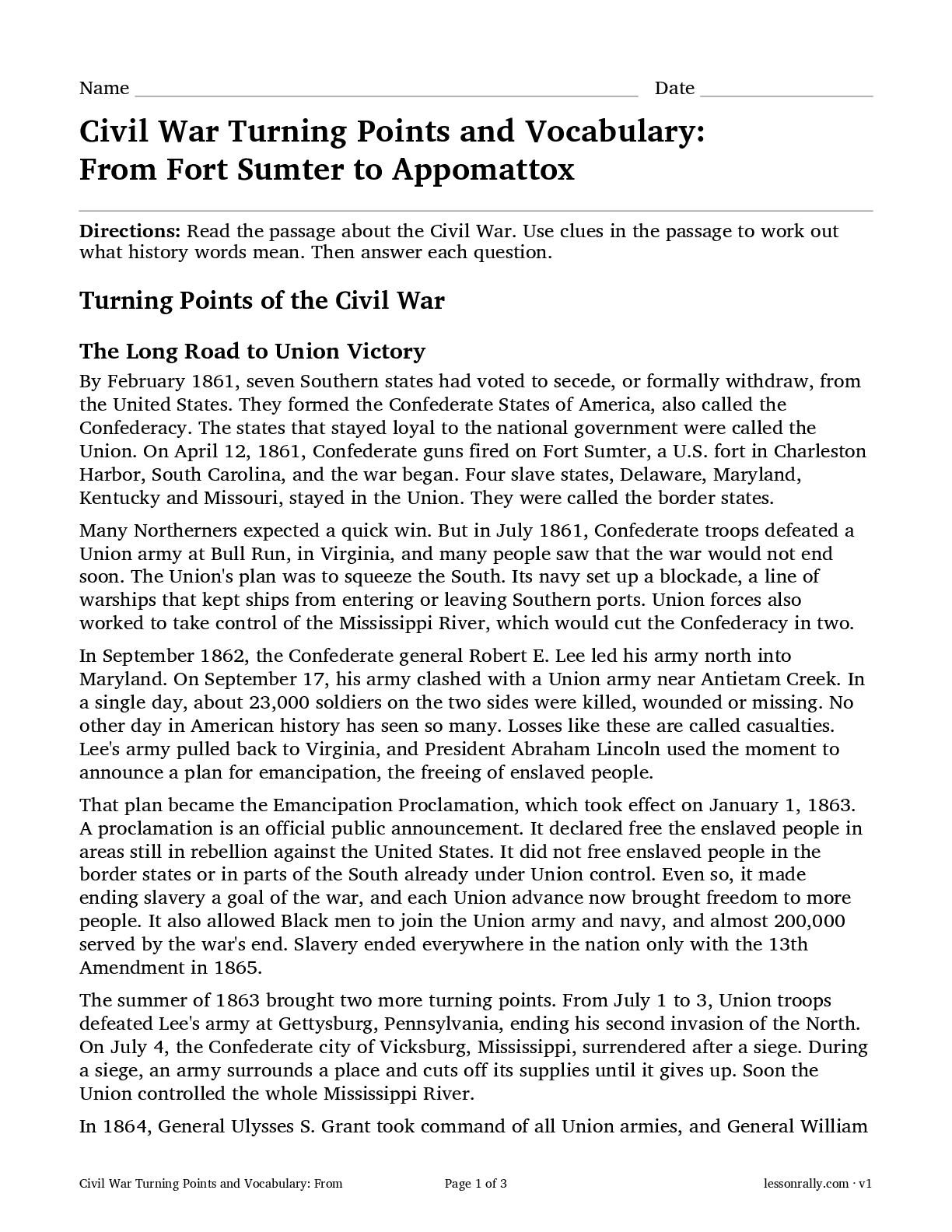
Read the passage about the Civil War. Use clues in the passage to work out what history words mean. Then answer each question.

Turning Points of the Civil War

The Long Road to Union Victory

By February 1861, seven Southern states had voted to secede, or formally withdraw, from the United States. They formed the Confederate States of America, also called the Confederacy. The states that stayed loyal to the national government were called the Union. On April 12, 1861, Confederate guns fired on Fort Sumter, a U.S. fort in Charleston Harbor, South Carolina, and the war began. Four slave states, Delaware, Maryland, Kentucky and Missouri, stayed in the Union. They were called the border states.

Many Northerners expected a quick win. But in July 1861, Confederate troops defeated a Union army at Bull Run, in Virginia, and many people saw that the war would not end soon. The Union's plan was to squeeze the South. Its navy set up a blockade, a line of warships that kept ships from entering or leaving Southern ports. Union forces also worked to take control of the Mississippi River, which would cut the Confederacy in two.

In September 1862, the Confederate general Robert E. Lee led his army north into Maryland. On September 17, his army clashed with a Union army near Antietam Creek. In a single day, about 23,000 soldiers on the two sides were killed, wounded or missing. No other day in American history has seen so many. Losses like these are called casualties. Lee's army pulled back to Virginia, and President Abraham Lincoln used the moment to announce a plan for emancipation, the freeing of enslaved people.

That plan became the Emancipation Proclamation, which took effect on January 1, 1863. A proclamation is an official public announcement. It declared free the enslaved people in areas still in rebellion against the United States. It did not free enslaved people in the border states or in parts of the South already under Union control. Even so, it made ending slavery a goal of the war, and each Union advance now brought freedom to more people. It also allowed Black men to join the Union army and navy, and almost 200,000 served by the war's end. Slavery ended everywhere in the nation only with the 13th Amendment in 1865.

The summer of 1863 brought two more turning points. From July 1 to 3, Union troops defeated Lee's army at Gettysburg, Pennsylvania, ending his second invasion of the North. On July 4, the Confederate city of Vicksburg, Mississippi, surrendered after a siege. During a siege, an army surrounds a place and cuts off its supplies until it gives up. Soon the Union controlled the whole Mississippi River.

In 1864, General Ulysses S. Grant took command of all Union armies, and General William T. Sherman's troops captured Atlanta, Georgia. On April 9, 1865, Lee surrendered to Grant at Appomattox Court House, Virginia. Other Confederate armies gave up in the weeks that followed. Historians estimate that more than 600,000 soldiers died in the war.


Question 1

Read this sentence from the passage: "By February 1861, seven Southern states had voted to secede, or formally withdraw, from the United States." Which words in the sentence explain what secede means?

Choose one answer.

  • By February 1861
  • had voted
  • formally withdraw
  • seven Southern states

Question 2

Why does the passage call Delaware, Maryland, Kentucky and Missouri border states?

Choose one answer.

  • They were slave states that stayed in the Union.
  • They were states along the border with Mexico.
  • They were free states that joined the Confederacy.
  • They were the states where the war's last battles took place.

Question 3

According to the passage, why did the Union want to control the Mississippi River?

Choose one answer.

  • Taking the river would end the blockade of Southern ports.
  • The river was the only way to reach Fort Sumter.
  • Union ships needed the river to sail to Britain.
  • Control of the river would cut the Confederacy in two.

Question 4

The passage explains each of these Civil War words. Pair each word with its meaning.

Match each item to an option.

Items

  1. siege
  2. Confederacy
  3. blockade
  4. casualties

Options

  1. An official public announcement
  2. A line of warships that keeps ships from entering or leaving ports
  3. Soldiers killed, wounded or missing in battle
  4. Surrounding a place and cutting off its supplies until it gives up
  5. The nation formed by the states that seceded

Question 5

As the passage uses it, what does emancipation mean?

Choose one answer.

  • The joining of more states to the Confederacy
  • A count of the soldiers lost in one battle
  • The freeing of enslaved people
  • A plan to buy new land in the West

Question 6

Which of these was a result of the Battle of Antietam, as the passage describes it?

Choose one answer.

  • France sent its warships to fight on the Union side.
  • The Confederacy surrendered at Appomattox.
  • Lee's army captured the city of Washington, D.C.
  • Lincoln announced a plan to free enslaved people.

Question 7

According to the passage, which enslaved people did the Emancipation Proclamation declare free?

Choose one answer.

  • Those in areas still in rebellion
  • Those in the border states that stayed in the Union
  • Every enslaved person in every state
  • Only those who had already joined the Union army

Question 8

Which two statements describe what the Emancipation Proclamation did, according to the passage?

Choose 2 answers.

  • It made ending slavery a goal of the war.
  • It freed the enslaved people of Delaware and Maryland.
  • It ended slavery everywhere in the nation.
  • It ended the war in 1863.
  • It allowed Black men to join the Union army and navy.

Question 9

What made the summer of 1863 a time of turning points, according to the passage?

Choose one answer.

  • Lincoln was elected president for the first time, and South Carolina left the Union.
  • The Union won at Gettysburg and took Vicksburg, gaining control of the Mississippi River.
  • Seven states formed the Confederacy, and their guns fired on Fort Sumter.
  • Lee captured Gettysburg and then marched on to take the city of Washington, D.C.

Question 10

According to the passage, what happened after Lee surrendered to Grant at Appomattox Court House?

Choose one answer.

  • The Confederacy won its independence from the United States.
  • Seven more states voted to secede.
  • Lincoln issued the Emancipation Proclamation.
  • Other Confederate armies gave up in the weeks that followed.

Reviews

No reviews yet.

Reviews come from teachers who assigned this activity to a class.

Sign in to write a review

Have a topic of your own? Make a printable worksheet and online quiz, free.

Create an activity

Answer key

Answer keys come with Premium

Print this worksheet with the correct answers marked. The key includes any explanations, sample answers, and rubrics supplied with the activity.

Answer keys aren't public: only teachers with Premium and the people who can edit an activity can download one, so students can't get a ready-to-print key from this page.

Premium includes:

  • No ads for you, and no ads for your students on the assignments you post.
  • Answer keys for printable worksheets, with the correct answers marked and any explanations, sample answers, and rubrics.
  • Create with AI: up to 100 activities a year (5 during the free trial), with every answer checked before you see the draft.

$29 a year, plus sales tax where it applies.

New Premium teachers can try it free for 7 days. A card or other payment method is needed to start. Unless you cancel before the trial ends, you are charged then and the plan renews every year.

Already have Premium or edit this activity? Sign in